
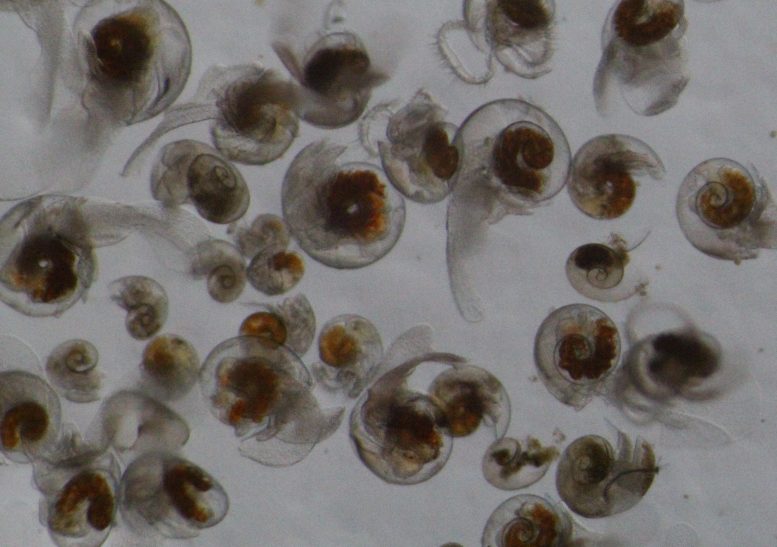
Researchers investigating the life cycles of pteropods in the Southern Ocean have discovered varying degrees of susceptibility to oceanic changes among different species.
Approximately one-fourth of all carbon dioxide (CO2) emissions are absorbed by the world’s oceans. When this absorption occurs, CO2 interacts with seawater, leading to a drop in the ocean’s pH levels – a process referred to as ocean acidification. This results in a decrease in the concentration of carbon ions. Some marine creatures, like pteropods, rely on carbon ions to create and maintain their shells. Pteropods play an important role in the marine ecosystem.
However, the understanding of certain features of pteropods, such as their life cycles and population dynamics, remains limited. This can be attributed to factors like their small size – some species of sea butterflies are less than a millimeter in size – and their low survival rate in captivity over extended periods. Recently, a group of marine scientists conducted a study on the life cycles, abundance, and seasonal fluctuations of shelled sea butterflies in the north-east Scotia Sea. This area is experiencing some of the most rapid climate changes in the Southern Ocean.
“Decline in Antarctic Ocean pteropod populations could have cascading ramifications to the food web and carbon cycle,” said Dr. Clara Manno, a researcher at the British Antarctic Survey and corresponding author of the study published in Frontiers in Marine Science. “Knowledge about the life cycle of this keystone organism may improve prediction of ocean acidification impacts on the Antarctic ecosystem.”
Population Stability Essential for Species Survival
For their work, the scientists collected sea butterflies in a sediment trap, a sampling device moored at 400 meters depth. “It is impossible to observe the full life cycle of sea butterflies in a laboratory setting, so we had to piece together information about their spawning, growth rate and population structure,” added Dr Vicky Peck, a researcher at the British Antarctic Survey and co-author of the study. “Using sediment trap samples, we successfully reconstructed their life cycle over a year.”
For the two dominant species collected – Limacina rangii and Limacina retroversa – the scientists observed contrasting life cycles, leading to different vulnerabilities to changing oceans. L. rangii, a polar species, can be found as both adults and juveniles during the winter months. L. retroversa, a subpolar species, appear to occur only as adults during the winter.
During the coldest season, ocean water is more acidic than during other times of the year because cooler temperatures increase CO2 dissolution in the ocean. The life stages of sea butterflies that exist then are more exposed and vulnerable to increased levels of ocean acidification, the researchers wrote.
The fact that L. rangii adults and juveniles coexist over winter may give them a survival advantage. If one cohort is vulnerable, the overall population stability is not at risk. With L. retroversa, however, if one cohort is removed, the whole population may be vulnerable.
Prolonged Exposure Is a Survival Challenge
The researchers noted that despite species being impacted differently, neither is likely to remain unharmed if exposed to unfavorable conditions for extended time periods.
As the intensity and duration of ocean acidification events increase, they begin to overlap with spawning events in the spring. This may put the most vulnerable life stage, the larvae, particularly at risk and could jeopardize future populations, the scientists warned.
To learn how such a scenario might play out in the Scotia Sea, the research team will continue to study sea butterflies dwelling there. “A next step will be to focus on multiyear sediment trap samples to identify potential inter-annual variability in the life cycle associated with environmental change,” said Dr Jessie Gardner of the British Antarctic survey, lead author of the study.
Reference: “Contrasting life cycles of Southern Ocean pteropods alter their vulnerability to climate change” by Jessie Gardner, Victoria L. Peck, Dorothee C. E. Bakker, Geraint A. Tarling and Clara Manno, 11 May 2023, Frontiers in Marine Science.
DOI: 10.3389/fmars.2023.1118570
Never miss a breakthrough: Join the SciTechDaily newsletter.
Follow us on Google and Google News.