
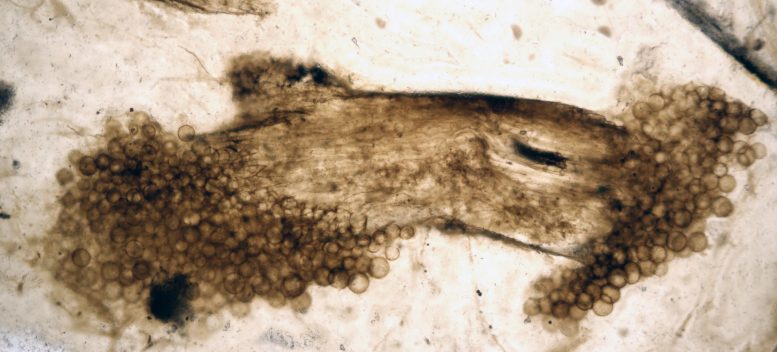
Advanced imaging and machine learning reveal molecular fingerprints in 407-million-year-old Rhynie chert fossils, offering new insights into early life and enigmatic organisms like nematophytes.
Cutting-edge technology has revealed new insights about a globally famous fossil treasure trove, which may provide critical evidence concerning early life on Earth.
Scientists investigating the 400 million-year-old fossil cache, discovered in the remote northeastern region of Scotland, report that their results display a higher level of molecular preservation in these fossils than what was previously expected.
Fresh scrutiny of the exquisitely preserved treasure trove from Aberdeenshire has enabled scientists to identify the chemical fingerprints of the various organisms within it.
Just as the Rosetta Stone helped Egyptologists translate hieroglyphics, the team hopes these chemical codes can help them decipher more about the identity of the life forms, that other more ambiguous fossils represent.
Uncovering the Rhynie Chert
The spectacular fossil ecosystem near the Aberdeenshire village of Rhynie was discovered in 1912, mineralized and encased by chert – hard rock composed of silica. Known as the Rhynie chert, it originates from the Early Devonian period – about 407 million years ago – and has a significant role to play in scientists’ understanding of life on Earth.
Researchers combined the latest non-destructive imaging with data analysis and machine learning to analyze fossils from collections held by National Museums Scotland and the Universities of Aberdeen and Oxford. Scientists from the University of Edinburgh were able to probe deeper than has previously been possible, which they say could reveal new insights about less well-preserved samples.
Employing a technique known as FTIR spectroscopy – in which infrared light is used to collect high-resolution data – researchers found impressive preservation of molecular information within the cells, tissues, and organisms in the rock.
Since they already knew which organisms most of the fossils represented, the team was able to discover molecular fingerprints that reliably discriminate between fungi, bacteria, and other groups.
These fingerprints were then used to identify some of the more mysterious members of the Rhynie ecosystem, including two specimens of an enigmatic tubular “nematophyte”.
These strange organisms, which are found in Devonian – and later Silurian – sediments have both algal and fungal characteristics and were previously hard to place in either category. The new findings indicate that they were unlikely to have been either lichens or fungi.
Dr. Sean McMahon, Chancellor’s Fellow from the University of Edinburgh’s School of Physics and Astronomy and School of GeoSciences, said: “We have shown how a quick, non-invasive method can be used to discriminate between different lifeforms, and this opens a unique window on the diversity of early life on Earth.”
The team fed their data into a machine learning algorithm that was able to classify the different organisms, providing the potential for sorting other datasets from other fossil-bearing rocks.
The study, published in Nature Communications, was funded by The Royal Society, Wallonia–Brussels International, and the National Council of Science and Technology of Mexico.
Bridging Paleontology, Physics, and Chemistry
Dr Corentin Loron, Royal Society Newton International Fellow from the University of Edinburgh’s School of Physics and Astronomy said the study shows the value of bridging paleontology with physics and chemistry to create new insights into early life.
“Our work highlights the unique scientific importance of some of Scotland’s spectacular natural heritage and provides us with a tool for studying life in trickier, more ambiguous remnants,” Dr. Loron said.
Dr. Nick Fraser, Keeper of Natural Sciences at National Museums Scotland, believes the value of museum collections for understanding our world should never be underestimated.
He said: “The continued development of analytical techniques provides new avenues to explore the past. Our new study provides one more way of peering ever deeper into the fossil record.”
Reference: “Molecular fingerprints resolve affinities of Rhynie chert organic fossils” by C. C. Loron, E. Rodriguez Dzul, P. J. Orr, A. V. Gromov, N. C. Fraser and S. McMahon, 13 March 2023, Nature Communications.
DOI: 10.1038/s41467-023-37047-1
Never miss a breakthrough: Join the SciTechDaily newsletter.
Follow us on Google and Google News.