
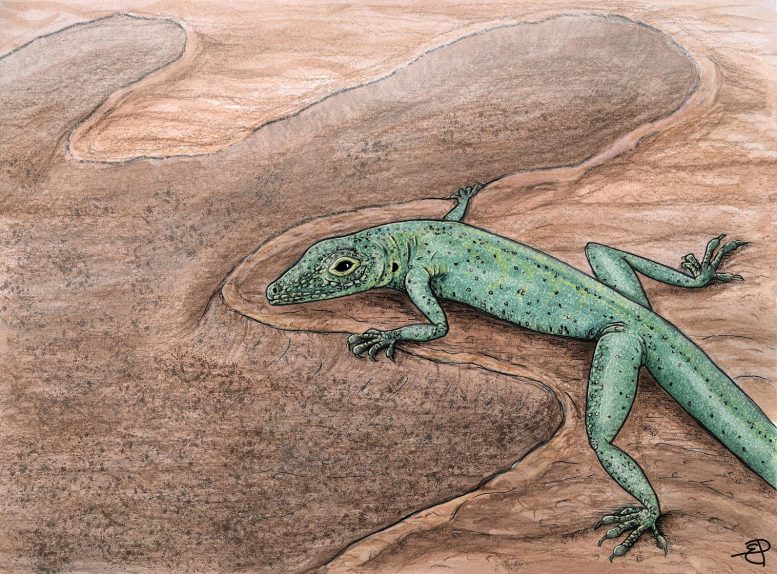
A fossil discovery from Scotland has provided new information on the early evolution of lizards, during the time of the dinosaurs.
The tiny skeleton discovered on the Isle of Skye, called Bellairsia gracilis, is only 6 cm (2.4 inches) long and dates from the Middle Jurassic, 166 million years ago. The exceptional new fossil comprises a near-complete skeleton in life-like articulation, missing only the snout and tail. This makes it the most complete fossil lizard of this age anywhere in the world.
Bellairsia has a mixture of ancestral and modern features in its skeleton, providing evidence of what the ancestor of today’s lizards (which are part of the wider animal group known as ‘squamates’) might have looked like.
The research, a joint project between researchers at the universities of Warsaw, Oxford, and UCL (University College London), is reported in the journal Nature. First author Dr. Mateusz Tałanda (University of Warsaw and UCL) said: ‘This little fossil lets us see evolution in action. In paleontology, you rarely have the opportunity to work with such complete, well-preserved fossils coming from a time about which we know so little.’
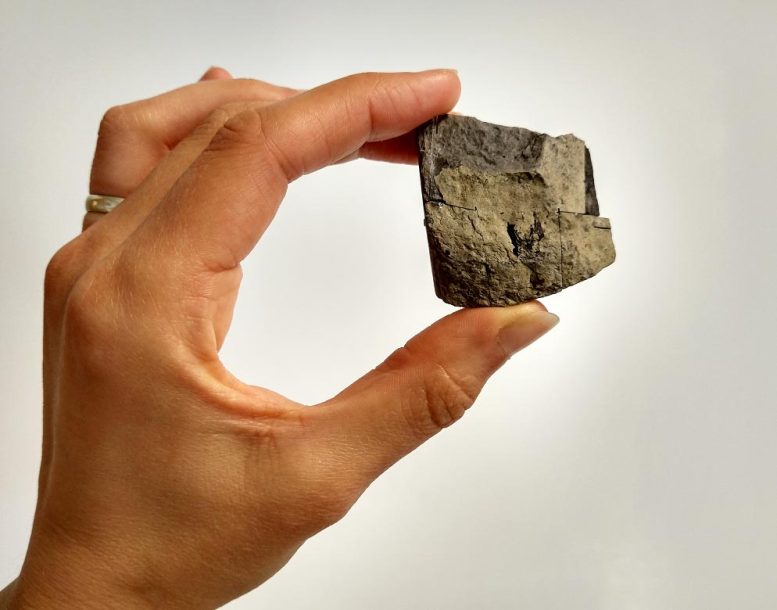
The fossil was found in 2016 by a team led by Oxford University and National Museums Scotland. It is one of several new fossil discoveries from the island, including early amphibians and mammals, which are revealing evolution of important animal groups that persist to the present day.
Dr. Tałanda commented: ‘Bellairsia has some modern lizard features, like traits related to cranial kinesis – that’s the movement of the skull bones in relation to one another. This is an important functional feature of many living squamates.’
Co-author Dr. Elsa Panciroli (Oxford University Museum of Natural History and National Museums Scotland) who discovered the fossil, said: ‘It was one of the first fossils I found when I began working on Skye. The little black skull was poking out from the pale limestone, but it was so small I was lucky to spot it. Looking closer I saw the tiny teeth, and realized I’d found something important, but we had no idea until later that almost the whole skeleton was in there.’

Revealing Squamate Evolution
Squamates are the living group that includes lizards and snakes, and comprises more than 10,000 species today, making them one of the most species-rich living vertebrate animal groups. They include animals as diverse as snakes, chameleons, and geckos, found around the world. The group is characterized by numerous specialized features of the skull and rest of the skeleton.
Although we know the earliest origins of squamates lie 240 million years ago in the Triassic, a lack of fossils from the Triassic and Jurassic has made their early evolution and anatomy difficult to trace.
Analyzing the new fossil alongside living and extinct fossil squamates confirms Bellairsia belongs to the ‘stem’ of the squamate family tree. This means that it split from other lizards just before the origin of modern groups. The research also supports the finding that geckos are a very early branching lineage, and that the enigmatic fossil Oculudentavis, previously suggested to be a dinosaur, is also a stem squamate.
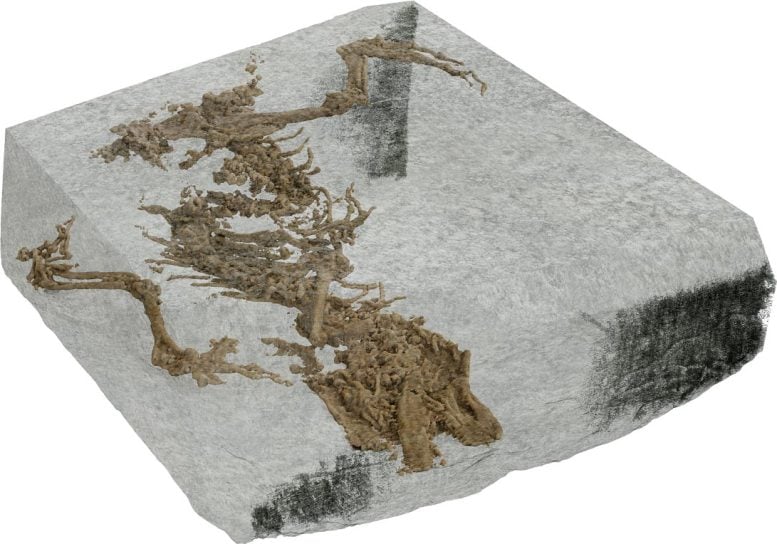
To study the specimen, the team used X-ray computed tomography (CT) which, like medical CT, allows for non-invasive 3D imaging. This allowed the researchers to image the entire fossil, even though most of the specimen is still hidden by surrounding rock. Whereas medical scanners work at the millimeter scale, the Oxford University CT scanner revealed details down to a few tens of micrometers.
Parts of the skeleton were then imaged in even greater detail, including the skull, hindlimbs and pelvis, at the European Synchrotron (ESRF, Grenoble, France). The intensity of the synchrotron beam permits a resolution of 4 micrometers, revealing details of the smallest bones in the skeleton.
Filling Gaps in the Evolutionary Record
Co-author Professor Roger Benson (Department of Earth Sciences, University of Oxford), said: ‘Fossils like this Bellairsia specimen have huge value in filling gaps in our understanding of evolution and the history of life on Earth. It used to be almost impossible to study such tiny fossils like this, but this study shows the power of new techniques including CT scanning to image these non-destructively and in great detail.’
Co-author Professor Susan Evans (UCL), who first described and named Bellairsia from a few jaw and skull bones from Oxfordshire 25 years ago, added: ‘It is wonderful to have a complete specimen of this tantalizing little lizard, and to see where it fits in the evolutionary tree. Through fossils like Bellairsia we are gaining a better understanding of early lizard anatomy. Angus Bellairs, the lizard embryologist after which Bellairsia was originally named, would have been delighted.’
Reference: “Synchrotron tomography of a stem lizard elucidates early squamate anatomy” by Mateusz Tałanda, Vincent Fernandez, Elsa Panciroli, Susan E. Evans and Roger J. Benson, 26 October 2022, Nature.
DOI: 10.1038/s41586-022-05332-6
The study was led by Dr. Mateusz Tałanda (University of Warsaw) and involved researchers from the University of Oxford’s Earth Sciences Department, Oxford University Museum of Natural History, UCL (University College London), the European Synchrotron Radiation Facility, the Natural History Museum in London and National Museums of Scotland.
Funding was provided by the Ministry of Science and Higher Education, Poland. The John Muir Trust provided access to the Elgol Coast Site of Special Scientific Interest, and NatureScot granted permits for fossil collection.
Never miss a breakthrough: Join the SciTechDaily newsletter.
Follow us on Google and Google News.