
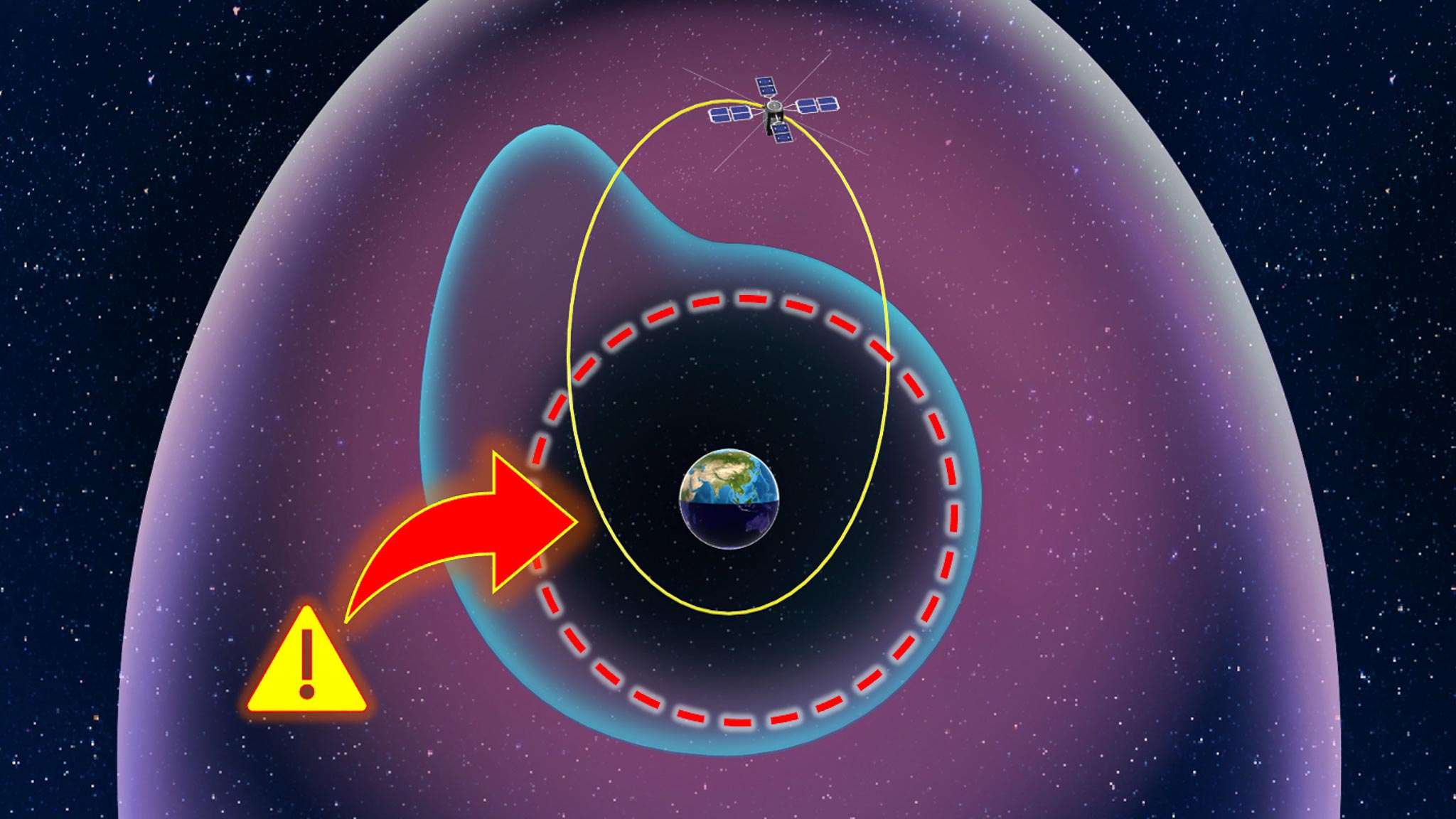
A solar superstorm appears to have turned a normally sheltered region near Earth into a natural particle accelerator, boosting electrons to energies capable of penetrating some satellite shielding.
Protecting spacecraft from radiation means understanding where hazardous particles can appear, especially during severe solar storms. Near Earth, an invisible boundary was thought to keep exceptionally energetic electrons out of a relatively protected region. During and after the geomagnetic superstorm of May 2024, Japan’s Arase space probe, operated by JAXA, detected large numbers of them well inside it. Some had energies exceeding three megaelectronvolts, enough to pass through some satellite shielding.
Researchers led by Nagoya University analyzed Arase’s observations to determine how these electrons appeared in a region that normally excludes them. Their evidence suggests the particles gained energy there, rather than entering it already highly energized. The distinction matters because it means a radiation hazard can develop within the supposedly protected region itself.
An electron barrier with uncertain origins
Earth’s magnetic field traps charged particles, including protons and electrons, in two doughnut-shaped regions called the Van Allen radiation belts. These particles can damage the hardware and electronics of spacecraft passing through the belts. At the inner edge of the outer belt, roughly three times Earth’s radius from the planet’s center, the most energetic electrons usually seem to encounter an invisible wall. Under typical conditions, the region inside this boundary is devoid of these extremely fast-moving electrons.
Scientists first identified the apparent barrier in 2014, but its origin remains incompletely understood. One possible explanation involves “plasmaspheric hiss,” low-frequency radio waves that sound like static when played through a speaker. These waves occur in Earth’s magnetosphere, the region of space dominated by its magnetic field. Human-made very-low-frequency radio transmissions used to communicate with submarines underwater may also help shape the boundary by scattering radiation-belt electrons into Earth’s atmosphere.
“One of the key questions was how these highly energetic electrons appeared inside the barrier,” said Yoshizumi Miyoshi, a professor at the Institute for Space-Earth Environmental Research (ISEE) at Nagoya University and the study’s lead author. “Were they transported inward from the outer radiation belt, or were they accelerated locally within this region?”
Chirping waves may accelerate electrons for days
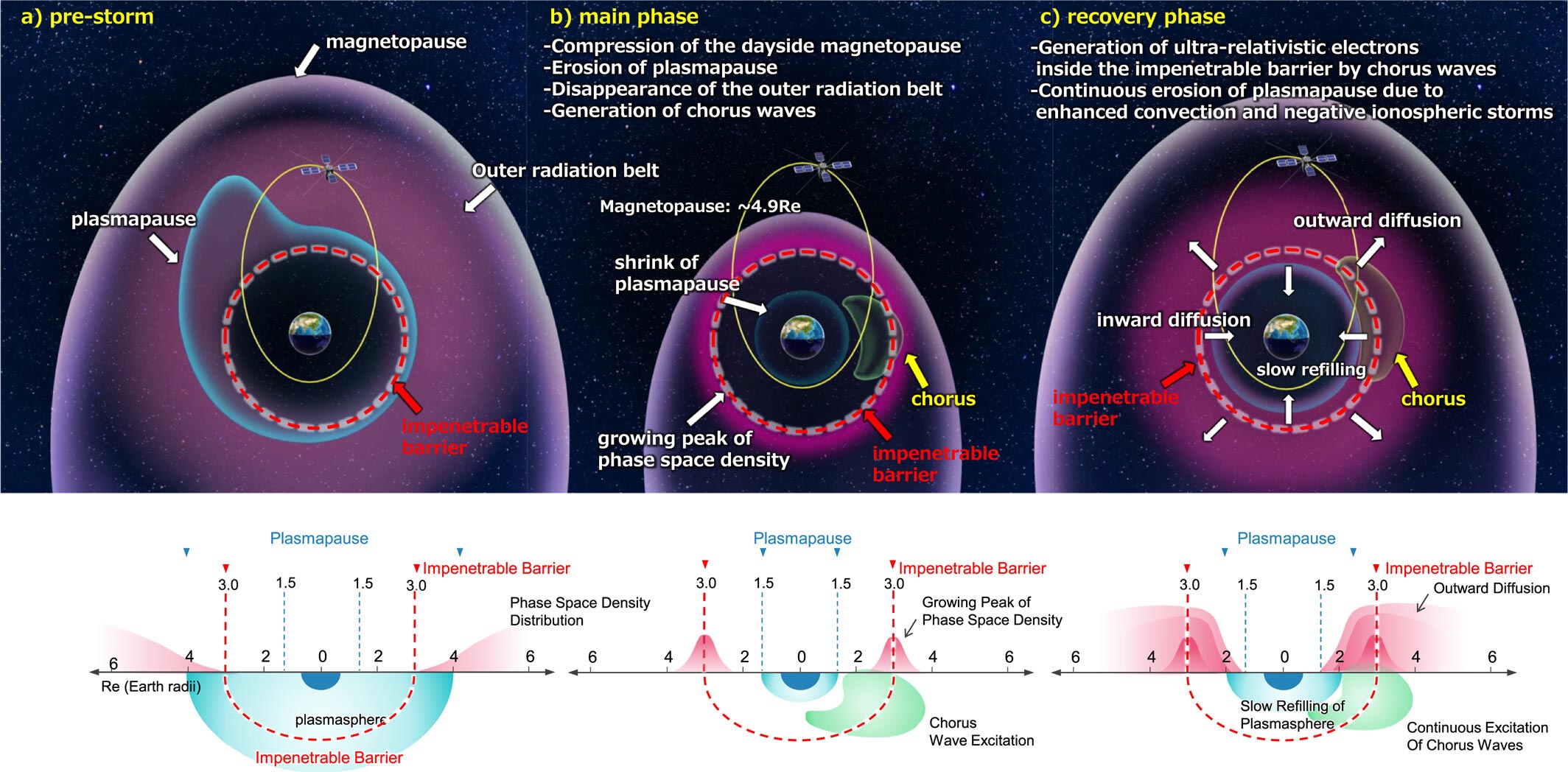
The intense solar activity behind the May 2024 superstorm brought northern lights to Hokkaido and as far south as Japan’s Hyogo prefecture. In space, the storm dramatically eroded Earth’s plasmasphere, a region filled with relatively cool charged particles. Its outer boundary retreated unusually close to the planet, leaving the area around the usual electron barrier much less densely populated with plasma. Hotter electrons could then reach farther inward and generate natural, low-frequency electromagnetic waves known as chorus waves.
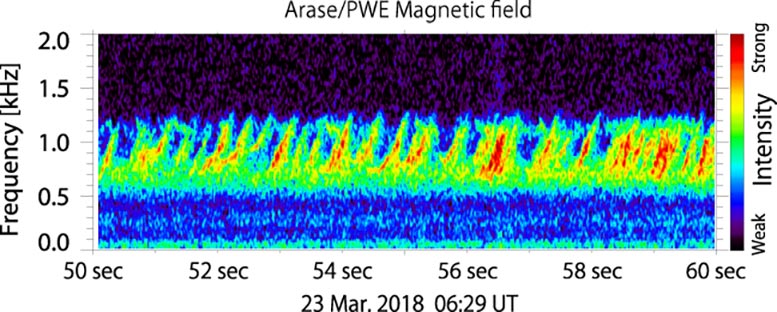
Arase detected intense chorus waves repeatedly sweeping upward in frequency. “When converted into audio, it sounds like a bird song,” Miyoshi said. These waves ripple through Earth’s magnetic field and can transfer energy to electrons when their oscillations match the electrons’ spiraling motion around magnetic field lines.
“Typically, the plasmasphere recovers on a timescale of about two days,” Miyoshi said. “During the May 2024 superstorm, however, it took approximately 4.3 to 4.7 days for the plasma density to recover to more than half of its pre-storm level in the observed region.”
The resulting low-density conditions persisted for several days, potentially allowing chorus-wave activity and the continued acceleration of electrons inside the previously impenetrable barrier.
Evidence of acceleration within the barrier
To distinguish local acceleration from the inward movement of already energetic electrons, the researchers analyzed electron phase space density, or PSD. This quantity describes how electrons are distributed according to their energies and motion. Using measurements from multiple Arase orbits, the team examined how PSD varied with distance from Earth while accounting for changes in the electrons’ motion.
A distinct local peak developed near the usual barrier boundary and grew stronger over time. That growing peak provided evidence that electrons were gaining energy within the region, rather than simply being transported inward from the outer radiation belt.
Miyoshi said the findings, published in Geophysical Research Letters, show that even parts of near-Earth space considered relatively protected from extremely energetic electrons can experience substantial increases in radiation during severe space weather. The observations also offer insight into how Earth’s magnetosphere responds to extreme solar activity and underscore the value of continuously monitoring the space environment around the planet.
“This discovery highlights the need to understand and predict how energetic electrons behave under extreme space weather conditions,” Miyoshi said. “Such knowledge is important for assessing radiation risks to spacecraft and improving future space weather predictions.”
Reference: “Local Acceleration of Multi-MeV Electrons Inside Earth’s Impenetrable Barrier During the May 2024 Superstorm” by Y. Miyoshi, S. Kurita, A. Shinbori, K. Yamamoto, C.-W. Jun, S. Matsuda, S. Saito, R. Kataoka, D. Wang, I. Shinohara, T. Takashima, T. Mitani, N. Higashio, A. Matsuoka, Y. Kasahara, F. Tsuchiya, A. Kumamoto, T. Hori, N. Kitamura and M. Teramoto, 26 October 2026, Geophysical Research Letters.
DOI: 10.1029/2026GL125879
This work was supported by the Japan Society for the Promotion of Science (JSPS) KAKENHI Grants 22K21345, 23K25925, 24K07112, 26K00765, and 26H02088.
Never miss a breakthrough: Join the SciTechDaily newsletter.
Follow us on Google and Google News.