
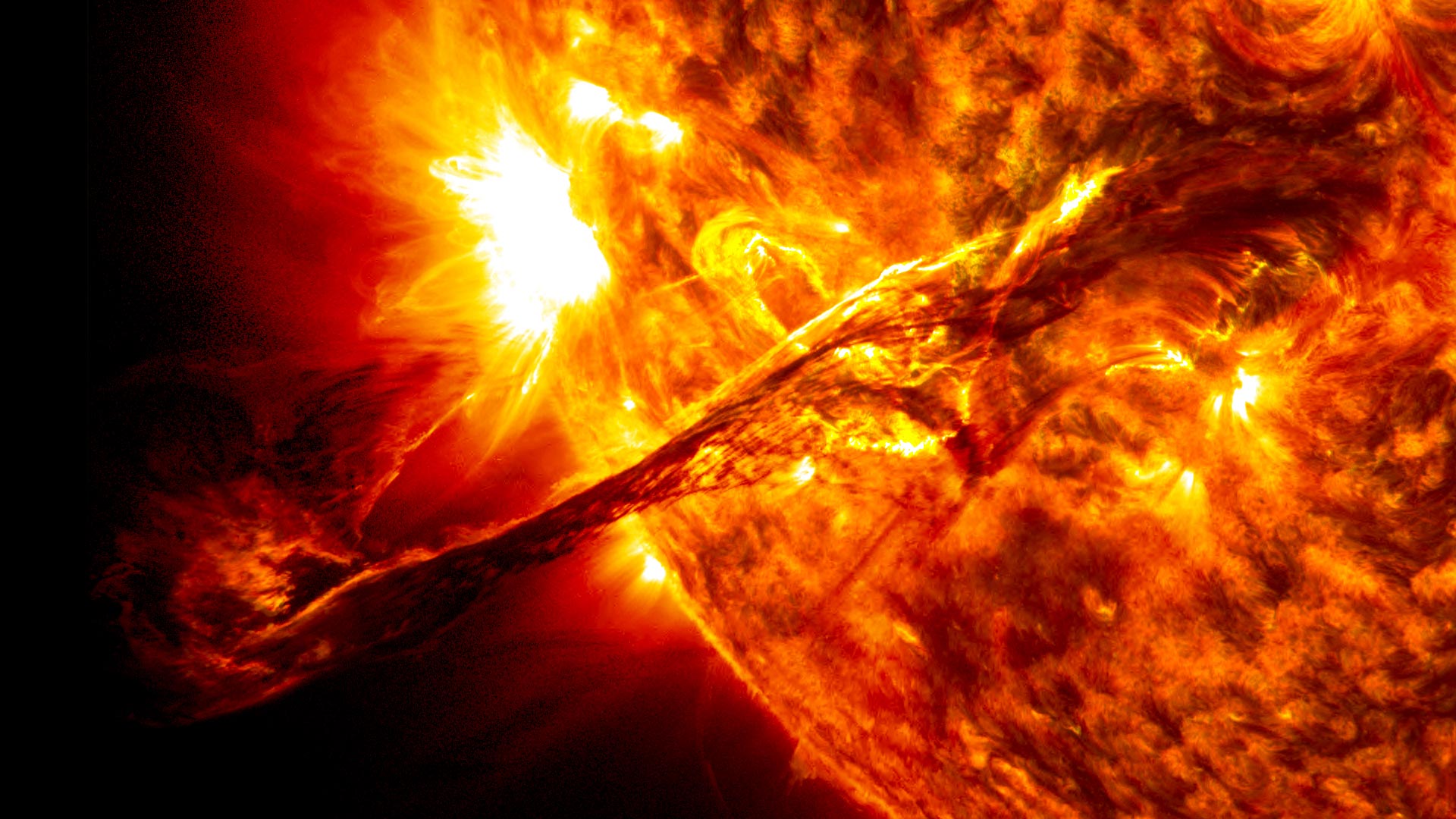
The sun’s solar wind, made of charged particles, interacts with powerful eruptions, affecting cosmic rays and space weather. A newly developed model improves predictions of particle acceleration and has been tested using real solar event data, providing valuable insights into solar storms.
Understanding Solar Wind and Its Connection to Cosmic Rays
The sun is an incredibly hot ball of gas, made mostly of hydrogen and helium. Its surface and outer atmosphere can reach scorching temperatures, ranging from 10,000 to 3.6 million degrees Fahrenheit. This intense heat causes the sun to constantly release a stream of plasma — charged particles like protons and electrons. These particles have so much energy that the sun’s gravity can’t hold them in, allowing them to escape into space as solar wind. Studying how solar wind interacts with bursts of energy from the sun helps scientists better understand cosmic rays produced by supernova explosions.

Advancing Solar Research with a New Model
Thomas Do, a graduate student in astronomy at Michigan State University, has developed a new model that predicts how these particles accelerate under a wider range of conditions than previous studies. His research could improve our ability to predict solar storms, which have the potential to disrupt technology in space.
Do started working on charged particles three years ago during an undergraduate research project at the Harvard-Smithsonian Center for Astrophysics in Massachusetts. His research aimed to illuminate how charged particles accelerate when they’re swept along by powerful ejections of mass from the sun. Those explosions are called coronal mass ejections, and when they’re fast enough, they can create shock waves.
Shock Waves and Particle Acceleration
“As they fly out from the sun, they interact with charged particles along the way. During those interactions, particles gain energy from the shock wave,” Do said.
As the particles gain energy, they hurtle faster and faster into space and toward Earth. Sometimes, particles gain so much speed that they catapult past the crest of the shock wave, escaping from behind it and into the cosmos.
To understand how charged particles escape, Do expanded on a model developed in 2021 by Federico Fraschetti, an astrophysicist at the Center for Astrophysics. Fraschetti and Do’s updated model predicts how particles accelerate and escape under a wider range of energies than previous models. In particular, their model accounts for the escape from the accelerating region of particles over a range of higher and lower energies. That’s important, Fraschetti said, because previously only high-energy particles were thought to break free from riding a shock wave.
Revisiting Decades-Old Models with Modern Insights
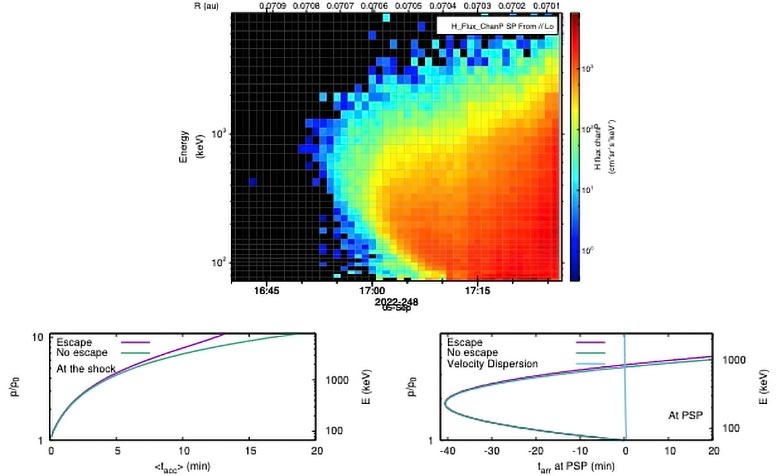
The previous model scientists used to make predictions about charged particles — developed around 50 years ago — didn’t include low-energy particles. Using multiple energy levels in their updated model, the team created a set of equations that predict how particles accelerate over time and how many particles escape at each energy level.
“We’re trying to allow for more particles to escape because we believe that’s more physically realistic,” Do said.
After expanding the model, he and Fraschetti wanted to compare it to an actual solar event.
They knew it was only a matter of time before they would have a chance, Fraschetti said. That’s because the sun reaches its solar maximum when solar activity is at its highest in its 11-year cycle. During a solar maximum, the massive explosions needed to generate shock waves are more frequent and more intense.

The Parker Solar Probe’s Crucial Findings
The team didn’t have to wait long for such an event. On September 5, 2022, the sun spat a huge wad of energy into space just as NASA’s Parker Solar Probe took one of its closest dives toward the star. The probe recorded data such as particle speed and temperature as the explosion’s shock wave smashed into it.
“We were so lucky in September 2022 to see the very beginning of this process,” Fraschetti said. “This is one of the events that Parker Solar Probe was designed to measure.”
They found that their model’s prediction matched what the Parker Solar Probe reported: particle acceleration and escape across a range of energy levels. The probe was very close to the sun — for scale, if the Earth and sun were a meter apart, the probe would only have been about 7 centimeters away. That proximity meant that the particles it passed had recently crossed paths with the shock wave, so the team could see data on particles that hadn’t gained much speed yet.
Confirming Expectations and Future Applications
“The model showed an excellent agreement with the data and confirmed that our physical expectation of what happens to young shock waves close to the sun is correct,” Fraschetti said. “We had never tested this expectation, and it did not have to be this way.”
“This model can be used in other areas of space research that involve charged particles,” Do said.
Reference: “Time-dependent Acceleration and Escape of Charged Particles at Traveling Shocks in the Near-Sun Environment” by Thomas M. Do, Federico Fraschetti, Jozsef Kota, Joe Giacalone, Christina M. S. Cohen and David J. McComas, 17 January 2025, The Astrophysical Journal.
DOI: 10.3847/1538-4357/ad93b2
Never miss a breakthrough: Join the SciTechDaily newsletter.
Follow us on Google and Google News.