
Close Menu
    Facebook X (Twitter) Instagram
    SciTechDaily
    • Biology
    • Chemistry
    • Earth
    • Health
    • Physics
    • Science
    • Space
    • Technology
    Facebook X (Twitter) Pinterest YouTube RSS
    SciTechDaily
    Home»Space»Killer Electron Hot Spot Found in Earth’s Van Allen Radiation Belts
    Space

    Killer Electron Hot Spot Found in Earth’s Van Allen Radiation Belts

    By Nagoya UniversityDecember 13, 2019No Comments3 Mins Read
    Facebook Twitter Pinterest Telegram LinkedIn WhatsApp Email Reddit
    Share
    Facebook Twitter LinkedIn Pinterest Telegram Email Reddit
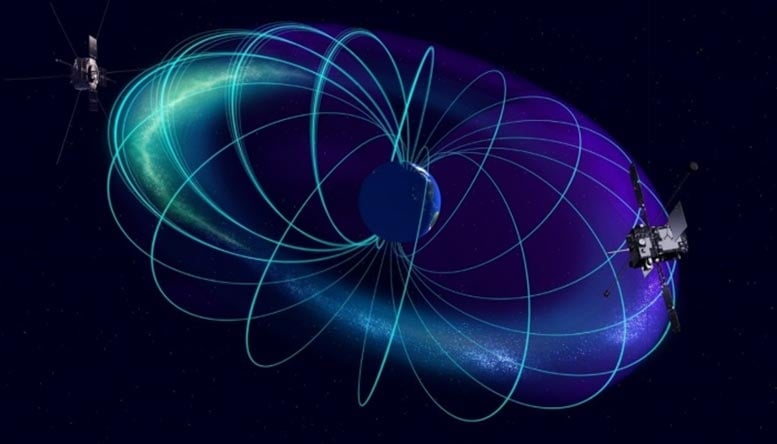
    Satellite Observations by JAXA/Arase and NASA/Van Allen Probes
    Multi-point satellite observations by JAXA/Arase and NASA/Van Allen Probes Electrons detected at Van Allen Probes position (left) drift to the Arase position (right). Credit: ERG Science Team

    JAXA and NASA satellite observations show where killer electrons are generated in the Van Allen radiation belts surrounding Earth.

    A collaboration between researchers in Japan, the USA, and Russia has found a hot spot in Earth’s radiation belt where killer electrons, which can cause serious anomalies in satellites, form. The finding, published in the journal Geophysical Research Letters, could help scientists more accurately forecast when these killer (relativistic) electrons will form.

    Professor Yoshizumi Miyoshi of the Institute for Space-Earth Environmental Research at Nagoya University and colleagues compared data from two satellites situated on opposite sides of the Earth: the Arase satellite, developed by the Japanese Aerospace Exploration Agency (JAXA), and NASA’s Van Allen Probes. Both satellites gather data from the Van Allen radiation belts, zones of energetic particles originating largely from solar wind. Energetic particles in the belts are trapped by Earth’s magnetic field.

    Scientists have known that electrons in Van Allen radiation belts that interact with ultralow frequency plasma waves accelerate to reach the speed of light. However, it has not been clear when or where these killer electrons start to accelerate.

    To gain more insight about the electrons, Professor Miyoshi and his colleagues analyzed data generated on March 30, 2017, by the Arase satellite and Van Allen Probe. On one side of the Earth, the Van Allen Probe identified characteristic signs of an interaction between ultralow frequency waves and energetic electrons. On the opposite side, at the same point in time, the Arase satellite identified high-energy electron signatures, but no ultralow frequency waves.

    The measurements indicate that the interaction region between electrons and waves is limited, but that the killer electrons then continue to travel on an eastward path around the Earth’s magnetosphere.

    “An important topic in space weather science is understanding the dynamics of killer electrons in the Van Allen radiation belt,” says Miyoshi. “The results of this study will improve the modeling and lead to more accurate forecasting of killer electrons in Van Allen radiation belts.”

    Reference: “Remote Detection of Drift Resonance Between Energetic Electrons and Ultralow Frequency Waves: Multisatellite Coordinated Observation by Arase and Van Allen Probes” by M. Teramoto, T. Hori, S. Saito, Y. Miyoshi, S. Kurita, N. Higashio, A. Matsuoka, Y. Kasahara, Y. Kasaba, T. Takashima, R. Nomura, M. Nosé, A. Fujimoto, Y.-M. Tanaka, M. Shoji, Y. Tsugawa, M. Shinohara, I. Shinohara, J. B. Blake, J.F. Fennell, S.G. Claudepierre, D. L. Turner, C. A. Kletzing, D. Sormakov and O. Troshichev, 6 November 2019, Geophysical Research Letters.
    DOI: 10.1029/2019GL084379

    Never miss a breakthrough: Join the SciTechDaily newsletter.
    Follow us on Google and Google News.

    Geophysics JAXA Nagoya University NASA Van Allen Radiation Belts
    Share. Facebook Twitter Pinterest LinkedIn Email Reddit

    Related Articles

    NASA Executes Rare Medical Evacuation From the International Space Station

    A Massive Geomagnetic Superstorm Crushed Earth’s Plasma Shield

    NASA Finds Venus Has a Surprisingly Thin Crust – And Something Stranger

    Massive Solar Storm Unleashes Mysterious New Radiation Belts

    A Meteor Strike Just Revealed a Hidden Seismic Highway on Mars

    A Third Radiation Belt Temporarily Appears in Earth’s Upper Atmosphere

    NASA Discovers a Third Van Allen Belt Surrounding Earth

    Earth’s Van Allen Radiation Belt to be Probed by NASA Satellites

    NASA’s THEMIS Satellite Records Effect of Geomagnetic Storms on Radiation Belts

    Leave A Reply Cancel Reply

    • Facebook
    • Twitter
    • Pinterest
    • YouTube

    Don't Miss a Discovery

    Subscribe for the Latest in Science & Tech!

    Trending News

    Popular Sugar-Free Sweetener Linked to Liver Disease, Study Warns

    What Is Hantavirus? The Deadly Disease Raising Alarm Worldwide

    Scientists Just Discovered How the Universe Builds Monster Black Holes

    Scientists Unveil New Treatment Strategy That Could Outsmart Cancer

    A Simple Vitamin May Hold the Key to Treating Rare Genetic Diseases

    Scientists Think the Real Fountain of Youth May Be Hiding in Your Gut

    Ravens Don’t Follow Wolves, They Predict Them

    This Common Knee Surgery May Be Doing More Harm Than Good

    Follow SciTechDaily
    • Facebook
    • Twitter
    • YouTube
    • Pinterest
    • Newsletter
    • RSS
    SciTech News
    • Biology News
    • Chemistry News
    • Earth News
    • Health News
    • Physics News
    • Science News
    • Space News
    • Technology News
    Recent Posts
    • Why Are So Many New Fathers Dying? Scientists Say the U.S. Has a Dangerous Blind Spot
    • Scientists Identify Simple Supplement That Greatly Reduces Alzheimer’s Damage
    • You May Have a Dangerous Type of Cholesterol Even if Your Tests Look Normal
    • Study Reveals Dangerous Flaw in AI Symptom Checkers
    • New MRI Breakthrough Captures Stunningly Clear Images of the Eye and Brain
    Copyright © 1998 - 2026 SciTechDaily. All Rights Reserved.
    • Science News
    • About
    • Contact
    • Editorial Board
    • Privacy Policy
    • Terms of Use

    Type above and press Enter to search. Press Esc to cancel.