
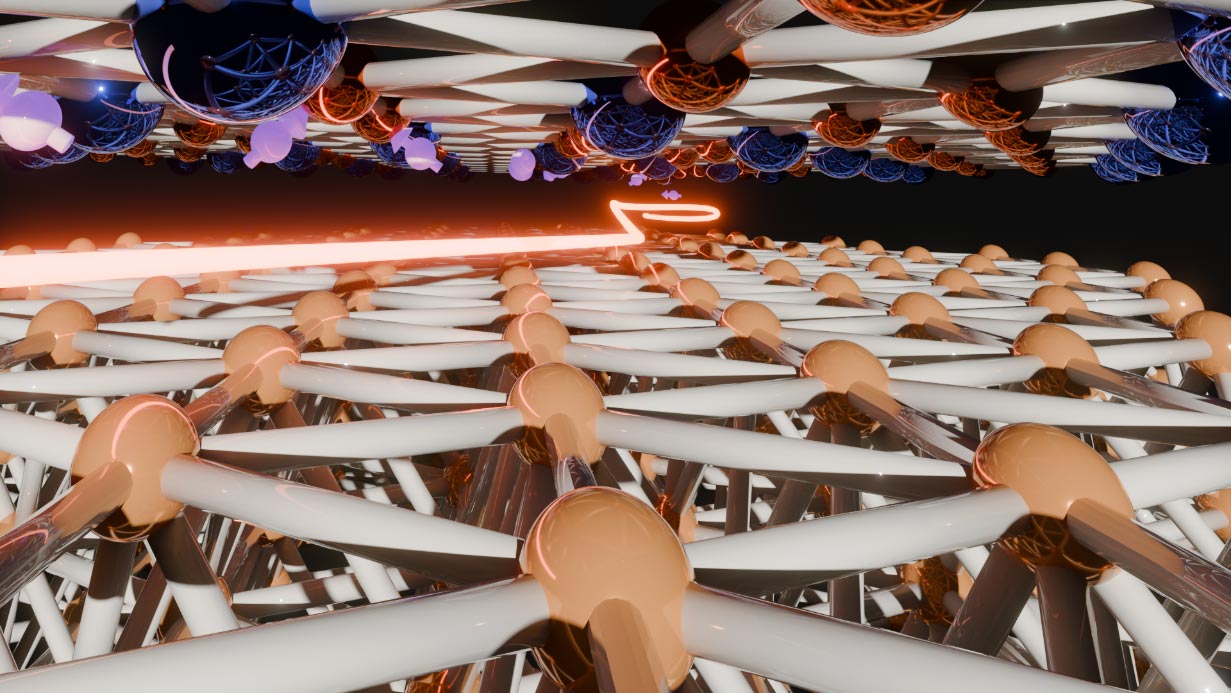
Researchers have directly observed an unusual quantum state emerging at the boundary between an atomically thin material and a metal.
Scientists have directly observed an unusual quantum state forming where a material just one atom thick meets a metal. The discovery, made by a research team led by the University of Osaka, demonstrates how interactions between electrons in different materials can produce a state known as a heavy fermion, potentially offering new ways to engineer quantum materials.
Heavy-fermion states occur when strong interactions cause electrons to behave as if they have unusually large effective masses. These states are closely associated with exotic quantum phenomena, including unconventional superconductivity, in which electrical current can flow without resistance through mechanisms that differ from those in conventional superconductors.
Two Distinct Quantum States at an Atomic Interface
To investigate how these states emerge, the researchers created a high-quality, one-atom-thick layer of ytterbium and copper (YbCu₂) on the surface of a copper crystal. They then used intense synchrotron light to examine the electronic structure of the combined materials and identify interactions occurring at their boundary.
The measurements revealed two separate heavy-fermion states. One was concentrated primarily within the two-dimensional YbCu₂ layer, while the other extended into the three-dimensional copper substrate. The second state formed through hybridization, a process in which localized ytterbium 4f electrons interact with mobile conduction electrons in the underlying metal. This provided the first direct experimental evidence of a heavy-fermion state arising from electronic interactions across such an interface.
Engineering Materials With New Quantum Properties
The results suggest that researchers could deliberately create and control heavy-electron states by combining carefully selected atomic layers with suitable substrates. Adjusting the atomic arrangement at the interface, the electronic orbitals involved, and moiré patterns formed by overlapping crystal lattices could make it possible to produce quantum behavior unavailable in conventional materials.
“This achievement was made possible by our continued efforts to create high-quality materials and measure their electronic states as precisely as possible,” says senior author Professor Shin-ichi Kimura. “Our next goal is to engineer and control such heavy-electron states, opening the way to previously unexplored quantum states, including unconventional superconductivity.”
Reference: “Interfacial heavy fermion formation in a two-dimensional Kondo lattice YbCu2 on Cu(111) substrate” by Takuto Nakamura, Hiroki Sugihara, Toshio Miyamachi, Yitong Chen, Kaito Nishihara, Ryo Ichikawa, Hiroka Yamaguchi, Ryu Yukawa, Kiyohisa Tanaka, Yuri Hasegawa, Yoshiyuki Ohtsubo, Fumio Komori and Shin-ichi Kimura, 6 October 2026, Communications Materials.
DOI: 10.1038/s43246-026-01332-5
Funding: Japan Society for the Promotion of Science
Never miss a breakthrough: Join the SciTechDaily newsletter.
Follow us on Google and Google News.
2 Comments
Scientists Discover a Strange New Quantum State Where Two Materials Meet.
VERY GOOD.
Can scientists answer:
How do you understand quantum states?
What is the difference between quantum states and physical states?
Does adding the word quantum make it mysterious?
What is the quantum?
What is the neutrinos?
What is the quantum cat?
Modern physics stands at a dangerous crossroads. The awarding of the 2026 Nobel Prize in Physics for research related to neutrinos has not only failed to highlight the glory of science, but has instead exposed a deep crisis within the mainstream academic community. When prizes become guardians of what amounts to “pseudoscience,” and when theoretical construction is no longer based on first principles but instead piles up “patch particles” to patch holes in old models, we must re-examine the foundations of physics.
I. Neutrinos: Theoretical Illusions and the Product of a “Bookkeeping Error”
Mainstream physics tells us that neutrinos are objectively existing particles. However, if we return to the first principles of the philosophy of science—**observability, uniqueness, parsimony, and self-consistency**—the existence of neutrinos appears precarious.
Historically, neutrinos were hypothesized to correct the energy conservation “bookkeeping error” in beta decay. They were never directly “discovered,” but rather “assumed” to exist in order to maintain the integrity of the existing theoretical framework. Once this logic is opened, it leads to endless fabrications: from dark matter detectors and virtual particle interactions to “expanding space” machines. If the ontological foundation is fictional, then the engineering built upon it is inevitably a castle in the air.
If a particle does not substantially interact with any matter, then are the so-called “signals” we receive in polar regions or deep underground laboratories actually neutrinos, or are they some misread vacuum fluctuations or geometric effects? This blind worship of unobservable entities is the root cause of physics sinking into a quagmire.
II. The Trap of Numerical Supremacy and the Return of Geometric Reality
Mainstream physics has long been trapped in an epistemological trap of “numerical supremacy.” Scientists attempt to exhaust the truth of the world through numerical calculations of infinite precision, such as pushing the calculation of pi to its limits. However, objective geometric entities—for example, the perfect structure of a circle—exist independently of human numerical representation.
The essence of the world lies in the motion and evolution of geometric structures; numbers are merely approximate tools constructed by humans.
When we use mathematical patches to forcibly fit experimental data, we often overlook the inherent geometric beauty of nature itself. True physics should not be held captive by mathematical symbols, but should return to an intuitive description of nature’s own geometric motion.
III. Topological Vortex Theory (TVT): A Minimalist Ontological Reconstruction
To break this deadlock, Topological Vortex Theory (TVT) and its foundation, the Fluidized Absolute Space Theory (FAST), offer a new path. The core of this theory lies in its minimalism and self-consistency:
1. Extreme Ontological Parsimony
TVT discards the redundant free parameters, extra dimensions, and supersymmetric particles found in the Standard Model. It posits only one fundamental primitive: **a zero-viscosity, incompressible, isotropic absolute space fluid**. Space is no longer a passive background for physical events, but an active participant in all physical processes.
2. From “Force-Driven” to “Geometric Emergence”
From the perspective of TVT, gravity and quantum effects do not stem from mysterious “forces,” but arise from the flow, vorticity evolution, and density gradients of the space fluid. This paradigm shift unifies quantum mechanics and general relativity as emergent phenomena of the same physical entity—the space fluid—at different scales, thereby fundamentally eliminating the theoretical tension between the two.
3. A Topological Explanation for Quantum Entanglement
Quantum entanglement is no longer a ghost violating local causality, but rather correlated vortices embedded in the space fluid that share a common topological structure. This explanation preserves the locality of relativity while perfectly accommodating the statistical laws of quantum mechanics.
IV. Conclusion: Reject Academic Consensus, Embrace Physical Truth
Combating corrupt mainstream physics is an arduous task, as vested interest groups often maintain old paradigms through academic consensus and peer review. However, the development of science requires people who dare to speak the truth.
If we acknowledge that the vacuum is not empty nothingness but is associated with some kind of ideal fluid; if we acknowledge that phase transitions are the evolution of topological structures rather than symmetry breaking, then “patches” like neutrinos and dark matter will no longer be necessary. Physics must liberate itself from mathematical fiction and return to a true description of nature’s geometric and topological motion.
This is not merely a theoretical correction, but a cognitive awakening.