
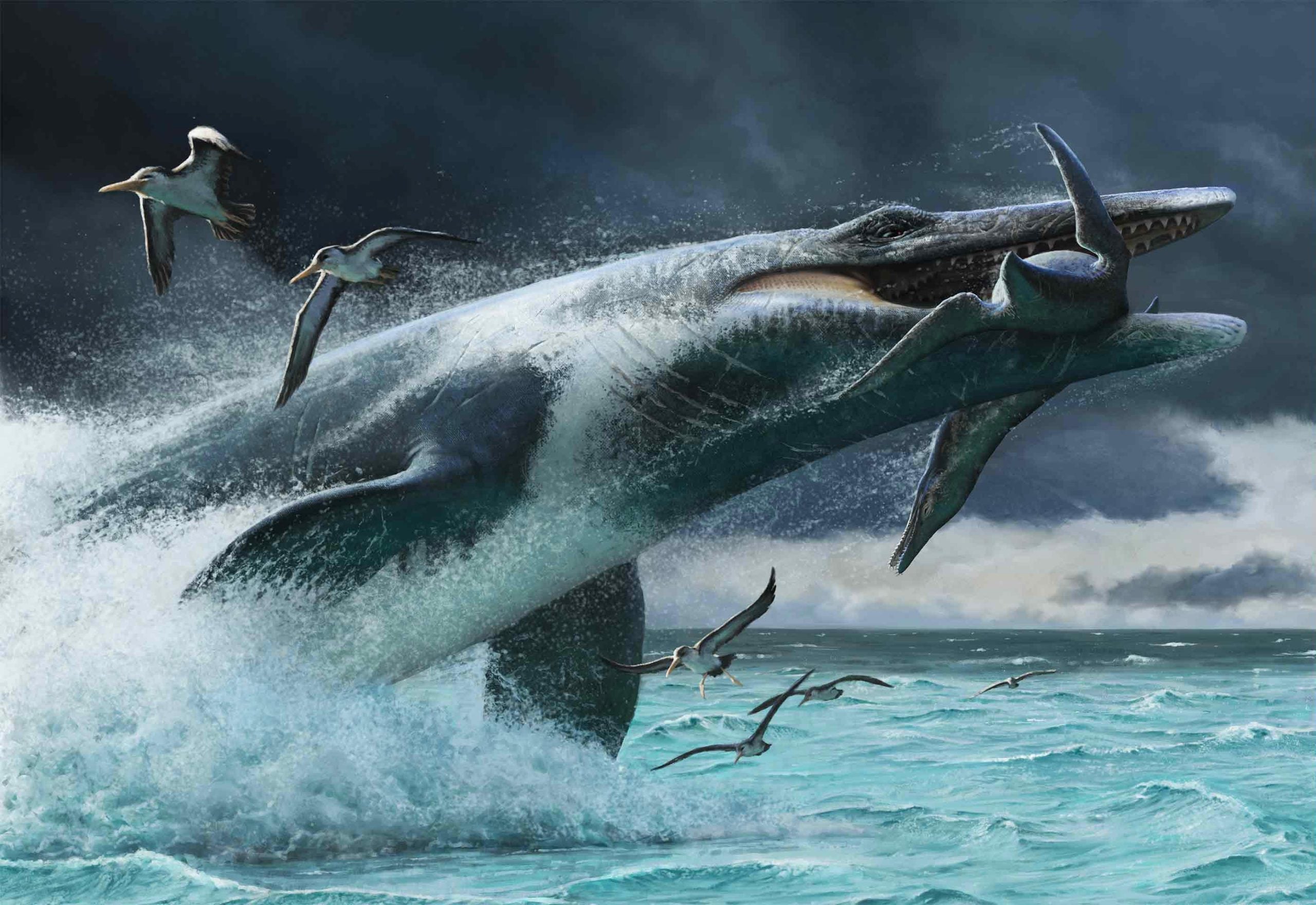
Giant marine reptiles that dominated prehistoric oceans may have relied on surprisingly different hunting strategies.
A giant marine reptile that lived during the age of dinosaurs may have reached speeds of roughly 15 miles per hour with a single powerful sweep of its tail. That estimate, calculated for an exceptionally large Tylosaurus, describes a brief burst of acceleration rather than sustained swimming. New research suggests that differences in tail anatomy gave some mosasaurs an advantage in sudden attacks, while others were better equipped to pursue prey across open water.
These formidable ocean predators were mosasaurs, a group of marine lizards that thrived during the final part of the dinosaur era. “At the same time dinosaurs like T. rex were ruling the land, mosasaurs were ruling the seas,” said Kiersten Formoso, an assistant professor at Rutgers University who led the study, published in Current Biology.
How Mosasaurs Accelerated Through Water
To investigate how these ancient predators moved, researchers reconstructed four mosasaur species from their fossil skeletons and used physics to calculate their potential acceleration. Rather than examining steady swimming, the team focused on a sudden movement called a “slam-start.” During this maneuver, an animal bends its tail to one side before forcefully sweeping it through the water, propelling its body forward.
“It’s the tail itself pushing off the water,” Formoso explained, comparing the motion to a swimmer launching from the wall of a pool. Because muscles rarely survive fossilization, the researchers estimated the missing tail musculature using anatomical evidence from living lizards, including Komodo dragons. They then tested different assumptions about muscle strength, tail flexibility, and water resistance to evaluate how these factors affected acceleration.
Different Tails, Different Hunting Strategies
The simulations consistently showed that Platecarpus and Tylosaurus could accelerate more rapidly for their body size than Mosasaurus and Plotosaurus. Of the four species studied, Platecarpus achieved the fastest modeled lunges. Its advantage came primarily from a relatively long, flexible portion of the tail that could bend farther before delivering a powerful stroke. The extent of this bending influenced acceleration more strongly than any other variable the researchers examined.
These differences suggest that Platecarpus and Tylosaurus were particularly well suited to ambushing prey in shallow seas. Mosasaurus and especially Plotosaurus, by contrast, appear to have been better adapted for sustained pursuit in open water. “That doesn’t mean Plotosaurus was slow,” Formoso said. “Its tail was built for sustained, tuna-like swimming rather than sudden bursts.”
Reconstructing the Lives of Ancient Ocean Predators
The proposed hunting strategies are consistent with other fossil evidence, including tooth wear, estimates of bite force, and chemical analyses that provide clues about mosasaur ecology. The researchers also investigated exceptionally large individuals, including a Mosasaurus reconstructed from a New Jersey fossil preserved at the New Jersey State Museum in Trenton. Although the precise swimming speeds remain uncertain, the results provide what the researchers describe as the first numerical estimates of burst swimming performance for marine reptiles from the dinosaur era.
Formoso, who also advised the documentary series Prehistoric Planet on mosasaur movement, studies how animals descended from land-dwelling ancestors adapted to aquatic environments. Her team is making its modeling tools publicly available so other scientists can investigate the swimming abilities of extinct animals, including species without close living counterparts. The approach relies on physical principles that have remained unchanged for millions of years. “Physics is physics,” she said.
Reference: “Mosasaur tail morphology reveals burst swimming performance and ecological diversity” by Kiersten K. Formoso, Nicholas Hebdon, Frank E. Fish, Robert L. Cieri and Michael B. Habib, 7 October 2026, Current Biology.
DOI: 10.1016/j.cub.2026.09.036
Funding: U.S. National Science Foundation, Geological Society of America, Paleontological Society
Never miss a breakthrough: Join the SciTechDaily newsletter.
Follow us on Google and Google News.