
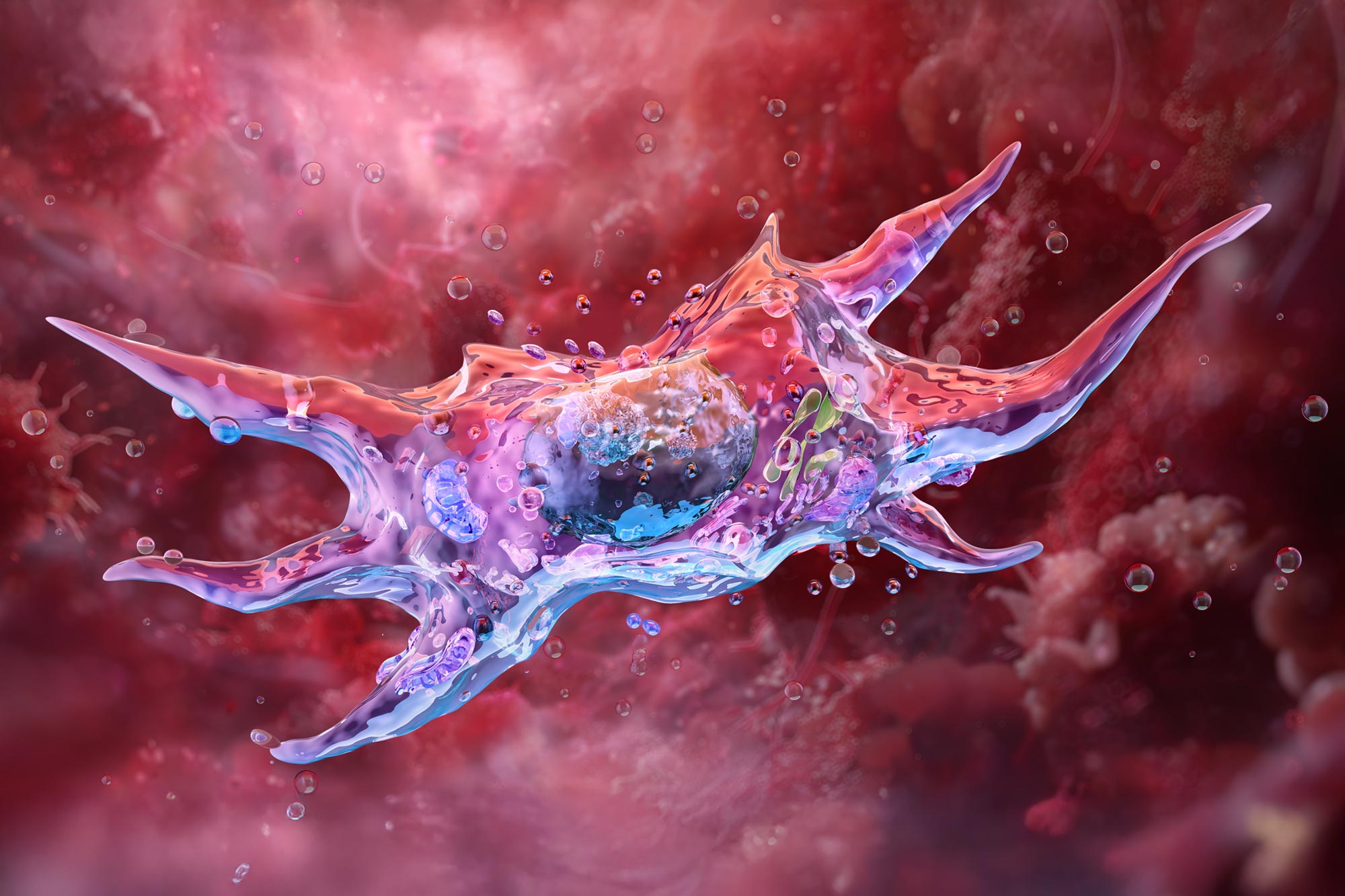
“Zombie cells” become harder to clear with age, and a new study reveals why the immune system struggles to remove them.
Researchers at Albert Einstein College of Medicine have identified a breakdown in protein recycling that helps explain why senescent cells, often called “zombie cells,” accumulate in aging tissues. In experiments involving older mice, restoring that process reduced senescent-cell buildup, inflammation, and tissue scarring. The findings, published in Nature Aging, suggest a possible way to help the immune system clear these cells more effectively.
Senescent cells remain alive after they stop dividing, but their activity changes. Although they can support tissue repair, their prolonged presence can fuel chronic inflammation and age-related disease. Most of the new experiments involved mice, with human lung samples providing evidence that the biological changes may also occur in people.
“In older animals, age-related changes in both senescent cells and the immune cells responsible for removing them allow these zombie cells to accumulate and play a role in disease,” said study leader Ana Maria Cuervo, M.D., Ph.D. “By restoring cellular recycling, we may be able to help the body’s own defenses clear these cells more effectively.”

When Helpful Cells Overstay Their Welcome
Some injured cells enter senescence and release substances that recruit other cells to support repair. Once that work is done, immune cells called macrophages normally remove the senescent cells.
Macrophages also fight infection, dispose of dead cells, and regulate inflammation and tissue repair. The researchers found that their ability to remove senescent cells depends partly on chaperone-mediated autophagy (CMA), a recycling process that uses specialized “chaperone” molecules to select damaged or unnecessary proteins for breakdown.
When the team genetically altered mice so their macrophages lacked CMA, senescent cells lingered at wound sites, and healing slowed compared with control animals. The experiment showed how a defect inside immune cells can turn a temporary repair response into a lingering obstacle to recovery.
Cuervo, a leading CMA researcher, is a distinguished professor of developmental & molecular biology and medicine, the Robert and Renee Belfer Chair for the Study of Neurodegenerative Diseases, and co-director of Einstein’s Institute for Geroscience. Her earlier research established that CMA declines with age. Subsequent work linked the resulting buildup of cellular waste to Alzheimer’s and other neurodegenerative diseases, as well as atherosclerosis and diabetes.
Old and Young Zombie Cells Behave Differently
The age-related decline in CMA also affects senescent cells themselves. To examine this, the researchers collected fibroblasts, cells found in connective tissue, from young and old mice. They then used drugs to stop the cells from dividing and induce senescence in the laboratory.
Cells from young mice responded by increasing CMA activity. Cells from old mice failed to increase their already low activity, allowing certain proteins to escape proper breakdown. They consequently released harmful substances that encouraged neighboring healthy cells to become senescent and interfered with macrophages’ ability to recognize and remove them.
At the same time, macrophages from older animals had lower CMA activity than those from younger animals and were less able to engulf senescent cells. Aging therefore disrupted both the cells awaiting removal and the immune cells responsible for clearing them.
Age-related changes in senescent cells could affect drug development. Researchers are developing senolytics to eliminate these cells, but testing them on cells taken from young animals and induced to become senescent in the lab may not accurately predict their effects in older bodies.
Restoring the Body’s Cleanup Process
The findings pointed toward another possibility: improve cellular recycling so senescent cells release fewer harmful substances and macrophages can recognize and engulf them more effectively. The team tested a compound it had previously developed, a small-molecule CMA activator called CA77.1.
Aged mice given CA77.1 orally every day for five months accumulated fewer senescent cells in several organs. They also showed fewer signs of inflammation and fibrosis, the buildup of scar tissue.
In a separate experiment, the researchers treated macrophages collected from aged mice with CA77.1. Their ability to engulf particles recovered to levels comparable to those of macrophages from young mice. That result demonstrated improved engulfing capacity, while the experiments in living animals showed reduced senescent-cell accumulation.
Testing A Link to Lung Fibrosis
The researchers next investigated idiopathic pulmonary fibrosis (IPF), an aging-associated disease in which scar tissue progressively builds up in the lungs, making breathing increasingly difficult. People diagnosed with IPF have a median survival of three to five years.
Lung samples from patients with IPF showed markedly reduced CMA activity, prompting the researchers to test whether boosting it with CA77.1 could help in a mouse model of lung fibrosis. Treatment with CA77.1 soon after lung injury reduced scarring, senescence, and inflammation.
“Our research connects two major drivers of aging—declining CMA and cellular senescence—and shows for the first time how their interaction allows senescent cells to evade clearance by the immune system in old organisms,” said Dr. Cuervo. “We’ve also found that instead of trying to kill zombie cells, we may be able to restore their interaction with the immune system so that the body can clear them naturally. The next challenge is determining whether this approach can eventually be developed into a safe treatment for age-related diseases in people.”
Reference: “Decline of chaperone-mediated autophagy in aging impairs macrophage clearance of senescent cells” by Rebecca Sereda, Kristen Lindenau, Antonio Diaz, Zhaohui Liu, Olaya Santiago-Fernández, Rabia R. Khawaja, Ronald Cutler, Jazmin Calyeca, Mericka McCabe, Sylvére Durand, Fanny Aprahamian, Natalia Del Pilar Vanegas, Hu Chen, Felipe Vilicich, Bhakti Chavda, Yair Botbol, Guido Kroemer, Toren Finkel, Evripidis Gavathiotis, Simone Sidoli, Ana L. Mora, Mauricio Rojas, Susmita Kaushik and Ana Maria Cuervo, 5 October 2026, Nature Aging.
DOI: 10.1038/s43587-026-01240-w
Never miss a breakthrough: Join the SciTechDaily newsletter.
Follow us on Google and Google News.