
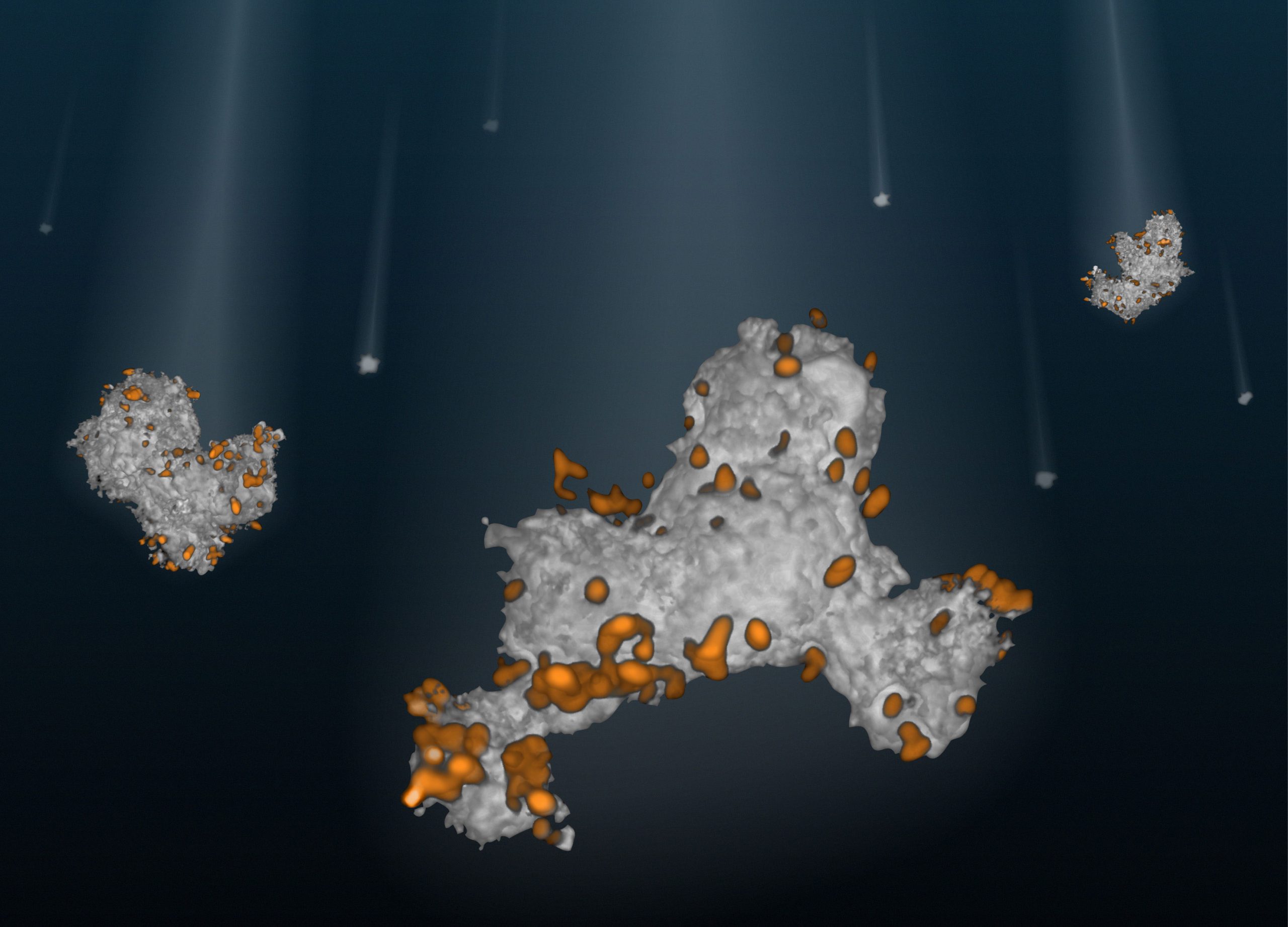
A new imaging technique reveals how bacteria interact with the microscopic structure of marine snow.
A surprising property of the tiny particles sinking through the ocean could help determine how much carbon is stored in the deep sea. Scientists have discovered that the stickiness of marine snow affects how easily bacteria can break it down, potentially changing how much carbon reaches the ocean depths.
Researchers at UC San Diego’s Scripps Institution of Oceanography and the University of Lincoln found that particularly gooey marine snow resists bacterial degradation. Their findings, published October 8 in Science, suggest that highly viscous particles can transport more than six times as much carbon to the deep ocean as less viscous particles.
The Ocean’s Never-Ending Snowfall
Marine snow consists of tiny clumps of dead plankton, waste, mucus, minerals, and other debris that continuously descend through the water column. As these particles sink, they carry carbon from the sunlit surface ocean toward deeper waters, where some of it can remain stored for hundreds or thousands of years.
Scientists estimate that marine snow transports more than 10 gigatons (11 billion U.S. tons) of carbon away from the surface each year. However, only about 2 gigatons (2.2 billion U.S. tons) reach depths where the carbon can remain stored for extended periods. Much of the sinking material is broken down or recycled before reaching those depths.
The new research identifies particle viscosity, a measure of resistance to flow, as an important factor in this process. Marine snow particles vary in composition and consistency, and those differences influence how bacteria colonize and consume them.
Scientists Find a Way to See Inside Marine Snow
Understanding these interactions required a technique that had previously been unavailable: directly observing individual living bacteria as they navigate the microscopic structure of mucus.
“Observing individual bacteria interacting with the physical structure of mucus had never been possible,” said Bryce Inman, who began investigating the problem in 2021 while working as a postdoctoral scholar at Scripps Oceanography.
After four years of unsuccessful attempts, Inman and his colleagues, including Scripps microbiologist and professor emeritus Farooq Azam, developed a working approach in 2025. By combining 3D confocal microscopy with specialized fluorescent molecules, they could map the intricate physical structure of marine snow and track how bacteria interacted with it. The imaging technique is described in a companion study published in Nature Communications.
Why Stickier Marine Snow Carries More Carbon
The images showed that bacteria colonize less viscous regions near the surface of marine snow particles more easily than the thicker, more resistant material inside. These internal regions present a physical barrier that bacteria must gradually break down before penetrating farther into the particle.
“Bacteria can latch on to less viscous portions of each particle, but cannot reach more viscous regions until they break it down,” Inman explained. “Think of it like a worm in an apple: the flesh is easy to penetrate, but the core is tough to chew through”
Laboratory experiments confirmed that more viscous marine snow takes longer for bacteria to degrade and fragment. Computer simulations further suggested that these resistant particles can sink to greater depths before breaking apart. Together, the findings indicate that viscosity can substantially influence how much carbon escapes recycling in shallower waters and reaches the deep ocean.
What Ocean Slime Could Reveal About Other Ecosystems
The newly developed imaging method could also help researchers investigate interactions between bacteria and mucus in other environments. Similar relationships occur in coral reefs, kelp forests, plant root systems, and the digestive tracts of humans and other animals.
“Mucus, slime, whatever you want to call it, has a surprising amount of structure,” Inman said. “There are bulges, crevasses, all this sort of structure to it that we really had no idea about at a scale smaller than bacteria. This is the first time we’re really examining this physical habitat.”
By making these microscopic environments visible, the technique could support research into how bacteria colonize mucus, interact with its physical structure, and influence processes ranging from ocean carbon storage to coral reef recovery and human health.
References:
“Marine snow viscosity regulates microbial degradation and the ocean carbon sink” by Bryce G. Inman, Stuart Humphries and Farooq Azam, 8 October 2026, Science.
DOI: 10.1126/science.adx4170
“Molecular rotors reveal the 3D viscous habitat of mucus-colonizing bacteria” by Bryce G. Inman, Nirav Patel, Gabriel Castro-Falcón, Taylor Hernandez, Ryan J. McGorty, Aki H. Ohdera, Logan M. Gonzalez, Kay D. Bidle, Farooq Azam and Stuart Humphries, 22 July 2026, Nature Communications.
DOI: 10.1038/s41467-026-75892-y
Never miss a breakthrough: Join the SciTechDaily newsletter.
Follow us on Google and Google News.