
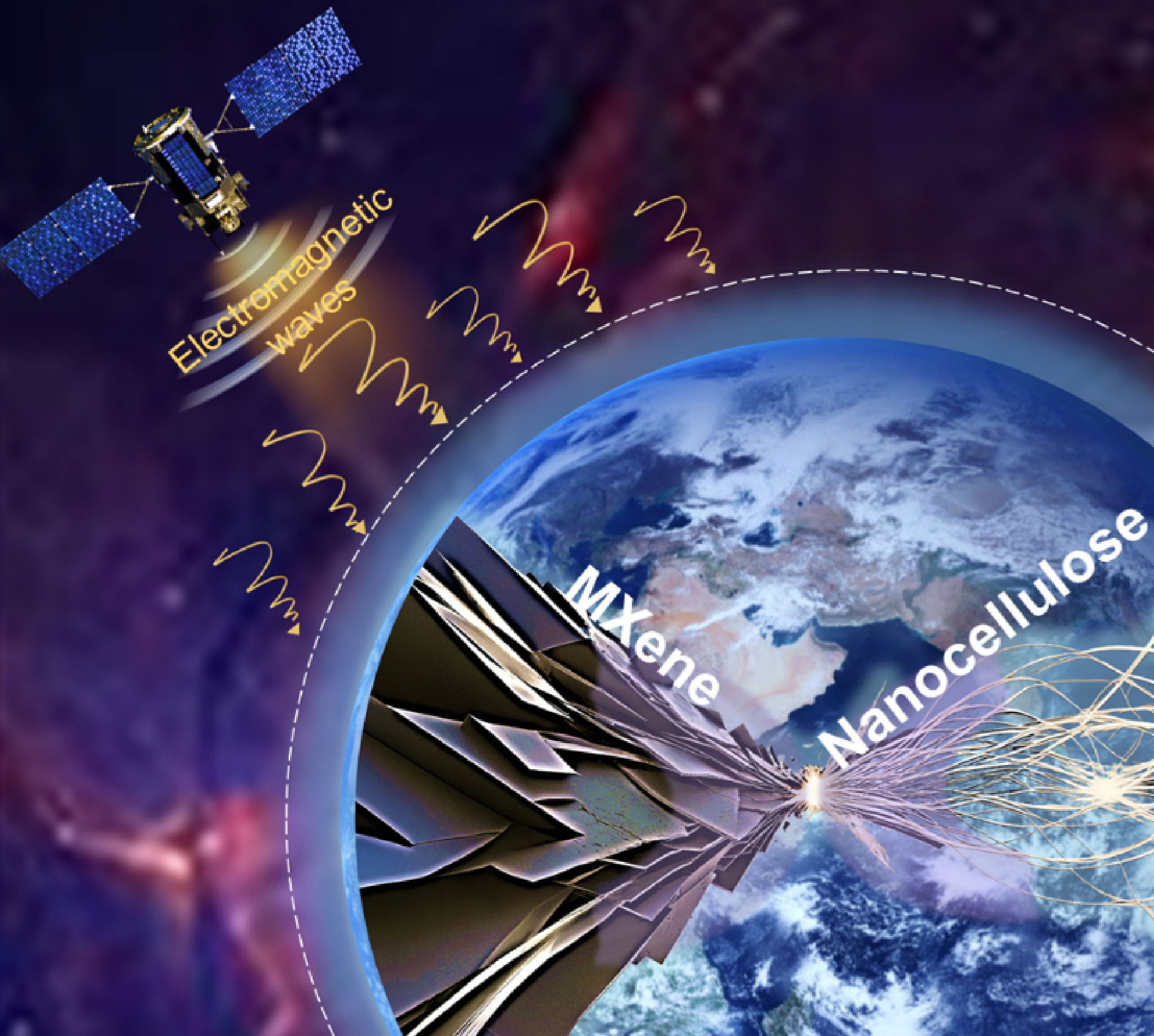
Researchers are exploring a new generation of electromagnetic shielding materials that combine exceptional conductivity with improved strength and flexibility.
Electromagnetic shielding materials must block unwanted signals without adding excessive weight or sacrificing durability. Conventional options, including metals, conductive polymers, and carbon-based materials, can be heavy, inflexible, or expensive. Researchers are now exploring composites that combine exceptional electrical conductivity with the strength and flexibility needed for practical applications.
One promising approach pairs two-dimensional transition metal carbides and nitrides (MXenes) with nanocellulose, a lightweight material derived from natural biomass. MXenes offer excellent conductivity and chemical stability, but films made from them alone tend to be brittle. Adding nanocellulose can improve mechanical strength while preserving the electrical properties needed to shield electronics from electromagnetic interference.
How Material Structure Changes Electromagnetic Shielding
A research team led by Prof. Ming-Guo Ma of Beijing Forestry University in China has published a comprehensive review of MXene/nanocellulose composites, examining how their structure, fabrication methods, and strengthening mechanisms influence performance.
The researchers identified important differences between one-dimensional fibers, two-dimensional layered films, and three-dimensional networks. Dense films primarily block electromagnetic waves through reflection, while porous aerogels favor absorption by allowing waves to penetrate interconnected structures and interact with conductive surfaces. Hydrogels can provide a more balanced combination of reflection and absorption. Layered designs, including sandwich, Janus, and structures inspired by nature, offer additional ways to control shielding behavior.
Building Stronger, More Flexible Materials
Improving durability requires more than simply combining MXene sheets with cellulose fibers. The review examines several strengthening approaches, including physical interactions such as hydrogen bonding, fiber entanglement, and metal-ion crosslinking. Chemical techniques introduce stronger covalent bonds using agents such as polydopamine or PMDI.
Combining reversible physical bonds with permanent chemical networks can produce materials with greater strength, toughness, and stability. The researchers also compared manufacturing techniques, ranging from solution mixing and vacuum filtration to 3D printing, freeze-drying, electrospinning, and layer-by-layer assembly. Each method presents different trade-offs between mechanical properties, shielding effectiveness, and manufacturing complexity.
What Must Improve Before Widespread Use?
Despite encouraging laboratory results, several obstacles remain. MXene production needs more environmentally friendly synthesis methods, and composite materials must maintain their performance under prolonged exposure to humidity and high temperatures. Scaling manufacturing processes while retaining consistent mechanical and electrical properties also presents challenges.
Future research may expand shielding capabilities across a broader frequency range, from gigahertz to terahertz, while incorporating magnetic or temperature-responsive components. Such advances could support smart shielding materials that adjust their electromagnetic behavior in response to changing conditions.
“This review provides a holistic perspective that connects fabrication methods, toughening mechanisms, and structural architectures,” said Prof. Ming-Guo Ma, the corresponding author. “It will greatly advance the rational design and practical application of high-performance MXene/nanocellulose electromagnetic shielding composites.”
Reference: “Flexible multifunctional MXene/nanocellulose nanocomposites for mechanical and electromagnetic shielding performance” by Qi Liu, Jia-Qi Lang, Lei Chen, Chuanyin Xiong, Xiufu Hua and Ming-Guo Ma, 30 August 2026, Nano Research.
DOI: 10.26599/NR.2026.94908889
This work was supported by the National Natural Science Foundation of China (22478036).
Never miss a breakthrough: Join the SciTechDaily newsletter.
Follow us on Google and Google News.