
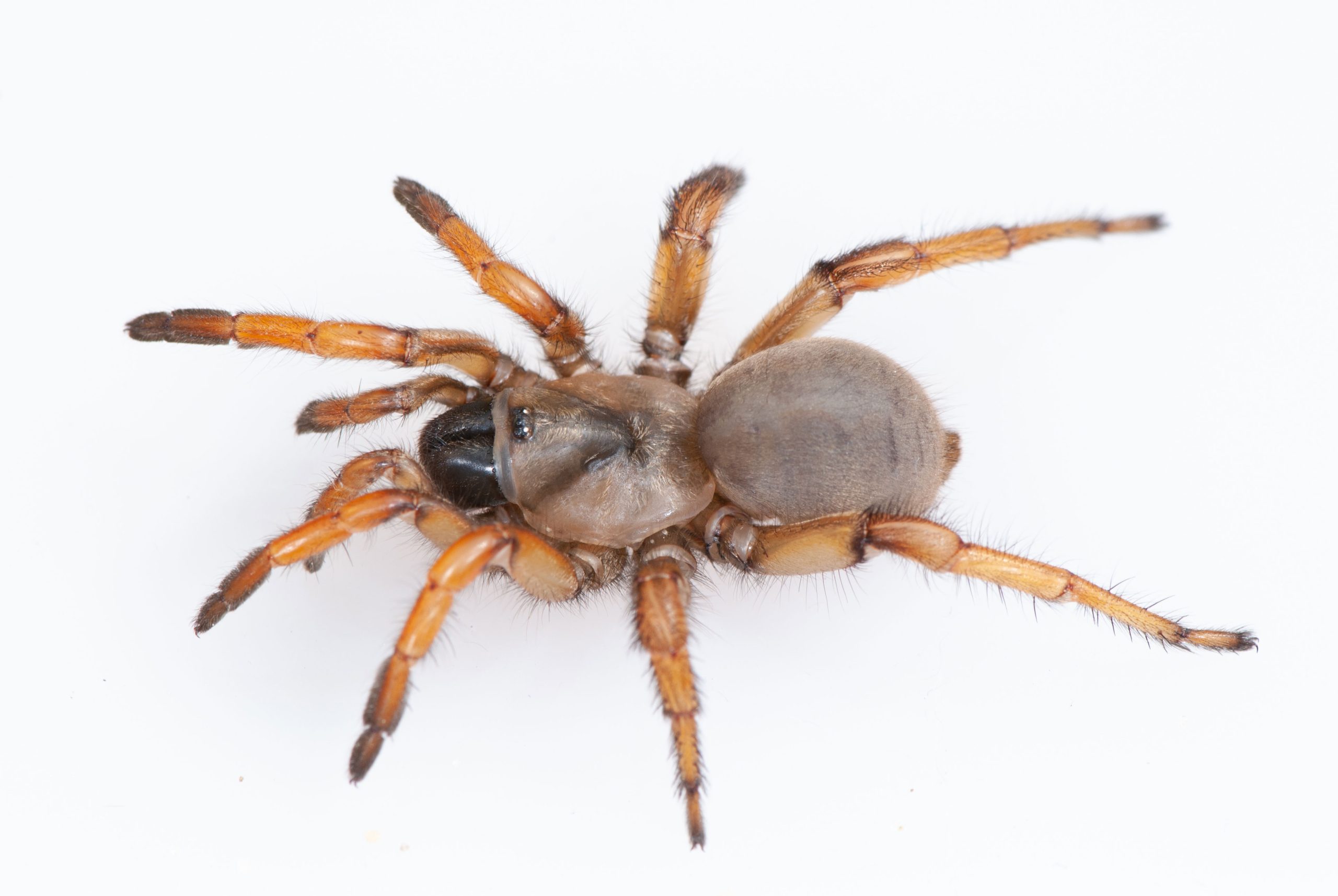
Scientists have sequenced the unusually large genome of a trapdoor spider named after comedian Stephen Colbert, uncovering surprising features of its DNA.
A spider no bigger than a quarter has a genome roughly 50% larger than the human genome. Known as Aptostichus stephencolberti, this elusive trapdoor spider lives beneath California’s coastal dunes and carries 4.6 billion DNA base pairs. Researchers at the University of California, Davis, have now sequenced its genome, uncovering features that could help explain how spider DNA has evolved.
“At 4.6 gigabases, or 4.6 billion DNA base pairs, it’s not the largest genome among the spiders, but it’s significant,” said Jason Bond, a professor in the UC Davis Department of Entomology and Nematology. The research, published in the Journal of Heredity, marks the first time scientists have sequenced the genome of a species in this spider family.
Why This Small Spider Has So Much DNA
The spider’s enormous genome is not packed with an unusually large number of genes. Instead, approximately 77% consists of repetitive DNA sequences, stretches of genetic material copied many times throughout the genome. Its DNA is organized into 52 chromosomes, compared with the 46 chromosomes typically found in human body cells.
Another feature involves telomeres, protective structures at the ends of chromosomes. Spiders lack the conventional telomere repeat sequences found in many other animals, a difference that may help explain why their chromosomes evolve more rapidly than those of vertebrates.
“It lends itself to broadening our understanding of spider genome composition and consequently how genomes have evolved across the animal Tree of Life,” Bond said.
A Secretive Predator Beneath California’s Beaches
A. stephencolberti lives in coastal sand dunes between the San Francisco Bay Area and Monterey, often sharing beaches with people who never realize the spiders are there. Females spend their entire lives inside underground burrows lined with silk and concealed beneath hinged, camouflaged doors. They detect vibrations from approaching prey and rapidly emerge to capture unsuspecting insects and other small animals.
Although these spiders use venom to subdue their prey, they are not dangerous to humans. According to Bond, among the more than 50,000 known spider species, only about 30 to 50 have venom known to be toxic to people.
Rising Seas Threaten an Already Fragmented Habitat
The genome sequencing is part of the California Conservation Genomics project, a state-funded initiative developing genetic resources to support wildlife conservation. Because trapdoor spiders rarely travel far from their burrows, populations can become genetically isolated when their habitats are separated. Examining their DNA could help scientists identify distinct populations that may need protection.
“We Californians love our beaches and trapdoor spiders share them with us,” Bond said. “We’re hoping to understand how things like climate change, fire and urbanization might be impacting the genetic diversity of species.”
The spider’s limited coastal range makes it particularly vulnerable to environmental changes. Rising sea levels threaten the dunes where it lives, while invasive species place additional pressure on its habitat. “They’re going to be incredibly sensitive to sea-level rise, but they’re also very sensitive to invasive species,” Bond said.
How Stephen Colbert Got a Spider Named After Him
The species has an unusual connection to comedian Stephen Colbert. In 2008, after learning that Bond had named another trapdoor spider after musician Neil Young, Colbert demanded similar recognition. He made his case during the “Who’s Not Honoring Me Now?” segment of his former Comedy Central program, “The Colbert Report.”
Bond granted the request, naming the species Aptostichus stephencolberti (the “t” in Colbert is silent). The spider’s oversized genome now provides an unexpected scientific distinction for an animal named after a comedian known for playing an exaggerated, self-important television pundit.
Spider Venom Could Hold Untapped Compounds
Beyond conservation and evolutionary research, spider genomes may help scientists investigate venom compounds with potential medical or agricultural applications. Some molecules found in spider venoms are being studied for their possible use in pain relief, while others could offer new approaches to controlling agricultural pests.
The full range of these substances remains largely unexplored, and the newly sequenced genome could provide a foundation for further investigations.
“We don’t really know what’s out there in terms of untapped natural product diversity for venoms,” Bond said.
Reference: “Reference genome of the Californian trapdoor spider Aptostichus stephencolberti Bond 2008 (Araneae: Mygalomorphae: Euctenizidae)” by Stephen Richards, Emma Jochim, Lacie Newton, James Starrett, Ruta Sahasrabudhe, Oanh Nguyen, Eric Beraut, Colin Fairbairn, Samuel Sacco, William Seligmann, Merly Escalona, Robert D Cooper, H Bradley Shaffer, Erin Toffelmier and Jason E Bond, 8 September 2026, Journal of Heredity.
DOI: 10.1093/jhered/esag069
This research was supported by the California Conservation Genomics Project, with funding provided to the University of California by the state of California, State Budget Act of 2019 and by the National Science Foundation.
Never miss a breakthrough: Join the SciTechDaily newsletter.
Follow us on Google and Google News.