
A beginner’s violin lesson may seem worlds apart from dementia research, yet wearable brain scans are revealing signals that could help scientists understand both learning and neurological disease.
Playing a familiar tune on a violin is no simple task for someone who has never held the instrument. Each movement must produce the intended sound, and the brain has to learn how to coordinate those movements. Researchers at the University of Nottingham have now captured changes in brain activity as beginners learned to play, revealing measurable differences after just one violin lesson.
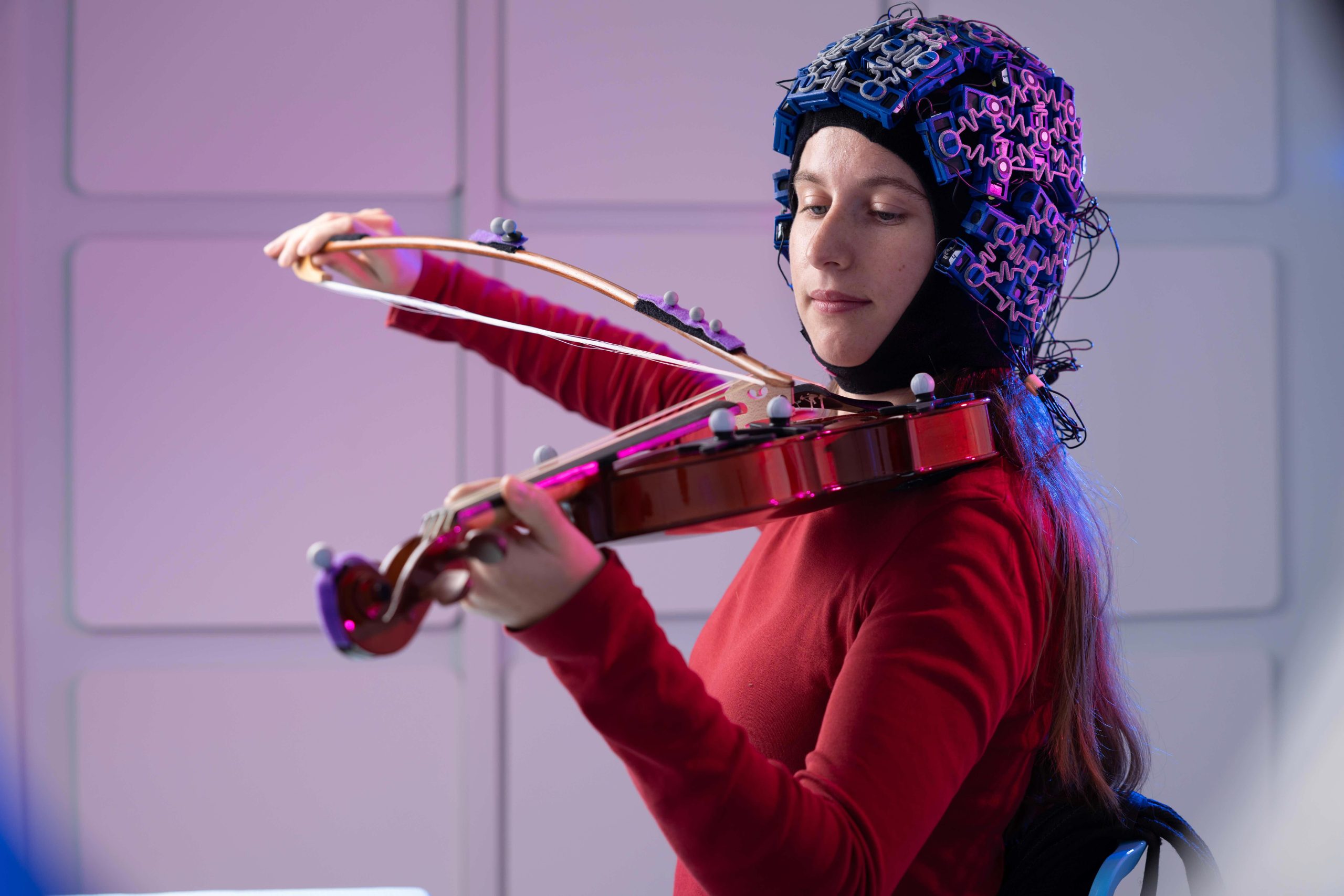
The study, published in the journal Imaging Neuroscience, involved 22 novice violin players. Using a wearable brain scanner, the scientists tracked patterns of neural activity while participants attempted to play “Twinkle Twinkle Little Star.” They found that those who improved the most also showed the greatest changes in certain brain signals associated with movement and learning.
A metal-free violin enables brain scans
Capturing those signals while someone plays an instrument presents a technical challenge. The electrical activity of neurons generates extremely weak magnetic fields, which can be measured to study brain function. However, the equipment must be sensitive enough to detect these signals without interference, while still allowing the person being studied to move naturally.
The researchers used a technology called OPM-MEG, developed in Nottingham, that incorporates brain-scanning sensors into a lightweight helmet connected to a backpack-mounted control unit. Unlike scanning systems that restrict movement, this wearable design allows researchers to monitor brain activity as people perform everyday tasks.
There was still one problem. A conventional violin contains metal components that would interfere with the scanner’s measurements.
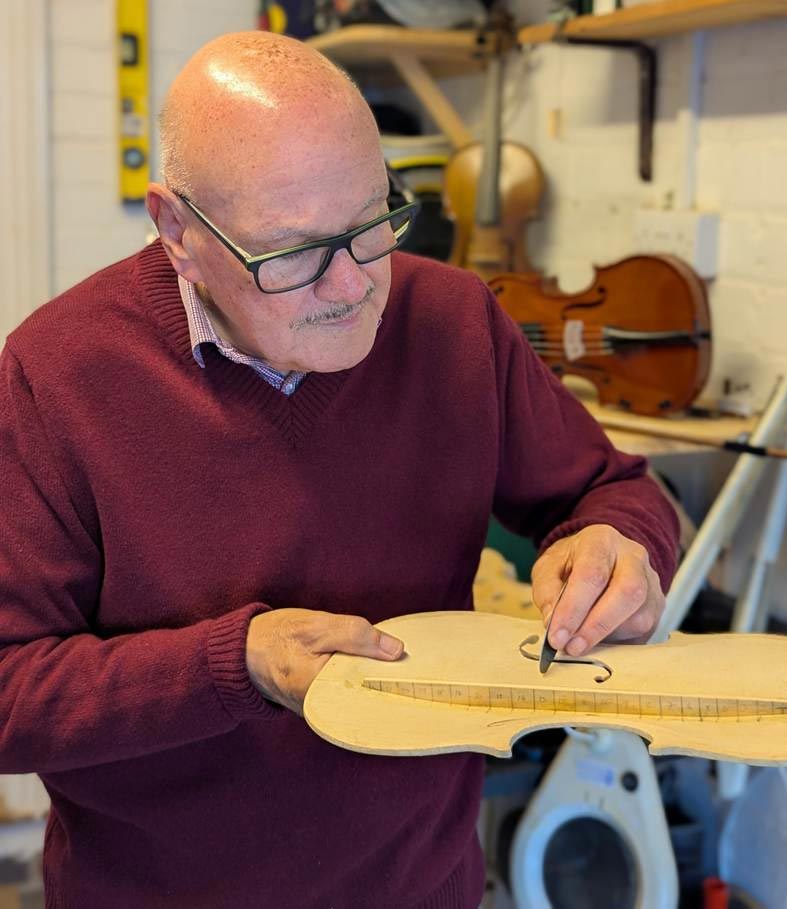
To overcome this obstacle, the team enlisted Alan Kirby, an expert violinist and violin maker from Nottingham. Kirby sourced a standard violin and replaced every metal part with alternatives he crafted himself, producing an entirely wooden instrument operating at frequencies associated with Baroque music.
“Bringing together the ancient art of violin making, with the quantum physics underpinning this brain scanner, has been amazing. Perhaps even more impressive was to actually see the effects of my lessons on peoples brains. That was quite an experience,” Kirby said.
Reading the brain’s musical predictions
Kirby also served as the participants’ violin instructor. At the beginning of the experiment, all 22 beginners watched a video of him playing “Twinkle Twinkle Little Star.” They then attempted to perform the same melody during their first scanning session, while the researchers recorded their brain activity.
After completing that initial recording, the participants received a violin lesson from Kirby. They then returned for a second scanning session, following the same procedure and attempting to play the tune again. By comparing recordings from before and after the lesson, the researchers could examine how the brain responded to a brief period of musical training.
Their attention focused on brain waves, rhythmic fluctuations in electrical activity that occur across groups of neurons. In particular, they examined oscillations in the beta frequency range, which are thought to help signal whether an action produces the result the brain expects.
When learning the violin, that process could involve predicting the sound of a note before playing it and registering whether the actual sound matches the prediction. Unexpected notes provide information that the movement did not produce the intended outcome.
“Your brain works by making predictions about what will happen as a result of your actions. So, if I am playing a violin, my brain will have an expectation of what sound it will make. If I play the expected note, my brain receives information that the outcome matched its prediction; if I hit an unexpected note, it receives information that it did not. In this experiment, we were able to measure these signals in real time while the instrument was being played,” said Joe Gibson, a Ph.D. researcher in the School of Physics and Astronomy.
Greater brain changes accompany better playing
The recordings revealed changes in beta-wave activity following the lesson, providing evidence that even a short period of musical instruction can alter measurable patterns of brain function. The researchers also found a relationship between those neural changes and improvements in playing ability.
Participants with the largest differences in beta-wave activity between the two scanning sessions also showed the greatest improvement in their violin performance. Although the findings do not establish that the changes in brain activity caused better playing, they suggest that beta oscillations are closely associated with how people acquire new motor skills.
Brain scanning could reach beyond music
Making these measurements possible required expertise extending well beyond neuroscience. Professor Matthew Brookes of the University of Nottingham’s School of Physics and Astronomy has spent more than a decade leading the development of OPM-MEG technology. The violin experiment brought together specialists in physics, engineering, mathematics, and music to create a system capable of studying movement as it happens.
“This is a study that we have been working on for years, and it’s taken a unique combination of skills: the physics required to measure brain activity; design engineering to create an ergonomic scanner that people can wear; the mathematics required to model the signals; and of course, Alan’s knowledge and abilities as a violin player and maker. Without this wonderful diversity of talent, we simply couldn’t have done the work.”
The researchers believe the technology could eventually help scientists investigate more than musical learning. Some of the patterns of brain activity measured during the experiment can also be affected by neurological conditions, including dementia. Studying these signals during natural movements could offer another way to examine how brain function changes in health and disease.
“The results provide a greater understanding of motor learning. It’s also fascinating that some of the effects that we measure here are among those that can be affected by disorders like dementia. Hopefully this type of study will bring about a new understanding of not just healthy brain function, but also disease,” said Brookes.
Reference: “Beta-band dynamics during a naturalistic motor task: an OPM-MEG study” by Joseph Gibson, Jessikah Fildes, Alan Kirby, Niall Holmes, Lukas Rier, Karen J. Mullinger, Matias Ison, Peter G. Morris, Elena Boto, Ryan M. Hill and Matthew J. Brookes, 27 July 2026, bioRxiv.
DOI: 10.64898/2026.07.27.740561
Disclosure: The University launched a spin-out company, Cerca Magnetics Limited, in 2020 to commercialize OPM-MEG scanners and related technologies. The wearable system has been installed in a number of high profile research institutions across the globe and is being used to investigate a range of neurological and psychiatric conditions, including epilepsy and dementia.
Never miss a breakthrough: Join the SciTechDaily newsletter.
Follow us on Google and Google News.