

A newly discovered dwarf planet candidate has a trail stretching back more than a decade in telescope images, giving astronomers a head start in understanding its orbit.
2026 ED138 could become the solar system’s sixth officially recognized dwarf planet. The newly discovered icy body orbits beyond Pluto, and early measurements suggest it is among the largest dwarf planet candidates ever found beyond Neptune.
Astronomers spotted the provisionally named object in data from the Simonyi Survey Telescope at the NSF-DOE Vera C. Rubin Observatory. It had likely escaped earlier searches because millions of Milky Way stars crowded the view, making even a world this large difficult to pick out.
A possible sixth dwarf planet
Its distance, brightness, and estimated surface reflectivity suggest a diameter of 600 to 1,500 kilometers, or about 370 to 930 miles. Icy bodies that large are expected to have enough gravity to pull themselves into a round shape, one requirement for dwarf planet status. More observations are needed to measure ED138’s exact size and confirm whether it qualifies.
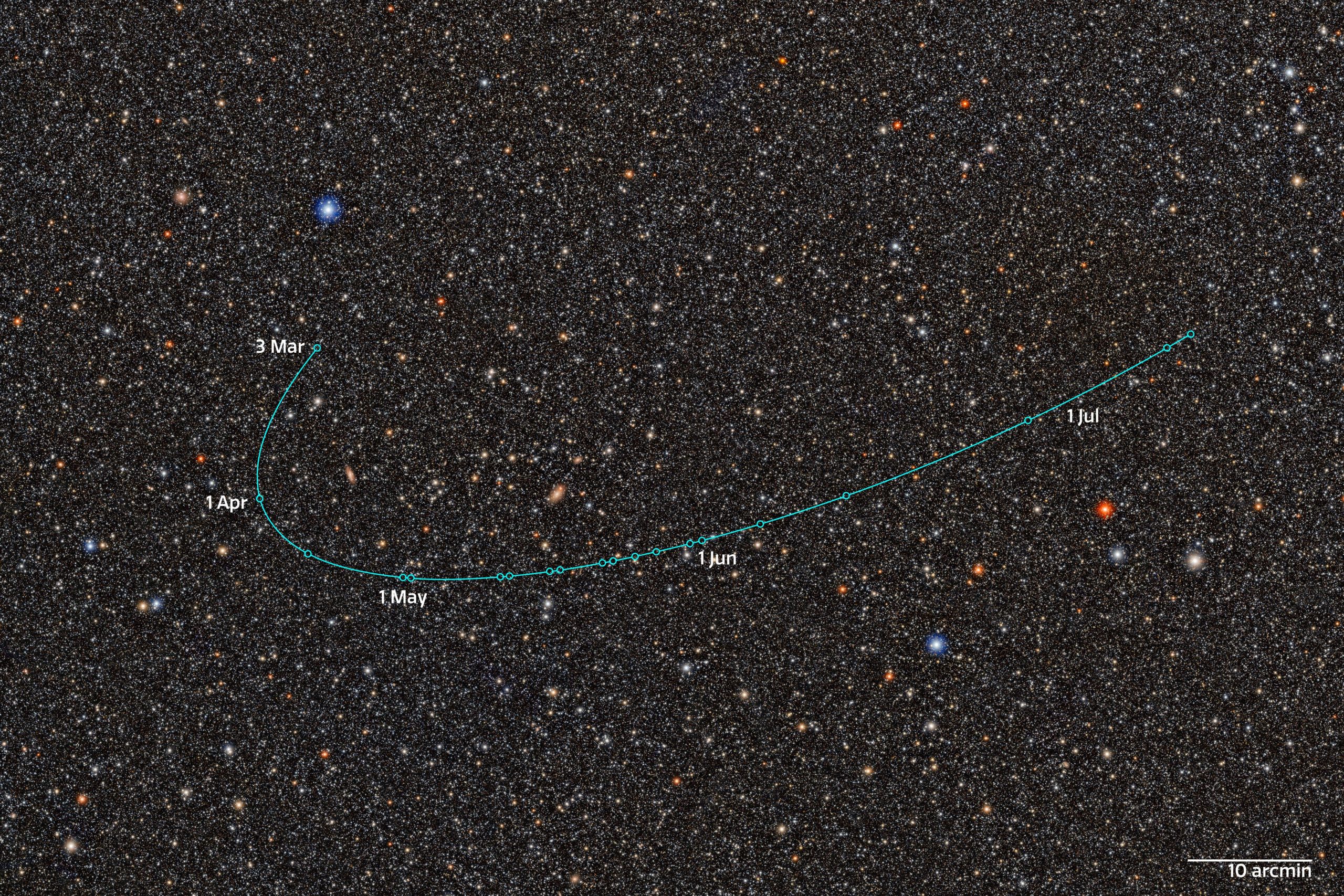
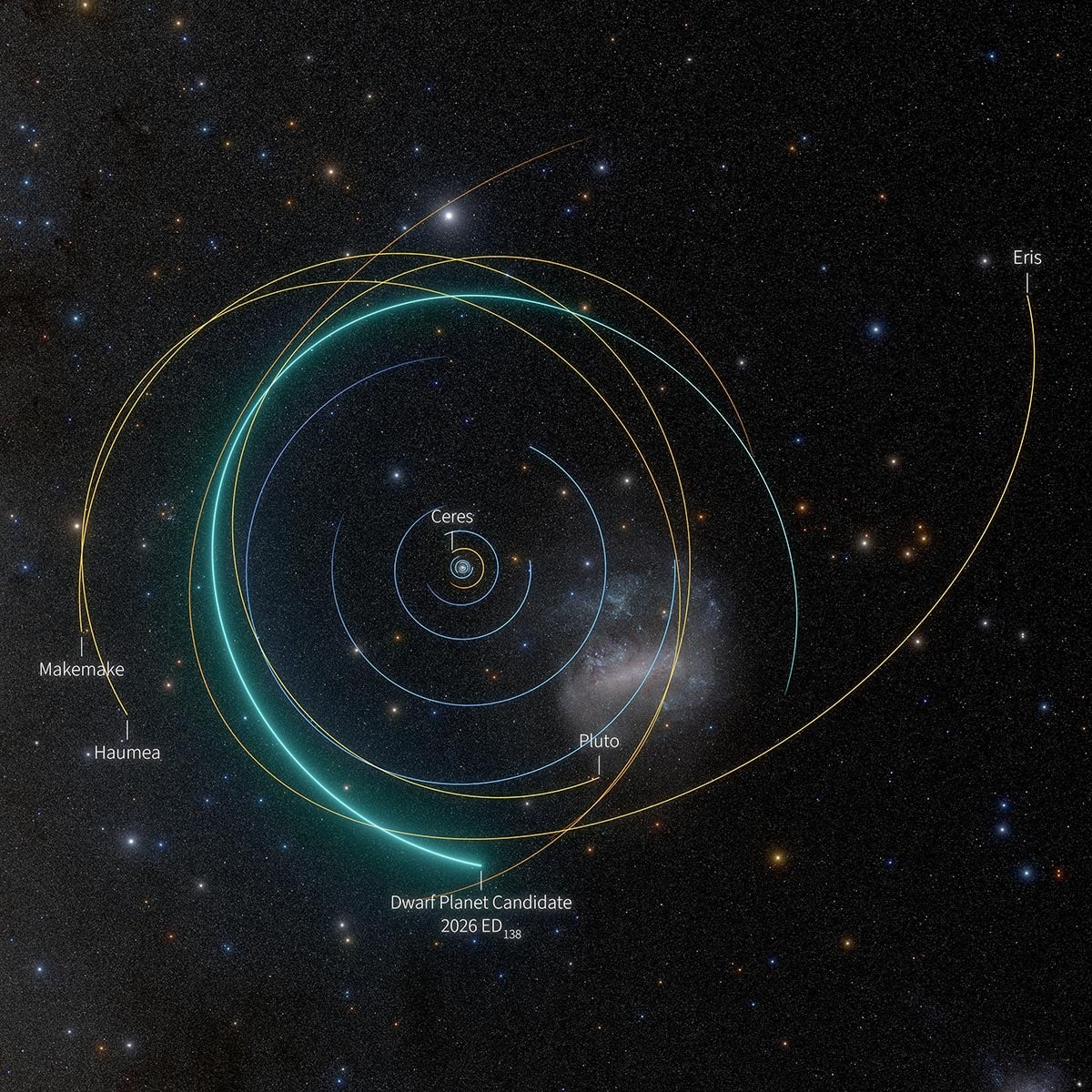
If confirmed, ED138 would join the five dwarf planets recognized by the International Astronomical Union: Pluto, Ceres, Eris, Haumea, and Makemake.
Matthew Holman, a senior astrophysicist at the Harvard & Smithsonian Center for Astrophysics, first identified the candidate. He and Mario Jurić, a University of Washington professor of astronomy and leader of Rubin’s solar system team, presented the results at a press conference on October 27, 2026. Jurić contributed additional observations that helped establish the object’s orbit.
“Finding an object this big, roughly 1,000 kilometers across, is something that happens maybe once in a generation,” Jurić said. “It’s the largest trans-Neptunian object found in about 20 years, and Rubin turned it up while we were still commissioning the telescope.”

ED138 is currently about 46 astronomical units (au) from the Sun. One au is the average distance between Earth and the Sun, and Pluto’s average distance is about 40 au. ED138 belongs to a population called trans-Neptunian objects (TNOs), which orbit the Sun beyond Neptune.
The sizes, compositions, and orbits of these distant objects offer clues to how the solar system formed. Scientists study them to understand how the giant planets migrated over time and how smaller bodies were scattered as the system evolved.
Spotting motion among millions of stars
Finding ED138 required distinguishing its movement from the crowded stellar background near the plane of the Milky Way. Rubin repeatedly monitors the entire southern sky, while powerful algorithms sift through millions to billions of points of light to identify small moving objects. Together, those capabilities allowed the team to pick ED138 out of a field where it had been difficult for other telescopes to detect.
On the evening of October 13, Holman was processing Rubin observations collected earlier in 2026 with search code he had developed with colleague Kevin Napier. The code compares billions of detections of moving objects and determines which detections belong to the same body. When ED138 appeared in the results, its brightness and distance immediately suggested that it was unusually large.
“My first reaction was one of excited disbelief,” Holman said. “Objects like this are very rare, so I immediately started checking whether I or the code had done something wrong.”
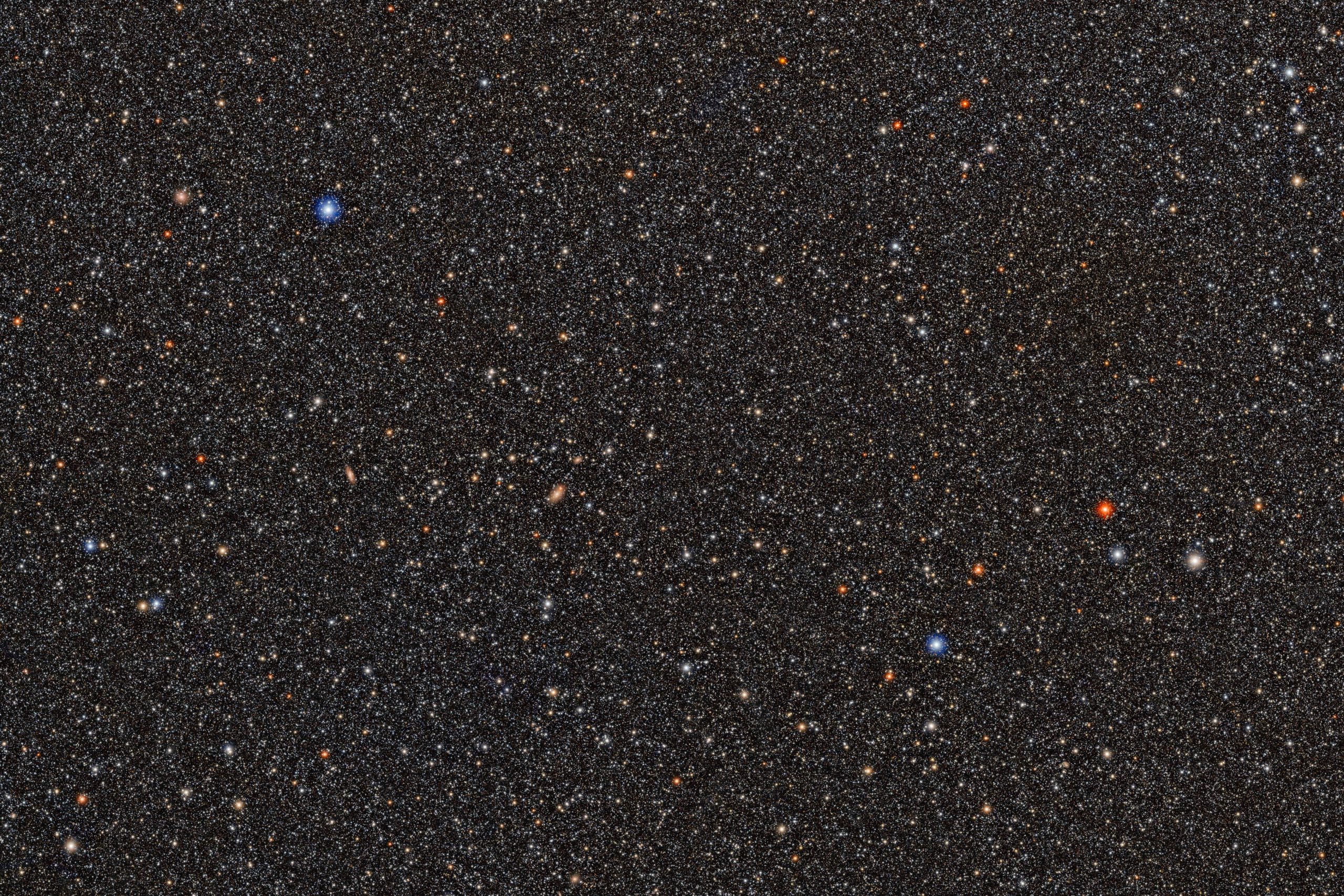
Jurić searched Rubin’s catalogs and images and located 20 more observations stretching back to March 2026. The team also found ED138 in archival images from other surveys dating to 2016. Those records allowed the researchers to trace more than 10 years of its orbit.
“Rubin is giving us an unprecedented capacity to explore the sky through a combination of speed, depth, and precision,” Jurić said. “And the discovery is just the beginning: Once we identify a new object, we can search back months, and sometimes even decades, finding it in images where nobody knew to look. This ability to both discover and ‘precover’ objects is transforming how quickly and accurately we can determine their orbits and understand the distant solar system.”
A ten-year search for overlooked worlds
ED138 adds to a rapidly growing collection of solar system objects discovered by Rubin since it began gathering early data in preparation for the Legacy Survey of Space and Time, or LSST. The survey began in June 2026. In April, before its formal start, Rubin’s solar system team announced observations of more than 11,000 new asteroids, with roughly 380 new TNOs included in the announcement. The team called that submission “the tip of the iceberg” and expressed excitement about the discoveries to come once LSST began.
“If confirmed as a dwarf planet, ED138 would join a very small family of worlds,” Holman said. “Rubin will image the whole southern sky again and again for 10 years, so any others hiding in the places earlier surveys skipped are now within reach.”
Operations of the Vera C. Rubin Observatory are funded by the U.S. National Science Foundation and the U.S. Department of Energy’s Office of Science.
Never miss a breakthrough: Join the SciTechDaily newsletter.
Follow us on Google and Google News.