
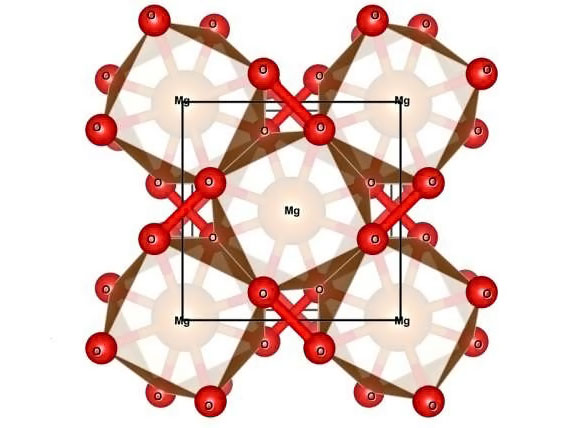
New research suggests that magnesium peroxide may be abundant in extremely oxidized mantles and cores of rocky planets outside our Solar System.
As astronomers continue finding new rocky planets around distant stars, high-pressure physicists are considering what the interiors of those planets might be like and how their chemistry could differ from that found on Earth. New work from a team including three Carnegie scientists demonstrates that different magnesium compounds could be abundant inside other planets as compared to Earth. Their work is published by Scientific Reports.
Oxygen and magnesium are the two most abundant elements in Earth’s mantle. However, when scientists are predicting the chemical compositions of rocky, terrestrial planets outside of our own Solar System, they shouldn’t assume that other rocky planets would have Earth-like mantle mineralogy, according to a research team including Carnegie’s Sergey Lobanov, Nicholas Holtgrewe, and Alexander Goncharov.
Stars that have rocky planets are known to vary in chemical composition. This means that the mineralogies of these rocky planets are probably different from each other and from our own Earth, as well. For example, elevated oxygen contents have been observed in stars that host rocky planets. As such, oxygen may be more abundant in the interiors of other rocky planets, because the chemical makeup of a star would affect the chemical makeups of the planets that formed around it. If a planet is more oxidized than Earth, then this could affect the composition of the compounds found in its interior, too, including the magnesium compounds that are the subject of this study.
Magnesium oxide, MgO, is known to be remarkably stable, even under very high pressures. And it isn’t reactive under the conditions found in Earth’s lower mantle. Whereas magnesium peroxide, MgO2, can be formed in the laboratory under high-oxygen concentrations, but it is highly unstable when heated, as would be the case in a planetary interior.
Previous theoretical calculations had indicated that magnesium peroxide would become stable under high-pressure conditions. Taking that idea one step further, the team set out to test whether stable magnesium peroxide could be synthesized under extreme conditions mimicking planetary interiors.
Using a laser-heated, diamond-anvil cell, they brought very small samples of magnesium oxide and oxygen to different pressures meant to mimic planetary interiors, from ambient pressure to 1.6 million times normal atmospheric pressure (0-160 gigapascals), and heated them to temperatures above 3,140 degrees Fahrenheit (2,000 Kelvin). They found that under about 950,000 times normal atmospheric pressure (96 gigapascals) and at temperatures of 3,410 degrees Fahrenheit (2,150 Kelvin), magnesium oxide reacted with oxygen to form magnesium peroxide.
“Our findings suggest that magnesium peroxide may be abundant in extremely oxidized mantles and cores of rocky planets outside our Solar System,” said Lobanov, the paper’s lead author “When we develop theories about distant planets, it’s important that we don’t assume their chemistry and mineralogy is Earth-like.”
“These findings provide yet another example of the ways that high-pressure laboratory experiments can teach us about not only our own planet, but potentially about distant ones as well,” added Goncharov.
Because of its chemical inertness, MgO has also long been used as a conductor that transmits heat and pressure to an experimental sample. “But this new information about its chemical reactivity under high pressure means that such experimental uses of MgO need to be revised, because this very stable at ambient conditions material could be creating unwanted reactions at high pressures,” Goncharov added.
The other co-authors are Qiang Zhu and Artem Oganov of Stony Brook University and Clemens Prescher and Vitali Prakapenka of the University of Chicago.
This study was funded by the Deep Carbon Observatory, the National Science Foundation, DARPA, the Government of the Russian Federation, and the Foreign Talents Introduction and Academic Exchange Program. Calculations were performed on XSEDE facilities and on the cluster of the Center for Functional Nonomaterials Brookhaven National Laboratory, which is supported by the DOE-BES.
Reference: “Stable magnesium peroxide at high pressure” by Sergey S. Lobanov, Qiang Zhu, Nicholas Holtgrewe, Clemens Prescher, Vitali B. Prakapenka, Artem R. Oganov and Alexander F. Goncharov, 1 September 2015, Scientific Reports.
DOI: 10.1038/srep13582
Never miss a breakthrough: Join the SciTechDaily newsletter.
Follow us on Google and Google News.