
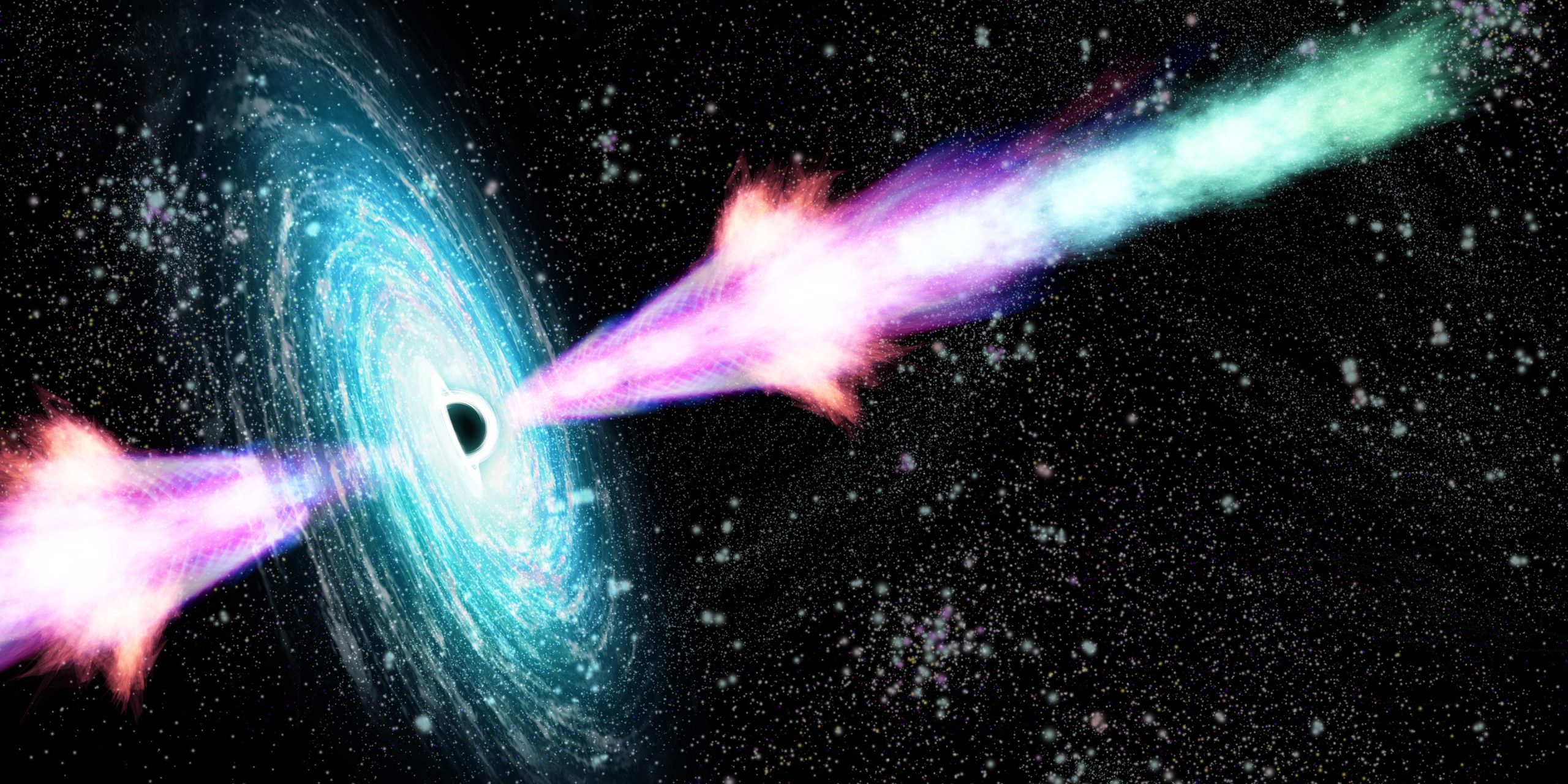
Scientists determine that a gamma-ray burst detected on Earth was caused by a space explosion that happened when the universe was less than 900 million years old.
On September 5, 2021, light from a very energetic gamma-ray burst (GRB) – an incredibly energetic explosion that happened in a faraway galaxy – reached our planet. To get to Earth, it traveled for more than 12.8 billion years. The glow began its journey when the Universe (which is considered to be 13.7 billion years old) was just 880 million years old.
A worldwide team of astronomers proceeded to study the explosion’s afterglow in the months that followed this finding in order to understand what caused it. Dr. Andrea Rossi, a researcher at the Italian National Institute of Astrophysics (INAF), headed the group. Professor Carole Mundell from the University of Bath was also involved.
The scientists came to the conclusion that the GRB that caused the glow was one of the most distant and energetic ones ever found. Additionally, it had one of the most luminous afterglows ever seen.
The scientists were also surprised to see that despite the GRB 210905A’s age, it displayed properties (such as X-ray wavelength) that are strikingly similar to those seen in GRBs produced by cosmic explosions that happened both much more recently and far closer to Earth.
“Thanks to our observations, we can conclude that the mechanism responsible for GRBs does not evolve with the Universe,” says Dr. Rossi.
Professor Mundell, Hiroko Sherwin Chair in Extragalactic Astronomy and head of Astrophysics at Bath, was also involved in the research. She says: “As one of the most powerful and distant cosmic explosions yet found, this rare Gamma-Ray Burst joins a tiny club of such bursts discovered from early in the history of the Universe – and this one is from the brightest host galaxy ever detected.
“This discovery gives us new understanding and confirmation that massive stars – which live fast and die hard – are forming and evolving early in the universe.”
First Came the Explosion
The GRB observed in this study was the ‘long’ kind, meaning it came from a black hole that would have arisen from the catastrophic collapse of a massive star. ‘Short’ GRBs are usually linked to the collision of compact objects such as neutron stars.
The light burst was first detected by instruments aboard the Neil Gehrels Swift Observatory in orbit around the Earth, as well as Konus-WIND, a GRB-hunting telescope operating in interplanetary space.
Observations continued for eight further months using an array of major telescopes both on the ground and in space. These included the Hubble, Swift, and Chandra telescopes.
“Once again, we have shown that when dealing with transient phenomena, you need to be able to act quickly and have the right tools,” says Dr. Rossi. “You have to be able to both observe the phenomenon when it is still bright to obtain a clear and unequivocal result, and then you need access to those facilities that allow you to cover a large wavelength range, from gamma-rays to X-rays, optical and radio.”
The researchers expect to deepen their understanding of the original explosion with the help of the recently launched James Webb Space Telescope.
“This telescope has just begun to demonstrate its incredible capabilities, promising to unveil the characteristics of the environment where the massive star at the origin of this GRB was born,” says Dr. Rossi.
Most of the astronomers involved in the GRB study are members of the STARGATE collaboration, which brings together all those active in GRB follow-up with ESO facilities.
Professor Mundell says: “This is an exciting example of collaboration and coordination between scientists around the world, working together to gather, combine and interpret data taken using a suite of telescopes and detectors on the ground and in space, catching the fading light from this burst at energies across the electromagnetic spectrum – and in real-time.”
Reference: “A blast from the infant Universe: The very high-z GRB 210905A” by A. Rossi, D. D. Frederiks, D. A. Kann, M. De Pasquale, E. Pian1, G. Lamb, P. D’Avanzo, L. Izzo, A. J. Levan, D. B. Malesani, A. Melandri, A. Nicuesa Guelbenzu, S. Schulze, R. Strausbaugh, N. R. Tanvir, L. Amati1, S. Campana, A. Cucchiara, G. Ghirlanda, M. Della Valle, S. Klose, R. Salvaterra, R. L. C. Starling, G. Stratta, A. E. Tsvetkova, S. D. Vergani, A. D’Aì, D. Burgarella, S. Covino, V. D’Elia, A. de Ugarte Postigo, H. Fausey, J. P. U. Fynbo, F. Frontera, C. Guidorzi, K. E. Heintz, N. Masetti, E. Maiorano, C. G. Mundell, S. R. Oates, M. J. Page, E. Palazzi, J. Palmerio, G. Pugliese, A. Rau, A. Saccardi, B. Sbarufatti, D. S. Svinkin, G. Tagliaferri, A. J. van der Horst, D. J. Watson, M. V. Ulanov, K. Wiersema, D. Xu and J. Zhang, 21 September 2022, Astronomy and Astrophysics.
DOI: 10.1051/0004-6361/202243225
Never miss a breakthrough: Join the SciTechDaily newsletter.
Follow us on Google and Google News.