
The James Webb Space Telescope’s discovery of AzTECC71, a dusty star-forming galaxy from the early universe, challenges previous assumptions about galaxy prevalence and composition, offering new insights into cosmic history and galaxy evolution.
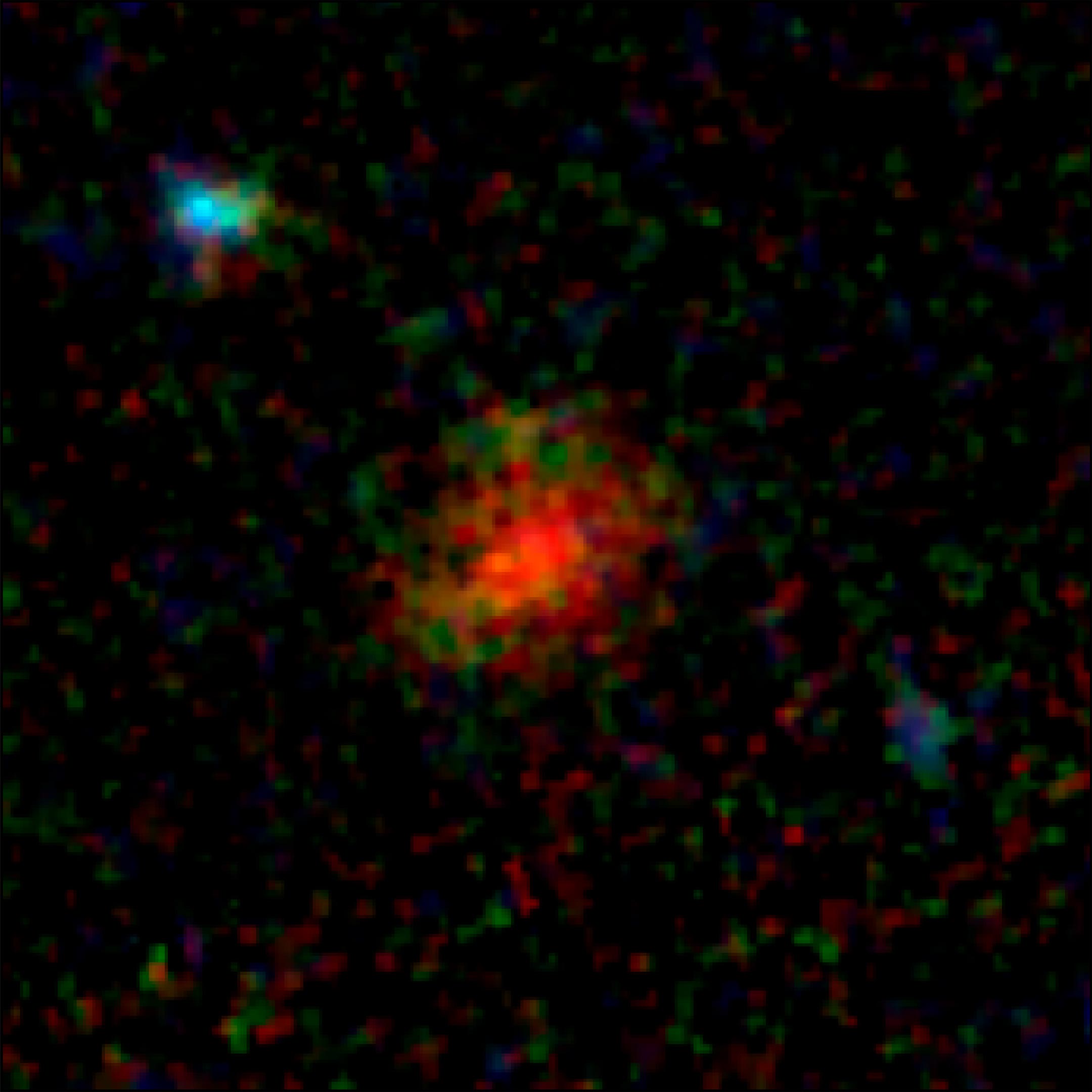
It first appeared as a glowing blob from ground-based telescopes and then vanished completely in images from the Hubble Space Telescope. Now, the ghostly object has reappeared as a faint, yet distinct galaxy in an image from the James Webb Space Telescope (JWST).
Insights from COSMOS-Web Collaboration
Astronomers with the COSMOS-Web collaboration have identified the object AzTECC71 as a dusty star-forming galaxy. Or, in other words, a galaxy that’s busy forming many new stars but is shrouded in a dusty veil that’s hard to see through — from nearly 1 billion years after the Big Bang. These galaxies were once thought to be extremely rare in the early universe, but this discovery, plus more than a dozen additional candidates in the first half of COSMOS-Web data that have yet to be described in the scientific literature, suggests they might be three to 10 times as common as expected.
Astrophysical Significance and Research Findings
“This thing is a real monster,” said Jed McKinney, a postdoctoral researcher at The University of Texas at Austin. “Even though it looks like a little blob, it’s actually forming hundreds of new stars every year. And the fact that even something that extreme is barely visible in the most sensitive imaging from our newest telescope is so exciting to me. It’s potentially telling us there’s a whole population of galaxies that have been hiding from us.”
If that conclusion is confirmed, it suggests the early universe was much dustier than previously thought.
The team published its findings in The Astrophysical Journal.
The COSMOS-Web project — the largest initial JWST research initiative, co-led by Caitlin Casey, an associate professor at UT Austin — aims to map up to 1 million galaxies from a part of the sky the size of three full moons. The goal in part is to study the earliest structures of the universe. The team of more than 50 researchers was awarded 250 hours of observing time in JWST’s first year and received a first batch of data in December 2022, with more coming in through January 2024.
Technological Advances and Future Research
A dusty star-forming galaxy is hard to see in optical light because much of the light from its stars is absorbed by a veil of dust and then re-emitted at redder (or longer) wavelengths. Before JWST, astronomers sometimes referred to them as “Hubble-dark galaxies,” in reference to the previously most-sensitive space telescope.
“Until now, the only way we’ve been able to see galaxies in the early universe is from an optical perspective with Hubble,” McKinney said. “That means our understanding of the history of galaxy evolution is biased because we’re only seeing the unobscured, less dusty galaxies.”
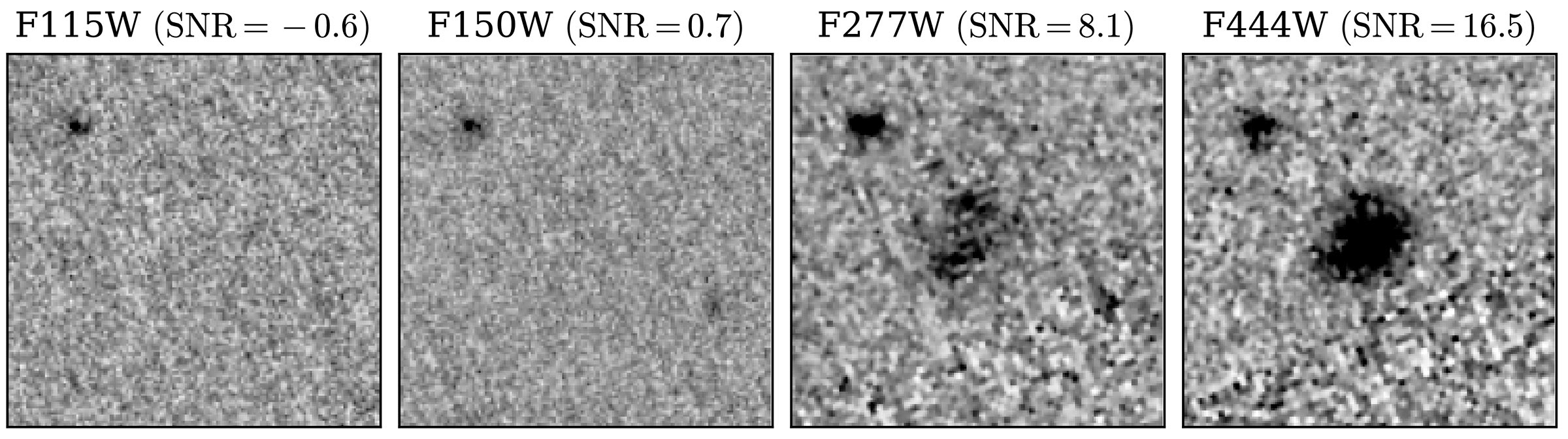
This galaxy, AzTECC71, was first detected as an indistinct blob of dust emission by a camera on the James Clerk Maxwell Telescope in Hawaii that sees in wavelengths between far infrared and microwave. The COSMOS-Web team next spotted the object in data collected by another team using the ALMA telescope in Chile, which has higher spatial resolution and can see in infrared. That allowed them to narrow down the location of the source. When they looked in the JWST data in the infrared at a wavelength of 4.44 microns, they found a faint galaxy in exactly the same place. In shorter wavelengths of light, below 2.7 microns, it was invisible.
A comparison of Hubble Space Telescope’s image of AzTECC71 and the corresponding image from the James Webb Space Telescope. Credit: J. McKinney/M. Franco/C. Casey/University of Texas at Austin
Now, the team is working to uncover more of these JWST-faint galaxies.
“With JWST, we can study for the first time the optical and infrared properties of this heavily dust-obscured, hidden population of galaxies,” McKinney said, “because it’s so sensitive that not only can it stare back into the farthest reaches of the universe, but it can also pierce the thickest of dusty veils.”
The team estimates that the galaxy is being viewed at a redshift of about 6, which translates to about 900 million years after the Big Bang.
Reference: “A Near-infrared-faint, Far-infrared-luminous Dusty Galaxy at z ∼ 5 in COSMOS-Web” by Jed McKinney, Sinclaire M. Manning, Olivia R. Cooper, Arianna S. Long, Hollis Akins, Caitlin M. Casey, Andreas L. Faisst, Maximilien Franco, Christopher C. Hayward, Erini Lambrides, Georgios Magdis, Katherine E. Whitaker, Min Yun, Jaclyn B. Champagne, Nicole E. Drakos, Fabrizio Gentile, Steven Gillman, Ghassem Gozaliasl, Olivier Ilbert, Shuowen Jin, Anton M. Koekemoer, Vasily Kokorev, Daizhong Liu, R. Michael Rich, Brant E. Robertson, Francesco Valentino, John R. Weaver, Jorge A. Zavala, Natalie Allen, Jeyhan S. Kartaltepe, Henry Joy McCracken, Louise Paquereau, Jason Rhodes, Marko Shuntov and Sune Toft, 10 October 2023, The Astrophysical Journal.
DOI: 10.3847/1538-4357/acf614
Study authors from UT Austin are McKinney, Casey, Olivia Cooper (a National Science Foundation graduate research fellow), Arianna Long (a NASA Hubble fellow), Hollis Akins, and Maximilien Franco.
Support was provided by NASA through a grant from the Space Telescope Science Institute.
Never miss a breakthrough: Join the SciTechDaily newsletter.
Follow us on Google and Google News.
5 Comments
Lol, how your Tax dollars are spent on BS propaganda. Artist rendering, see actual blur below.
Yea. I feel like that they asked a fifteen-year-old boy to draw a ghost-like galaxy and he thought this would be the “coolest thing!”
very misleading as to what we can see in space
Could all this dust be the missing mater? Dust doesn’t emit visible light, only infrared. Dust only emits infrared if it’s heated. If it’s cold, it emits the same amount of light as a black hole.
It is castle GraySkull from Eternia!