
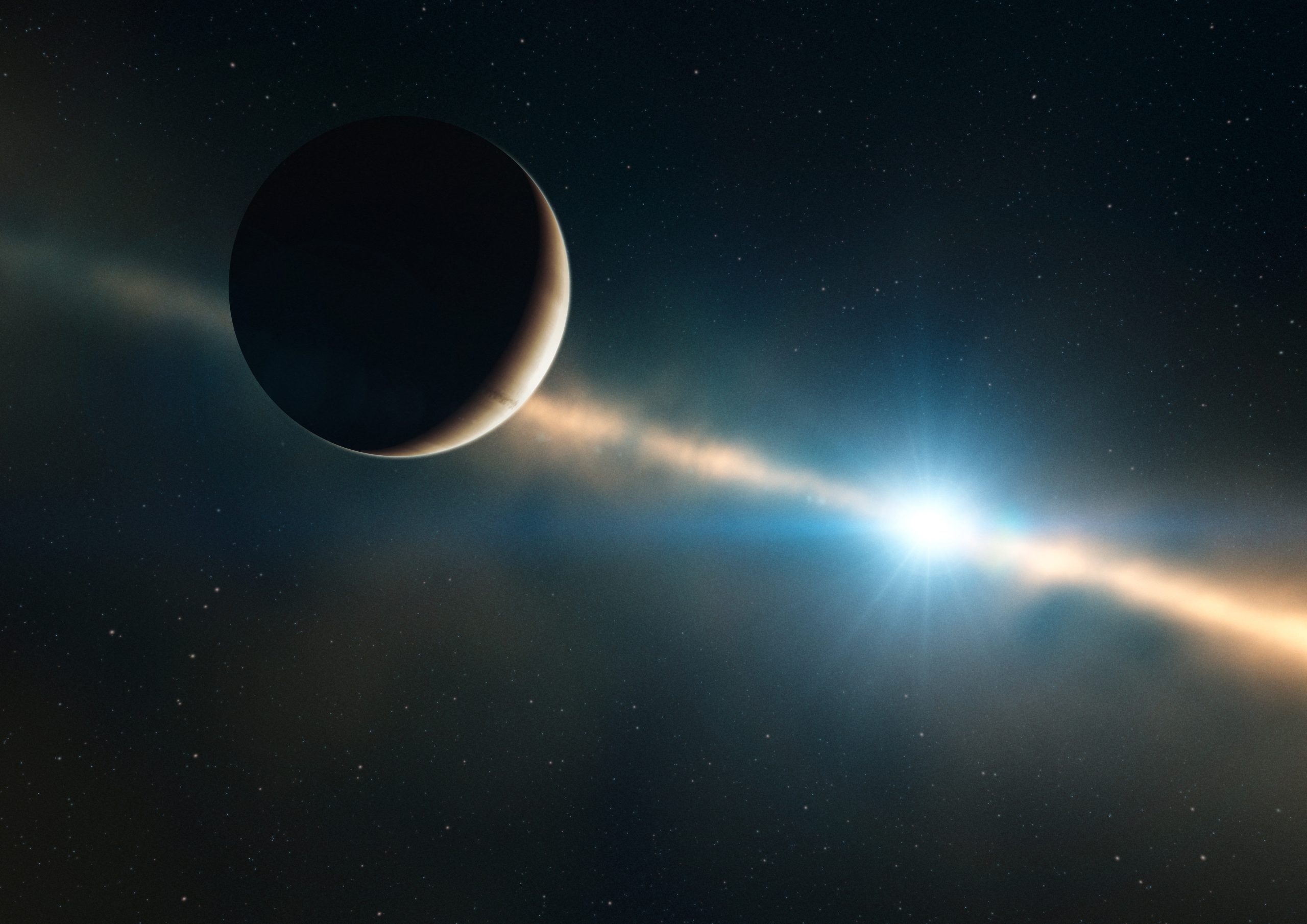
New observations of the giant exoplanet Beta Pictoris b are challenging assumptions about how and where massive planets form.
New observations of Beta Pictoris b, a massive planet orbiting a young star, are challenging a method astronomers hoped could reveal where giant planets form. More precise measurements of the planet’s atmosphere have overturned an earlier result, raising doubts about whether a particular chemical signature can reliably trace a planet’s birthplace.
Located in a 23-million-year-old planetary system, Beta Pictoris b is approximately 11 times Jupiter’s mass. It orbits about 10 astronomical units (approximately 930 million miles) from its star, completing one revolution every 23 years. Earlier atmospheric measurements suggested the planet might have formed much farther away before migrating inward, but the latest evidence points to a different possibility.
A Chemical Fingerprint of Planet Formation
Astronomers have proposed using the relative abundance of two forms of carbon monoxide (CO) to determine where giant planets formed within their original disks of gas and dust. These molecules contain different carbon isotopes, 12C and 13C, which have the same number of protons but different numbers of neutrons. Their slightly different masses can influence how they behave during chemical processes.
The method relies on the carbon monoxide snowline, the distance from a young star beyond which temperatures become cold enough for CO gas to freeze onto dust grains. Planets forming beyond this boundary may accumulate carbon monoxide ice, potentially leaving a different isotopic signature than planets that develop in warmer regions where CO remains gaseous.
Earlier observations of Beta Pictoris b using the original GRAVITY instrument produced a relatively low ratio of 12CO to 13CO. That result appeared consistent with formation beyond the snowline, followed by inward migration to the planet’s present orbit. However, the researchers cautioned that instrumental limitations could have affected the measurement.
Sharper Observations Change the Picture
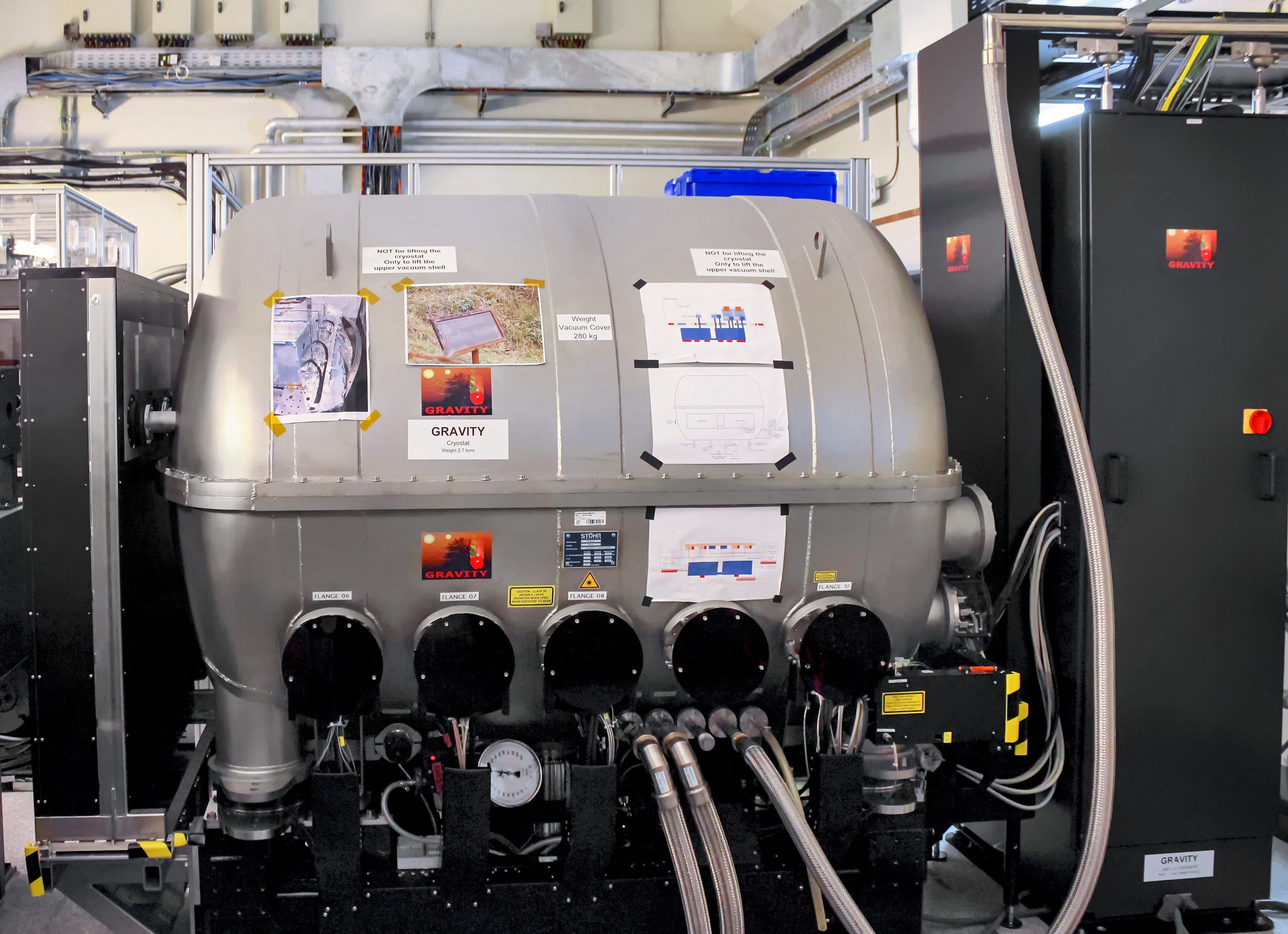
A team led by Antonia von Stauffenberg, a doctoral student at the Max Planck Institute for Astronomy (MPIA) in Heidelberg, Germany, has now revisited the planet using GRAVITY+. The upgraded instrument operates at the Very Large Telescope Interferometer (VLTI), managed by the European Southern Observatory (ESO) in Chile.
The new observations reveal a substantially higher 12CO/13CO ratio than previously reported. While 12CO produces a readily detectable signal, its less abundant counterpart, 13CO, is considerably harder to measure accurately. GRAVITY+ provides improved adaptive optics and greater observational precision, allowing researchers to better distinguish the two molecules.
“The GRAVITY+ interferometric instrument is highly stable […], making it uniquely capable of high-fidelity characterization of directly imaged exoplanets,” says co-author and MPIA scientist Jonas Sauter.
The revised ratio agrees with independent measurements reported by González Picos et al. (2026) using a different instrument. This agreement supports the new result and indicates that systematic uncertainties affected the earlier GRAVITY measurements.
Possible Atmospheric Changes on Beta Pictoris b
The researchers also detected tentative variations in the planet’s observed brightness. These fluctuations appear to follow a period of approximately 8.7 hours, close to the planet’s rotation period.
If confirmed, the variations could arise from atmospheric clouds or chemical differences moving in and out of view as the planet rotates. However, the evidence remains statistically weak, and more sensitive observations will be necessary to establish whether the changes are real.
“The ability to accurately constrain both isotopologues and potential rotational variability using ground-based observations of a bona fide planet such as Beta Pictoris b demonstrates the exceptional data quality achieved with the updated GRAVITY+ instrument,” says von Stauffenberg.
Why the Planet’s Birthplace Remains a Mystery
Under the proposed formation model, the revised carbon monoxide ratio would favor an origin inside the snowline, consistent with Beta Pictoris b’s current orbital distance. Yet the measurement also closely resembles ratios observed throughout the Solar System and the interstellar medium, the gas and dust occupying the space between stars.
Similar values have been measured in most of the roughly dozen young giant planets studied using this technique. This widespread consistency suggests that differences in carbon isotope abundances across planet-forming environments may be too small to distinguish reliably, limiting the method’s usefulness for reconstructing individual planetary histories.
“It is still difficult to utilize 13CO as a formation tracer of giant planets, due to the uncertainties that still persist in the models and measurements,” explains von Stauffenberg.
Current models may be missing important details of carbon monoxide ice chemistry in planet-forming disks. Until those processes are better understood, atmospheric carbon isotope ratios alone cannot establish whether a giant planet formed in a warm, gas-rich region or farther out among frozen materials. More precise observations and additional chemical indicators will be needed to reconstruct these planets’ origins, with GRAVITY+ offering a powerful tool for investigating both their formation and atmospheric behavior.
Reference: “13CO and potential variability in β Pictoris b with GRAVITY+” by A. von Stauffenberg, J. Sauter, P. Mollière, M. Ravet, D. Trevascus, W. Brandner, A. Berdeu, M. Bonnefoy, G. Bourdarot, J.-B. Le Bouquin, G. Chauvin, F. Eisenhauer, M. Houllé, L. Kreidberg, E. Matthews, F. Millour, J. Scigliuto, J. Wang, J. W. Xuan and Y. Zhang, 9 July 2026, Astronomy & Astrophysics.
DOI: 10.1051/0004-6361/202660275
Never miss a breakthrough: Join the SciTechDaily newsletter.
Follow us on Google and Google News.