
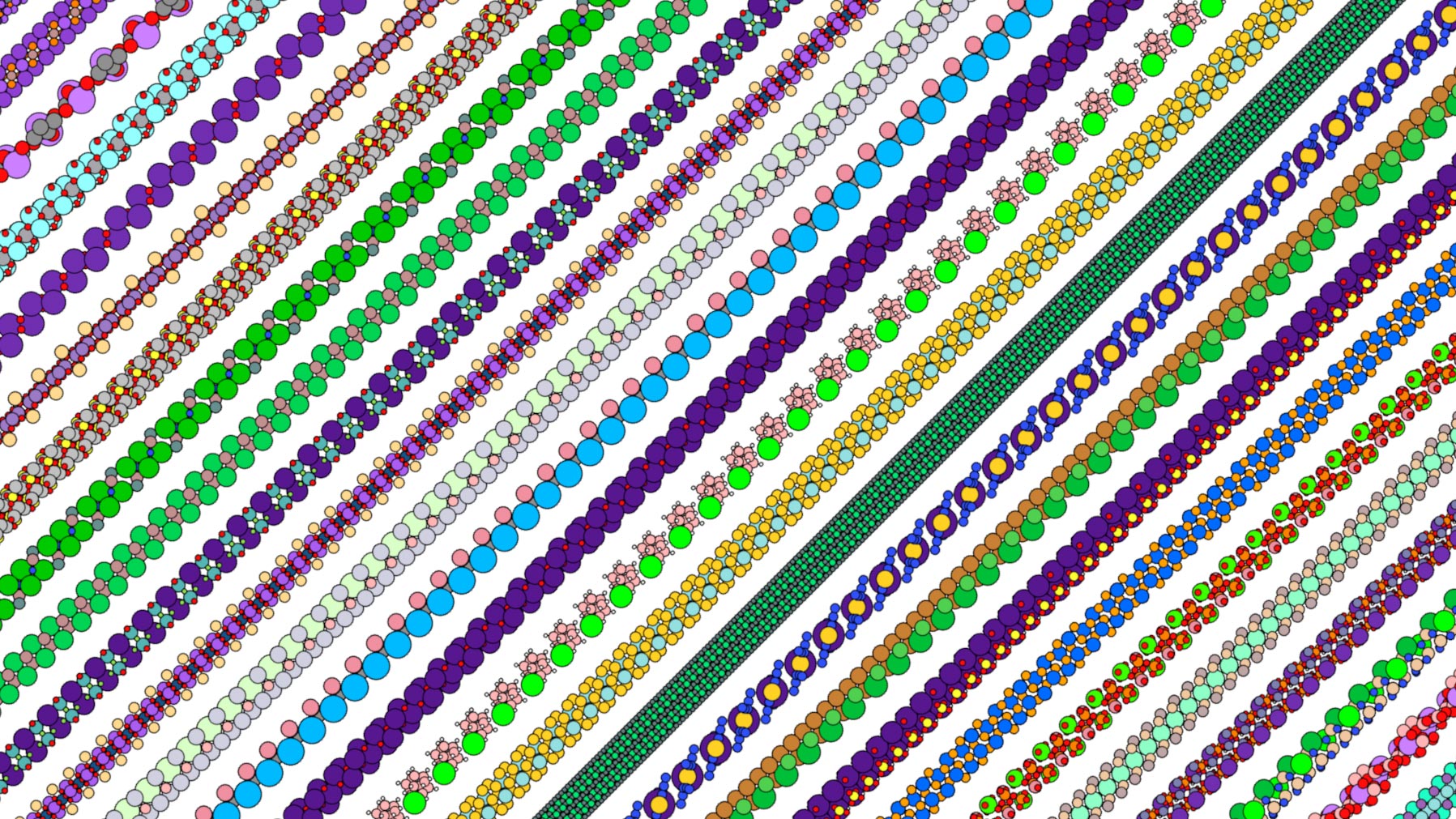
A computer search has identified thousands of crystals worth testing as sources of ultrathin materials, potentially widening the options for future electronics.
Peel a crystal down to a sheet just a few atoms thick, and you may change what the material can do. Its electrical, magnetic, or chemical behavior can shift, opening possibilities for electronics, energy storage, and faster chemical reactions.
These ultrathin sheets are known as two-dimensional, or 2D, materials. They have attracted scientific and technological interest since graphene was produced in 2004.
The challenge is finding crystals that will yield a sheet that holds together. Researchers have mostly started with crystals built like books, whose layers peel apart relatively easily because weak forces hold them together. Crystals with strong bonds running in every direction are much harder to separate.
Thousands of crystals could yield ultrathin sheets
A team at the Helmholtz-Zentrum Dresden-Rossendorf (HZDR) and TU Dresden has now developed the first efficient computational method for predicting separable atomic layers in any type of crystal. The findings, published in Nature Communications, give researchers a much wider selection of materials to investigate.
The team screened more than 24,000 known, non-layered crystal structures from one of the largest experimental materials databases and selected 2,531 particularly promising candidates for detailed calculations. These candidates would retain their chemical composition when a layer separated, and their calculated bonding ratios strongly favored a two-dimensional structure.
The predicted sheets differed markedly from existing database entries. Some could become metallic even though their original crystals are semiconductors, a fundamental change in how they carry electricity. Others could develop a direct band gap, an electronic feature potentially useful for devices that absorb or emit light. Magnetic candidates could also support spintronics, which uses electron spin to process and store data.
For most candidates, calculations indicated that separating a layer would require comparatively little energy. Many also appeared stable against small atomic disturbances and energetically favorable, basic requirements for technological use. Experiments must establish whether these materials can actually be made and under what conditions.
Finding where crystals can split
“Given that this class of materials is still so young, selecting suitable materials for experiments was often based on experience and intuition,” explains Dr. Rico Friedrich of HZDR’s Institute of Ion Beam Physics and Materials Research and TU Dresden. “Using our universal method, we can now determine the points at which a crystal in any material can best be split and whether a potentially stable two-dimensional structure can form in the process.”
The method starts by calculating how strongly individual atoms are bonded. Its core model, called the eXfoliation and Cleavage Potential, or XCP, makes these precise calculations using the elements involved and the distances between atoms.
Two additional algorithms then look for ways to separate a sheet. One searches for easily separable planes within the crystal. The other gradually removes the weakest bonds from the model until two-dimensional structures remain. The approach also detects separation surfaces that are uneven at the atomic scale.
“Calculating the electronic structure for every conceivable surface would be incredibly time-consuming,” says lead author Tom Barnowsky. “Our efficient model, on the other hand, can search big materials databases with minimal computational effort. Detailed calculations are only required for particularly promising hits.”
Tests across a wide range of two-dimensional materials already produced experimentally showed that XCP reliably identified the preferred planes for separating layers. The method is freely available as a web tool.
“Our results vastly expand the horizon for two-dimensional materials,” says Friedrich. “The method doesn’t guarantee that every candidate can be produced in the lab. But it does show which crystals are actually worth the experimental effort.”
Reference: “High-Throughput Prediction of Exfoliable Non-van der Waals Materials from a Universal Potential” by Tom Barnowsky, Carsten Timm and Rico Friedrich, 25 August 2026, Nature Communications.
DOI: 10.1038/s41467-026-76806-8
Never miss a breakthrough: Join the SciTechDaily newsletter.
Follow us on Google and Google News.