
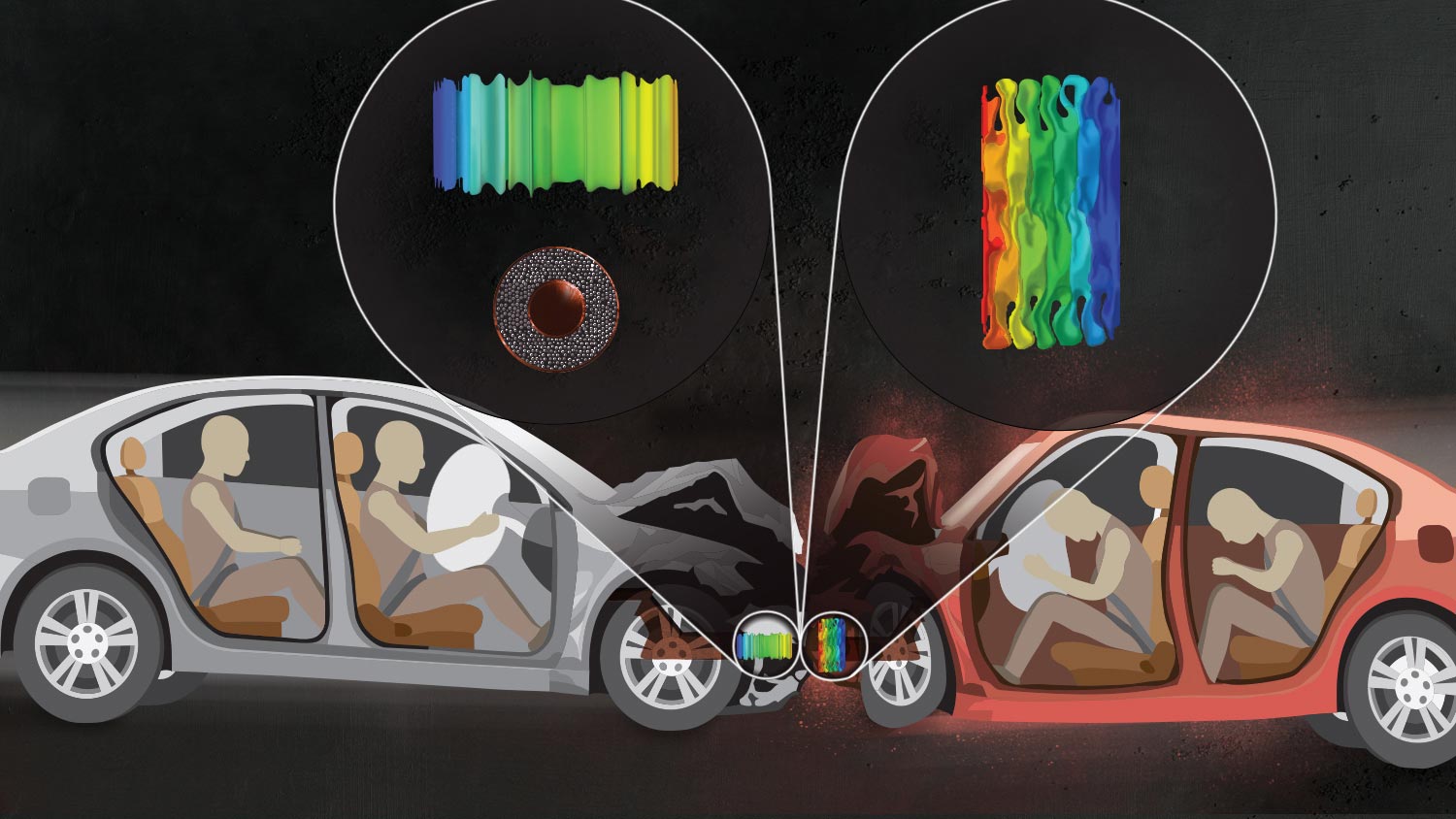
Metal foam explored for armor could also make everyday cars safer, with simulations suggesting it could absorb dangerous impacts without adding extra weight.
In a head-on collision, a car’s front rails must bend and collapse in a controlled way to help protect the people inside. These structures receive impact energy from the bumper and are designed to keep the vehicle from slowing too abruptly. Sudden deceleration can cause severe injuries, including head injuries.
A new study suggests that replacing conventional front rails with a lightweight metal foam could significantly improve crash protection, especially at higher speeds. Using detailed computer simulations, researchers found that the material absorbed impact energy more effectively than two common designs used in modern vehicles.
Hollow metal spheres absorb collision forces
The material, known as composite metal foam (CMF), contains hollow metal spheres embedded in a metallic matrix. The spheres can be made from metals or alloys such as steel, creating a structure that is lightweight and capable of withstanding substantial compression and impact. Researchers have also explored its potential use in aircraft wings, vehicle armor, and body armor.
“CMF is lighter than conventional metals without sacrificing strength, and our work here tells us that its unique structure allows it to better absorb energy during high-velocity impacts,” says Afsaneh Rabiei, corresponding author of the study and a professor of mechanical and aerospace engineering at North Carolina State University. “This is important because it slows the rate at which a vehicle decelerates during a crash – and slowing deceleration improves driver and passenger safety.”
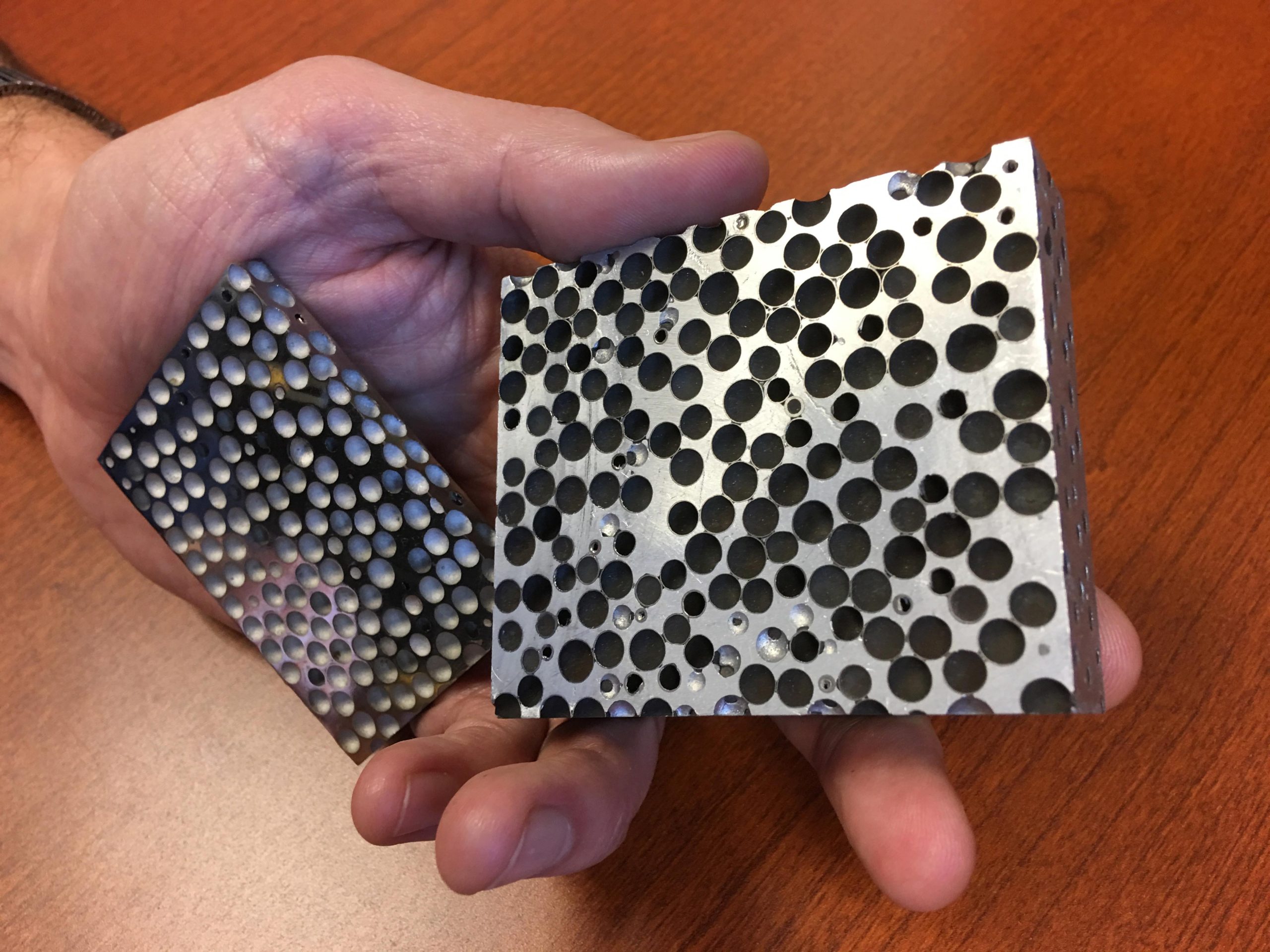
To evaluate its potential, the researchers compared front rails made from an aluminum tube with a steel CMF core against two conventional designs. One consisted of a long, hollow rectangular steel structure. The other used two hollow aluminum octagons stacked on top of each other, known as a double-octagonal design.
The team built computational models using extensive experimental data on CMF alongside publicly available information about conventional rail materials and designs. They then simulated high-speed frontal collisions to examine how effectively each structure managed the impact.
Crash simulations reveal major safety improvements
At 55 mph, CMF rails of the same weight and length reduced maximum deceleration by approximately 38% compared with double-octagonal rails. Overall crash severity fell by about 45%, while the Head Injury Criterion (HIC), a measure of the likelihood of serious head injury, also decreased by roughly 45%.
The improvements were even greater when compared with rectangular rails. At the same impact speed, CMF reduced maximum deceleration by approximately 84%, overall crash severity by 94%, and HIC by 83%.
The simulations also indicated that vehicles equipped with CMF rails could withstand substantially higher impact speeds before reaching critical safety limits. Compared with double-octagonal rails, vehicles could travel about 34% faster before reaching the critical crash-severity limit and approximately 40% faster before reaching the head-injury limit. Against rectangular rails, those increases were about 32% and 48%, respectively.
“CMF outperformed the conventional rails across the board,” Rabiei says. “And the higher the speed, the better the CMF performed compared to the conventional front rails. Comparing front rail performance during a 55 mph crash offers a good overview of the difference between designs.”
Better crash protection without added weight
Importantly, the simulated safety improvements did not require heavier or longer front rails. The CMF structures matched the conventional designs in both dimensions and weight, suggesting that manufacturers might eventually improve crash protection without compromising fuel economy.
“This also means that you could reduce the length of the front rails, still improve safety, and also make the vehicles more fuel efficient,” Rabiei says.
Potential protection for electric vehicle batteries
The material could also have applications in electric vehicles. Previous research has demonstrated CMF’s resistance to heat and fire, making it a potential candidate for structures designed to protect high-voltage battery packs from damage during collisions.
The findings are based on computational modeling, and physical testing would be needed to determine how CMF rails perform in actual vehicles. The researchers hope to work with manufacturers to explore these possibilities.
“We are open to working with the automobile industry to conduct testing of rails that make use of CMF in their existing front rail designs – or to develop new rail designs that make use of CMF to improve safety and fuel efficiency,” says Rabiei.
“We are also interested in working with automakers, suppliers and battery manufacturers to evaluate CMF-based structures for electric vehicles, including battery protection systems. CMF’s combination of lightweight impact-energy absorption and resistance to heat and fire creates opportunities to address multiple vehicle safety challenges with a single material system.”
Reference: “Enhancing Safety and Crashworthiness of Vehicles Using Composite Metal Foam” by Aman Kaushik and Afsaneh Rabiei, 2 September 2026, Journal of Composites Science.
DOI: 10.3390/jcs10090474
Never miss a breakthrough: Join the SciTechDaily newsletter.
Follow us on Google and Google News.
1 Comment
EVERYONE NEEDS SALVATION HERE ARE THE WORDS OF SALVATION PLEASE FORGIVE ME JESUS IM A SINNER COME INTO MY HEART AND SAVE ME FROM MY SIN I NO THAT YOU ARE THE SAVIOR AND I NO THAT YOU DIED FOR ME ON CALVARY AND I NO THAT GOD RAISE YOU FROM THE DEAD AND YOU ARE ALIVE AND I THANKYOU FOR YOUR SALVATION IN JESUS HOLY NAME AMEN AND ITS IMPORTANT TO ALWAYS ASK FOR FORGIVENESS EVERY NIGHT AND HOPE SOMEONE GETS SAVED ITS IMPORTANT