
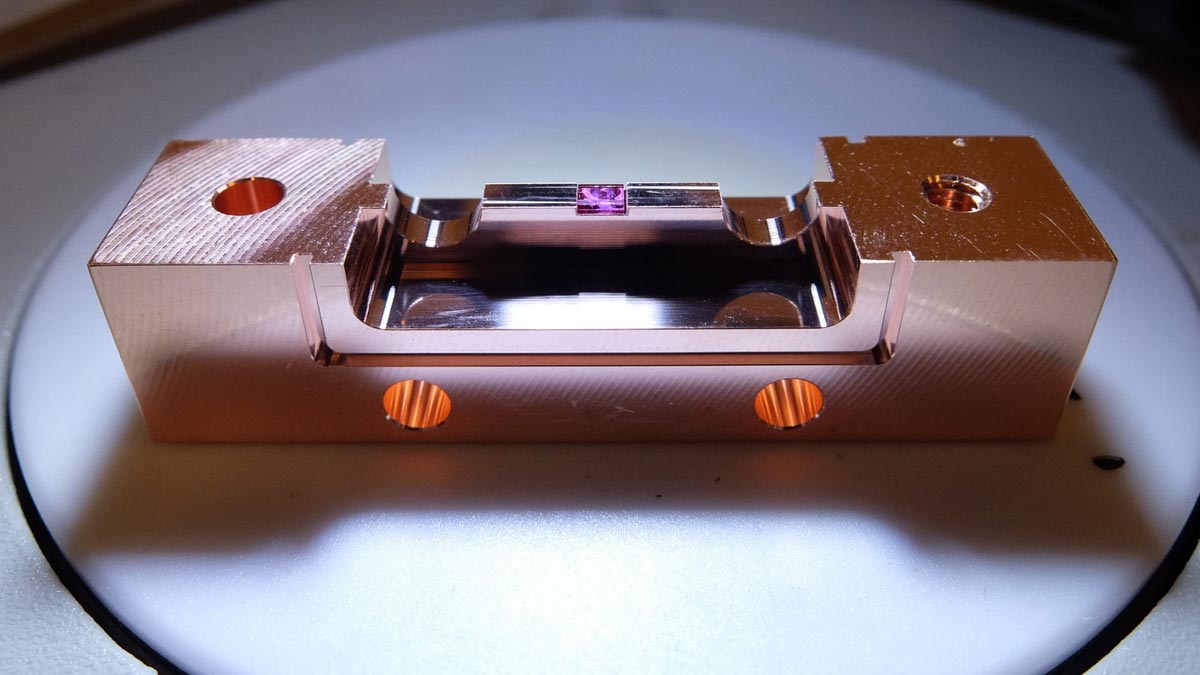
A technology older than the laser is finding new life inside diamond, offering a potential way to make quantum computers more powerful without overwhelming their sensitive measurement systems.
A quantum computer can process information using the strange rules of quantum physics, but getting an accurate answer out of it presents a challenge. The information is carried by extremely faint microwave signals that must be amplified before they can be measured. Unfortunately, amplifying those signals can introduce unwanted noise, making it harder to tell what the computer is actually saying.
Researchers at the Okinawa Institute of Science and Technology (OIST) have developed a new amplifier that tackles this problem using an unlikely material: diamond. Their device can strengthen microwave signals more than 1,000 times while adding very little noise. It can also handle stronger signals and operate in magnetic fields, potentially overcoming limitations that make today’s quantum computers difficult to scale up.
The findings were published on November 16, 2026, in Nature Communications.
Measuring multiple qubits can overwhelm amplifiers
In superconducting quantum computers, information is stored in quantum bits, or qubits. To determine a qubit’s state, researchers measure a weak microwave signal associated with it. The difficulty is that these signals are extraordinarily sensitive to interference.
That is one reason superconducting quantum computers operate at temperatures close to absolute zero, the lowest temperature theoretically possible. Keeping the equipment this cold reduces interference caused by heat, but it cannot eliminate the noise introduced by the amplifiers themselves. Once that unwanted noise enters the measurement, subsequent amplification stages strengthen it along with the original signal, increasing the chance of an incorrect reading.
Existing amplifiers can detect these faint signals with remarkably little added noise, although they come with trade-offs. Conventional Josephson parametric amplifiers, for example, can become overwhelmed when several qubits are measured simultaneously. This effect, known as saturation, limits how many signals they can reliably process at once.
Another technology, known as kinetic inductance parametric amplification, can handle stronger signals but generally requires more electrical power and additional wiring. As quantum computers grow, that extra equipment adds cost and complexity. Some systems also use qubits based on electron spin, which require magnetic fields that can disrupt conventional superconducting amplifiers.
Quantum computing revives the 1954 maser
The OIST researchers approached these challenges by revisiting a technology that predates the laser.
Masers were first demonstrated in 1954, six years before lasers appeared. Both technologies amplify electromagnetic waves, but while lasers work with light, masers operate with microwaves. They rely on a process called stimulated emission, in which an incoming photon carrying the right amount of energy prompts an excited electron to release another matching photon. Repeating this process strengthens the original signal.
“Despite being invented before optical lasers, masers — microwave lasers — have been left far behind because they often require cryogenic conditions to function, which made them impractical until very recently,” explains Dr. Yuimaru Kubo, head of the Hybrid Quantum Device Team at OIST. “But now, with quantum computers operating at temperatures very close to absolute zero, we have given them new life as very promising candidates for amplifying quantum signals with very little noise.”
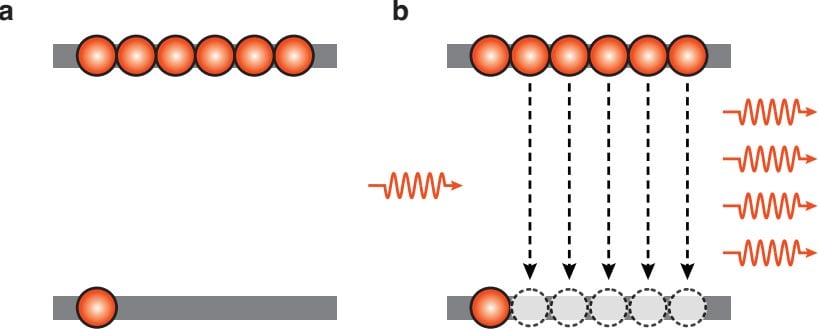
To put this older technology to work, the team used a specially prepared diamond containing nitrogen impurities known as P1 centers. These impurities contain electrons whose spin, an intrinsic quantum property, makes them behave like tiny magnets.
The researchers apply a relatively weak microwave field to the diamond, supplying energy that pushes most of these electron spins into higher-energy states. When a faint microwave signal enters the amplifier, it stimulates the excited spins to release their stored energy as additional microwaves at the same frequency.
In effect, the diamond transfers energy from its excited electrons into the incoming signal, making that signal stronger without requiring a powerful microwave source.
“We were surprised by how much amplification we could achieve using such a small amount of microwave power,” adds Kubo.
A thousandfold boost with little noise
In testing, the diamond maser amplified microwave signals more than 1,000-fold while introducing just 2.55 quanta of added noise. Quanta are discrete units used to describe energy at the quantum scale. For comparison, the fundamental quantum limit for this type of amplification is 0.5 quantum, meaning that even an ideal amplifier cannot eliminate added noise entirely.
The device also tolerated much stronger incoming signals than conventional Josephson parametric amplifiers. Because the diamond maser operates in a magnetic field, it could be particularly useful for quantum computers that rely on spin-based qubits.
Although the technology is still being developed toward commercialization, its potential uses extend beyond quantum computing. Sensitive microwave amplification is also important in spectroscopy, which scientists use to investigate the properties of materials, and nuclear magnetic resonance, the physical principle behind MRI scanners.
Other possible applications include fundamental physics experiments searching for dark matter, where detecting extremely weak signals could help researchers investigate one of the universe’s most elusive mysteries.
Reference: “A near-quantum-limited diamond maser amplifier operating at millikelvin temperatures” by Morihiro Ohta, Ching-Ping Lee, Vincent P. M. Sietses, I. Kostylev, J. R. Ball, P. Moroshkin, T. Hamamoto, Y. Kobayashi, S. Onoda, T. Ohshima, J. Isoya, Hiroki Takahashi and Yuimaru Kubo, 16 November 2026, Nature Communications.
DOI: 10.1038/s41467-026-79021-7
This work was supported by the Proof-of-Concept (PoC) Program by OIST Innovation, the JST Moonshot R&D Program (Grant No. JPMJMS2066), JST-PRESTO (Grant No. JPMJPR15P7), JSPS KAKENHI Grant-in-Aid for Scientific Research (B) (Grant No. 18H01817), Grant-in-Aid for Scientific Research on Innovative Areas (Grant No. 18H04295), the Science Research Promotion Fund from the Promotion and Mutual Aid Corporation for Private Schools of Japan (PMAC), and the Research Encouragement Grant from the AGC Inc. Research Foundation. M.O. and T.H. acknowledge financial support from the JSPS Grant-in-Aid for Fellows (Grant Nos. 23KJ2135 and 24KJ2178), and J.R.B. acknowledges support from OIST Graduate University.
Never miss a breakthrough: Join the SciTechDaily newsletter.
Follow us on Google and Google News.