
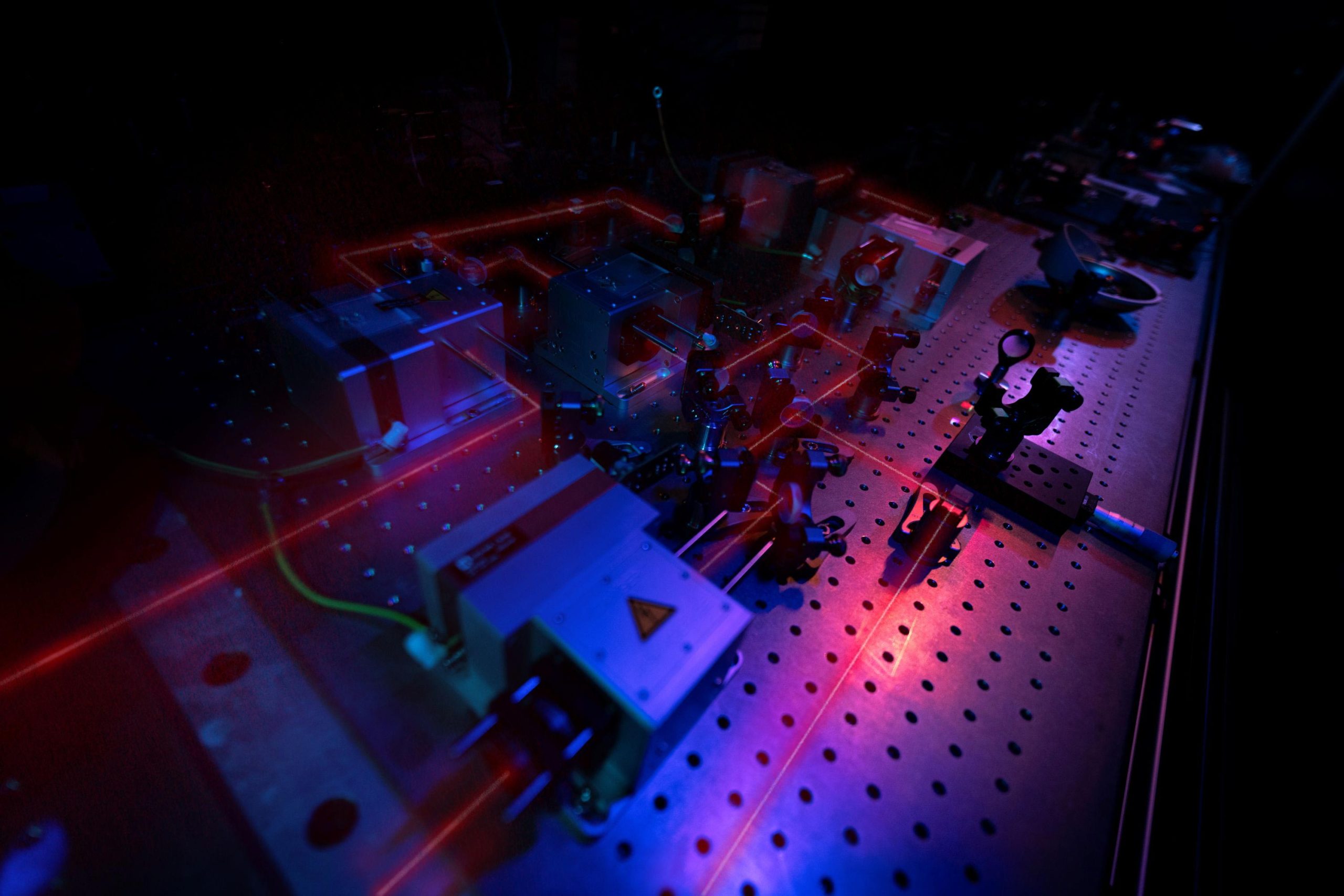
A new light-based processor suggests future quantum computers could tackle very different problems without being rebuilt, while laying the groundwork for more reliable calculations.
Light has enormous potential for quantum computing, but one of its greatest strengths is also a major obstacle. Photons, the tiny particles that make up light, are excellent carriers of quantum information because they rarely interact with one another. Yet those interactions are essential for many of the calculations that quantum computers need to perform, making it difficult to build versatile machines using light alone.
Researchers from Imperial College London’s Department of Physics and collaborating institutions have developed a new approach that could help overcome this limitation. Their programmable quantum processor, called Clavina, combines different types of quantum operations in a single system, allowing it to tackle multiple computational tasks without requiring an entirely new hardware design.
The research, published in Nature Photonics, offers a promising direction for building more flexible light-based quantum computers, including systems that could eventually detect and correct their own errors.
Changing calculations without rebuilding hardware
Most photonic quantum processors are designed with a particular task in mind. Adapting them to solve another problem can require substantial changes to their hardware, limiting how easily the technology can evolve.
Clavina takes inspiration from ordinary computers, which use specialized components to handle graphics, artificial intelligence, and other demanding tasks. Instead of relying on one fixed arrangement, the new processor uses a central control unit to direct information through a programmable optical network and specialized modules.
The optical network handles linear operations, which manipulate light without requiring photons to interact. The additional modules provide nonlinear operations, expanding the kinds of calculations the system can perform. Because these components can be combined in different ways, researchers can change the processor’s functions without rebuilding it from scratch.
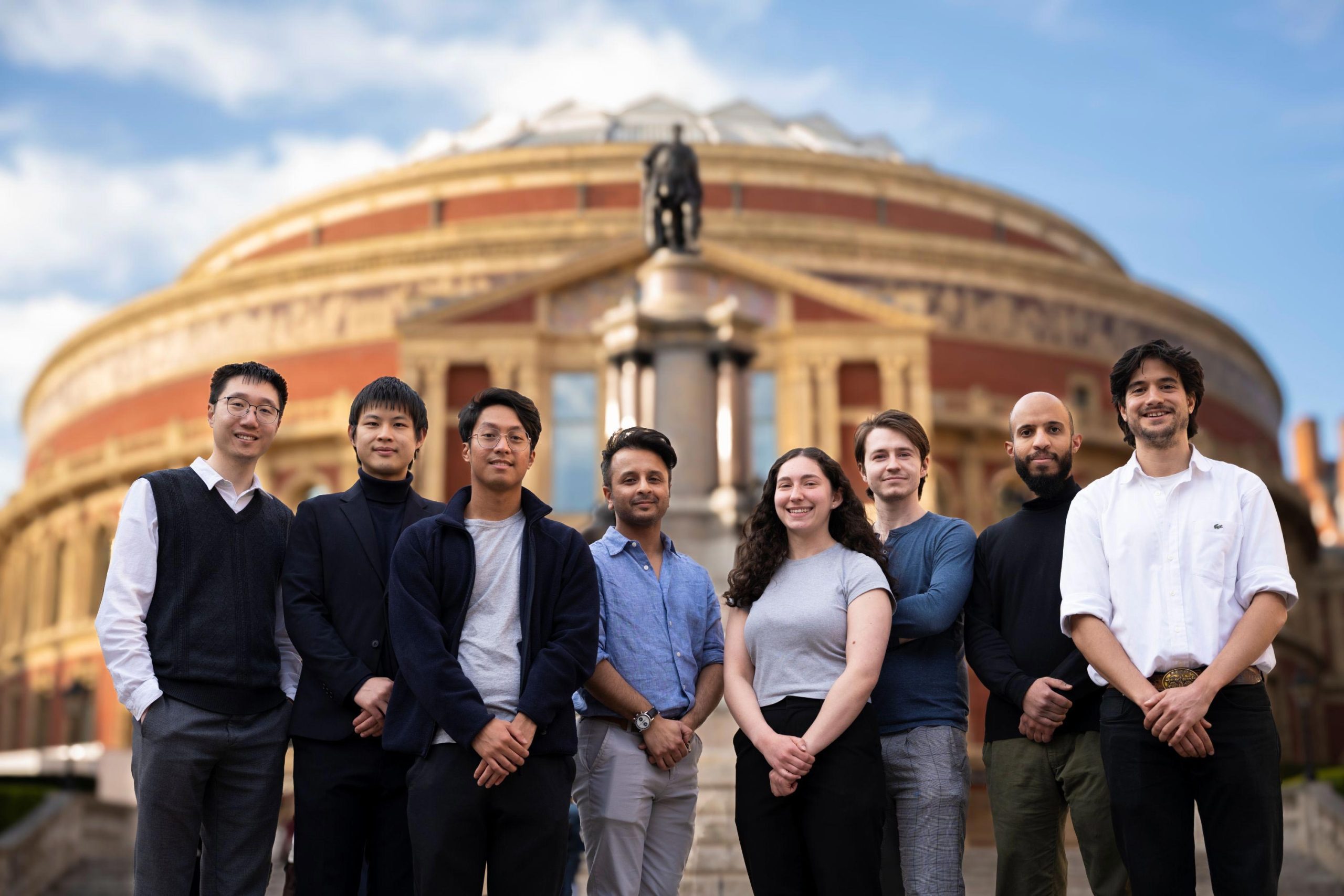
Dr. Shang Yu, the study’s lead author and a Marie Skłodowska-Curie Fellow at Imperial, said, “We set out to build a photonic quantum processor that provides a step change in functionality over our previous designs. Our new architecture ‘Clavina’ is scalable, modular and extensible, allowing different functional modules to be used depending on the computational task we wish to perform.”
Simulating interactions between quantum particles
To test what this flexibility could achieve, the researchers put Clavina to work on two very different challenges.
The first involved simulating the Bose-Hubbard model, a well-known problem in condensed matter physics that describes how quantum particles interact. These calculations involve many-body interactions, where the behavior of multiple particles must be considered together. Such simulations are challenging even for other quantum computing technologies, including superconducting quantum computers.
Dr. Jinzhao Sun of Queen Mary University of London explained, “The versatility of our hardware enables us to integrate nonlinear operations and linear operations. We use these operations to perform simulations involving many-body interactions, which are also restricted on superconducting quantum computers.”
Producing quantum states for error correction
The second demonstration addressed another major challenge facing quantum computing: keeping delicate quantum information safe from errors.
Quantum systems are vulnerable to noise and disturbances that can interfere with calculations. One possible solution involves creating specially structured quantum states that encode information in ways that make errors easier to detect and correct.
Among the most promising are Gottesman-Kitaev-Preskill (GKP) states. Producing these states has been difficult for light-based systems because earlier approaches worked probabilistically, meaning researchers could not reliably generate the required states whenever they needed them.
Using Clavina, the team demonstrated a much more consistent method of generating GKP states. Although this does not mean they have built a fully error-correcting quantum computer, it addresses an important obstacle to making error correction practical.
Dr. Raj Patel, a UKRI Future Leaders Fellow who leads Imperial’s photonic quantum computing program, said, “Our architecture allows the generation of exotic quantum states such as Schrödinger cat states and Gottesman-Kitaev-Preskill states, which are valuable resources for fault-tolerant quantum computing. The nonlinear operations in our architecture provide a universal gate set at the physical level which is required for the future implementation of bosonic error-correcting codes.”
A universal gate set provides the fundamental operations that can be combined to carry out different quantum computations. Having these capabilities available in one programmable processor could support future error-correction techniques that use specially encoded states of light.
Expanding the range of quantum tasks
The architecture also offers possibilities beyond the two demonstrations. By allowing researchers to change or introduce functional modules, Clavina could be adapted to different scientific problems as quantum computing systems become larger and more complex.
Co-author Ying Dong of China Jiliang University said, “Previously, researchers would have to build photonic hardware tailored to a specific task. The ability to switch in different functional modules in our architecture enables a single set of hardware to perform multiple functions without overhauling the design. Clavina can solve graph problems, simulate quantum systems or generate large entangled states and resource states for error correction.”
Rather than developing a separate photonic processor for every new challenge, researchers could eventually build on the same adaptable foundation. Clavina’s demonstrations suggest that the ability to change what a quantum computer does may become just as valuable as increasing its computational power.
Reference: “Extensible universal photonic quantum computing with nonlinearity” by Shang Yu, Jinzhao Sun, Kuan-Cheng Chen, Zhi-Huai Yang, Zhenghao Li, Ewan Mer, Yazeed K. Alwehaibi, Shana H. Winston, Dayne Marcus Lopena, Zi-Cheng Zhang, Guang Yang, Runxia Tao, Mingti Zhou, Gerard J. Machado, Ying Dong, Roberto Bondesan, Vlatko Vedral, M. S. Kim, Ian A. Walmsley and Raj B. Patel, 31 July 2026, Nature Photonics.
DOI: 10.1038/s41566-026-01962-8
Never miss a breakthrough: Join the SciTechDaily newsletter.
Follow us on Google and Google News.