
Close Menu
    Facebook X (Twitter) Instagram
    SciTechDaily
    • Biology
    • Chemistry
    • Earth
    • Health
    • Physics
    • Science
    • Space
    • Technology
    Facebook X (Twitter) Pinterest YouTube RSS
    SciTechDaily
    Home»Technology»Needle-Like Carbon Nanofibers May Aid in New Drug Delivery Systems
    Technology

    Needle-Like Carbon Nanofibers May Aid in New Drug Delivery Systems

    By North Carolina State UniversityJanuary 15, 2013No Comments3 Mins Read
    Facebook Twitter Pinterest Telegram LinkedIn WhatsApp Email Reddit
    Share
    Facebook Twitter LinkedIn Pinterest Telegram Email Reddit
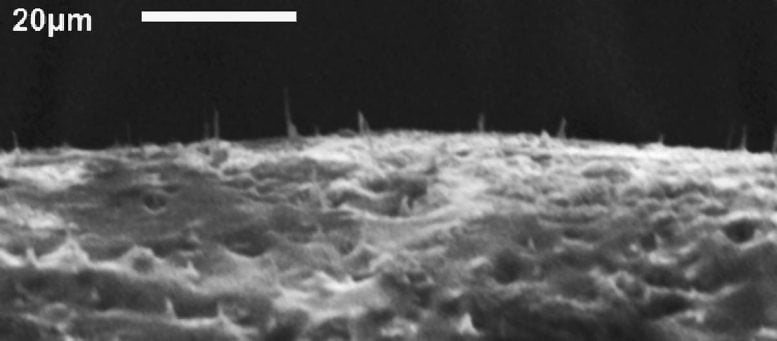
    Carbon Nanofiber Needles
    This image shows carbon nanofibers embedded in the elastic membrane. Credit: North Carolina State University

    In an effort to find a new way to deliver precise doses of drugs to specific targets, scientists at North Carolina State University developed a technique that embeds carbon nanofibers in an elastic silicone membrane, ensuring that the nanofibers are both perpendicular to the membrane’s surface and sturdy enough to impale cells.

    Researchers at North Carolina State University have come up with a technique to embed needle-like carbon nanofibers in an elastic membrane, creating a flexible “bed of nails” on the nanoscale that opens the door to development of new drug-delivery systems.

    The research community is interested in finding new ways to deliver precise doses of drugs to specific targets, such as regions of the brain. One idea is to create balloons embedded with nanoscale spikes that are coated with the relevant drug. Theoretically, the deflated balloon could be inserted into the target area and then inflated, allowing the spikes on the balloon’s surface to pierce the surrounding cell walls and deliver the drug. The balloon could then be deflated and withdrawn.

    But to test this concept, researchers first needed to develop an elastic material that is embedded with these aligned, nanoscale needles. That’s where the NC State research team came in.

    “We have now developed a way of embedding carbon nanofibers in an elastic silicone membrane and ensuring that the nanofibers are both perpendicular to the membrane’s surface and sturdy enough to impale cells,” says Dr. Anatoli Melechko, an associate professor of materials science and engineering at NC State and co-author of a paper on the work.

    The researchers first “grew” the nanofibers on an aluminum bed, or substrate. They then added a drop of liquid silicone polymer. The polymer, nanofibers and substrate were then spun, so that centrifugal force spread the liquid polymer in a thin layer between the nanofibers – allowing the nanofibers to stick out above the surface. The polymer was then “cured,” turning the liquid polymer into a solid, elastic membrane. Researchers then dissolved the aluminum substrate, leaving the membrane embedded with the carbon nanofibers’ “needles.”

    “This technique is relatively easy and inexpensive,” says Melechko, “so we are hoping this development will facilitate new research on targeted drug-delivery methods.”

    Reference: “Transfer of Vertically Aligned Carbon Nanofibers to Polydimethylsiloxane (PDMS) while Maintaining their Alignment and Impalefection Functionality” by Ryan C. Pearce, Justin G. Railsback, Bryan D. Anderson, Mehmet F. Sarac, Timothy E. McKnight, Joseph B. Tracy and Anatoli V. Melechko, 2 January 2013, ACS Applied Materials & Interfaces.
    DOI: 10.1021/am302501z

    Lead authors on the paper are Ryan Pearce, a Ph.D. student at NC State, and Justin Railsback, a former NC State student now pursuing a Ph.D. at Northwestern University. Co-authors are Melechko; Dr. Joseph Tracy, an assistant professor of materials science and engineering at NC State; Bryan Anderson and Mehmet Sarac, Ph.D. students at NC State; and Timothy McKnight of Oak Ridge National Laboratory.

    The research was supported by the National Science Foundation and the Department of Defense, Defense Threat Reduction Agency.

    Never miss a breakthrough: Join the SciTechDaily newsletter.
    Follow us on Google and Google News.

    Materials Science Nanotechnology North Carolina State University
    Share. Facebook Twitter Pinterest LinkedIn Email Reddit

    Related Articles

    Unique Property Found in Complex Nanostructures for the First Time

    New Drug Delivery Technique Uses Graphene to Deliver Anticancer Drugs

    Researchers Discover a Simple Way to Increase Solar Cell Efficiency

    Self-Assembling Polymer Molecules Create Complex Microchip Structures

    Repeating Patterns Dictate Optical Properties of Nanoparticle Arrays

    Spray Paint Battery Can be Painted on Virtually Any Surface

    Nano-Sandwich Design Results in Slimmer Solar Cells With Decreased Costs

    SLIPS Prevents Ice From Sticking on Metal Surfaces

    3D Self-Assembling Polymer Materials Could Lead to New Microchips

    Leave A Reply Cancel Reply

    • Facebook
    • Twitter
    • Pinterest
    • YouTube

    Don't Miss a Discovery

    Subscribe for the Latest in Science & Tech!

    Trending News

    The Universe Is Expanding Too Fast and Scientists Can’t Explain Why

    “Like Liquid Metal”: Scientists Create Strange Shape-Shifting Material

    Early Warning Signals of Esophageal Cancer May Be Hiding in Plain Sight

    Common Blood Pressure Drug Shows Surprising Power Against Deadly Antibiotic-Resistant Superbug

    Scientists Uncover Dangerous Connection Between Serotonin and Heart Valve Disease

    Scientists Discover a “Protector” Protein That Could Help Reverse Hair Loss

    Bone-Strengthening Discovery Could Reverse Osteoporosis

    Scientists Uncover Hidden Trigger Behind Stem Cell Aging

    Follow SciTechDaily
    • Facebook
    • Twitter
    • YouTube
    • Pinterest
    • Newsletter
    • RSS
    SciTech News
    • Biology News
    • Chemistry News
    • Earth News
    • Health News
    • Physics News
    • Science News
    • Space News
    • Technology News
    Recent Posts
    • A Common Diabetes Drug May Hold the Key to Stopping HIV From Coming Back
    • Ancient “Syphilis-Like” Disease in Vietnam Challenges Key Scientific Assumptions
    • Drinking Alcohol To Cope in Your 20s Could Damage Your Brain for Life
    • Scientists Crack Alfalfa’s Chromosome Mystery After Decades of Debate
    • Ancient Ant-Plant Alliance Collapses As Predatory Wasps Move In
    Copyright © 1998 - 2026 SciTechDaily. All Rights Reserved.
    • Science News
    • About
    • Contact
    • Editorial Board
    • Privacy Policy
    • Terms of Use

    Type above and press Enter to search. Press Esc to cancel.