

Close Menu
    Facebook X (Twitter) Instagram
    SciTechDaily
    • Biology
    • Chemistry
    • Earth
    • Health
    • Physics
    • Science
    • Space
    • Technology
    Facebook X (Twitter) Pinterest YouTube RSS
    SciTechDaily
    Home»Technology»Unique Property Found in Complex Nanostructures for the First Time
    Technology

    Unique Property Found in Complex Nanostructures for the First Time

    By University of Texas at AustinOctober 23, 20221 Comment3 Mins Read
    Facebook Twitter Pinterest Telegram LinkedIn WhatsApp Email Reddit
    Share
    Facebook Twitter LinkedIn Pinterest Telegram Email Reddit
    Graphene Nanotechnology Energy Illustration
    The property had previously only been found in simple nanostructures.

    The Intriguing Material Property Dissipates Energy

    Researchers from North Carolina State University and The University of Texas at Austin have discovered a unique property in complex nanostructures that had previously only been seen in simple nanostructures. They have also uncovered the internal mechanics of the materials that allow for this property to exist.

    The findings were reported in a recent paper that was published in the journal Proceedings of the National Academy of Sciences. The scientists found these properties in oxide-based “nanolattices,” which are tiny, hollow materials with a structure resembling that of sea sponges.

    “This has been seen before in simple nanostructures, like a nanowire, which is about 1,000 times thinner than a hair,” said Yong Zhu, a professor in the Department of Mechanical and Aerospace Engineering at NC State, and one of the lead authors on the paper. “But this is the first time we’ve seen it in a 3D nanostructure.”
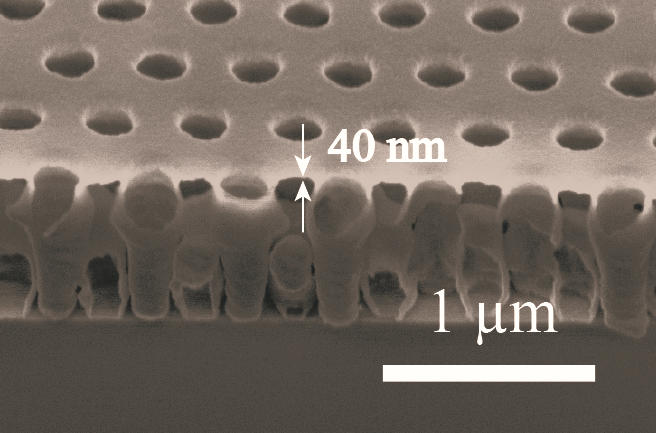
    Nanolattice
    Unique defects in a 3D material. Credit: The University of Texas at Austin/North Carolina State University

    The Research

    This phenomenon is referred to as anelasticity. It has to do with how materials respond over time to stress. When the materials investigated in this paper were bent, small defects moved slowly in response to the stress gradient. When the stress is released, the microscopic defects gradually return to their original locations, resulting in anelastic behavior.

    The researchers also found that these defects unlock energy dissipation characteristics when they move back and forth. This indicates that they have the ability to dissipate things like vibrations and pressure waves.

    Why it Matters

    The material could someday serve as a shock absorber, but because it’s so lightweight and thin, it would be on a very small scale. The researchers say it could make sense as part of chips for electronics or other integrated electronic devices.

    “You could potentially put this material under the semiconductor chips and protect them from outside impact or vibration,” said Chih-Hao Chang, an associate professor in the Walker Department of Mechanical Engineering at UT Austin.

    What’s Next

    Now that these anelastic characteristics have been discovered, the next step is to control them. The researchers will examine the geometry of the nanostructures and experiment with different loading conditions to see how to optimize the anelastic performance for energy dissipation applications.

    Reference: “Anelasticity in thin-shell nanolattices” by I-Te Chen, Felipe Robles Poblete, Abhijeet Bagal, Yong Zhu and Chih-Hao Chang, 12 September 2022, Proceedings of the National Academy of Sciences.
    DOI: 10.1073/pnas.2201589119

    The study was funded by the National Science Foundation. 

    Never miss a breakthrough: Join the SciTechDaily newsletter.
    Follow us on Google and Google News.

    Materials Science Nanostructures Nanotechnology North Carolina State University University of Texas at Austin
    Share. Facebook Twitter Pinterest LinkedIn Email Reddit

    Related Articles

    Scientists Develop “Super Sapphire” That Resists Scratches, Glare, Fog, and More

    New Drug Delivery Technique Uses Graphene to Deliver Anticancer Drugs

    Researchers Discover a Simple Way to Increase Solar Cell Efficiency

    Needle-Like Carbon Nanofibers May Aid in New Drug Delivery Systems

    Nano-Sandwich Design Results in Slimmer Solar Cells With Decreased Costs

    SLIPS Prevents Ice From Sticking on Metal Surfaces

    3D Self-Assembling Polymer Materials Could Lead to New Microchips

    Double-Walled Silicon Nanotube Battery Shows Promise

    Mapping the Pathways of Electrical Charge From Molecule to Molecule

    1 Comment

    1. alry on June 18, 2025 11:07 pm

      Fascinating read! Discovering a unique property in complex nanostructures for the first time is a major step forward in material science. It’s exciting to think how innovations like this could one day impact industries far beyond the lab—perhaps even influencing advanced construction techniques in places like naples florida, where high-tech architecture and sustainability are becoming increasingly important.

      Reply
    Leave A Reply Cancel Reply

    • Facebook
    • Twitter
    • Pinterest
    • YouTube

    Don't Miss a Discovery

    Subscribe for the Latest in Science & Tech!

    Trending News

    Your Blood Pressure Reading Could Be Wrong Because of One Simple Mistake

    Astronomers Stunned by Ancient Galaxy With No Spin

    Physicists May Be on the Verge of Discovering “New Physics” at CERN

    Scientists Solve 320-Million-Year Mystery of Reptile Skin Armor

    Scientists Say This Daily Walking Habit May Be the Secret to Keeping Weight Off After Dieting

    New Therapy Rewires the Brain To Restore Joy in Depression Patients

    Giant Squid Detected off Western Australia in Stunning Deep-Sea Discovery

    Popular Sugar-Free Sweetener Linked to Liver Disease, Study Warns

    Follow SciTechDaily
    • Facebook
    • Twitter
    • YouTube
    • Pinterest
    • Newsletter
    • RSS
    SciTech News
    • Biology News
    • Chemistry News
    • Earth News
    • Health News
    • Physics News
    • Science News
    • Space News
    • Technology News
    Recent Posts
    • Hidden Warm Water Beneath Antarctica Could Rapidly Raise Global Sea Levels
    • Scientists Revive Ancient Chemistry Trick To Engineer Next-Generation Glass
    • Scientists Use AI To Supercharge Ultrafast Laser Simulations by More Than 250x
    • Scientists Just Found a Surprising Way To Destroy “Forever Chemicals”
    • Popular Supplement Ingredient Linked to Shorter Lifespan in Men
    Copyright © 1998 - 2026 SciTechDaily. All Rights Reserved.
    • Science News
    • About
    • Contact
    • Editorial Board
    • Privacy Policy
    • Terms of Use

    Type above and press Enter to search. Press Esc to cancel.