
Close Menu
    Facebook X (Twitter) Instagram
    SciTechDaily
    • Biology
    • Chemistry
    • Earth
    • Health
    • Physics
    • Science
    • Space
    • Technology
    Facebook X (Twitter) Pinterest YouTube RSS
    SciTechDaily
    Home»Technology»Researchers Discover a Simple Way to Increase Solar Cell Efficiency
    Technology

    Researchers Discover a Simple Way to Increase Solar Cell Efficiency

    By Tracey Peake, North Carolina State UniversityJanuary 3, 2014No Comments3 Mins Read
    Facebook Twitter Pinterest Telegram LinkedIn WhatsApp Email Reddit
    Share
    Facebook Twitter LinkedIn Pinterest Telegram Email Reddit
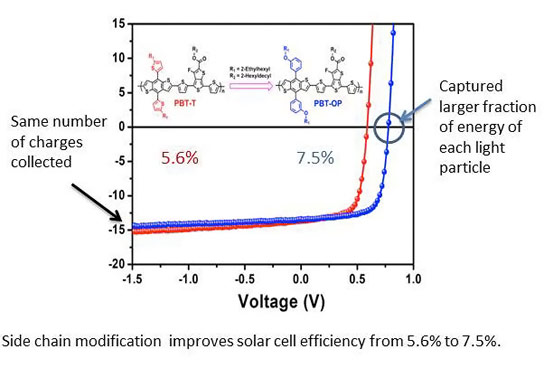
    Researchers Find a Simple Way to Increase Solar Cell Efficiency
    Scientists have discovered a simple method to alter the molecular structure of a polymer frequently employed in solar cells. This modification can enhance solar cell efficiency by over 30 percent. Credit: Maojie Zhang, et al. doi: 10.1002/adma.201304631

    By modifying the molecular structure of a polymer used in solar cells, an international team of researchers has increased solar efficiency by more than thirty percent.

    Researchers from North Carolina State University and the Chinese Academy of Sciences have found an easy way to modify the molecular structure of a polymer commonly used in solar cells. Their modification can increase solar cell efficiency by more than 30 percent.

    Polymer-based solar cells have two domains, consisting of an electron acceptor and an electron donor material. Excitons are the energy particles created by solar cells when light is absorbed. In order to be harnessed effectively as an energy source, excitons must be able to travel quickly to the interface of the donor and acceptor domains and retain as much of the light’s energy as possible.

    One way to increase solar cell efficiency is to adjust the difference between the highest occupied molecular orbit (HOMO) of the acceptor and lowest unoccupied molecular orbit (LUMO) levels of the polymer so that the exciton can be harvested with minimal loss. One of the most common ways to accomplish this is by adding a fluorine atom to the polymer’s molecular backbone, a difficult, multi-step process that can increase the solar cell’s performance, but has considerable material fabrication costs.

    A team of chemists led by Jianhui Hou from the Chinese Academy of Sciences created a polymer known as PBT-OP from two commercially available monomers and one easily synthesized monomer. Wei Ma, a post-doctoral physics researcher from NC State and corresponding author on a paper describing the research, conducted the X-ray analysis of the polymer’s structure and the donor:acceptor morphology.

    PBT-OP was not only easier to make than other commonly used polymers, but a simple manipulation of its chemical structure gave it a lower HOMO level than had been seen in other polymers with the same molecular backbone. PBT-OP showed an open circuit voltage (the voltage available from a solar cell) value of 0.78 volts, a 36 percent increase over the ~ 0.6 volts average from similar polymers.

    According to NC State physicist and co-author Harald Ade, the team’s approach has several advantages. “The possible drawback in changing the molecular structure of these materials is that you may enhance one aspect of the solar cell but inadvertently create unintended consequences in devices that defeat the initial intent,” he says. “In this case, we have found a chemically easy way to change the electronic structure and enhance device efficiency by capturing a larger fraction of the light’s energy, without changing the material’s ability to absorb, create and transport energy.”

    The researchers’ findings appear in Advanced Materials. The research was funded by the U.S. Department of Energy, Office of Science, Basic Energy Science, and the Chinese Ministry of Science and Technology. Dr. Maojie Zhang synthesized the polymers; Xia Guo, Shaoqing Zhang, and Lijun Huo from the Chinese Academy of Sciences also contributed to the work.

    Reference: “An Easy and Effective Method to Modulate Molecular Energy Level of the Polymer Based on Benzodithiophene for the Application in Polymer Solar Cells” by Maojie Zhang, Xia Guo, Wei Ma, Shaoqing Zhang, Lijun Huo, Harald Ade and Jianhui Hou, 17 December 2013, Advanced Materials.
    DOI: 10.1002/adma.201304631


    Never miss a breakthrough: Join the SciTechDaily newsletter.
    Follow us on Google and Google News.

    Green Technology Materials Science Nanotechnology North Carolina State University Renewable Energy Solar Cells
    Share. Facebook Twitter Pinterest LinkedIn Email Reddit

    Related Articles

    New Type of CNT Solar Cell is Twice as Efficient as Its Predecessors

    New 3D Graphene Material – An Inexpensive Replacement for Platinum in Solar Cells

    Disordered Nature of Plastic Polymers Can Improve Performance of Plastic Solar Cells

    Researchers Develop First Fully Integrated Nanosystem for Artificial Photosynthesis

    New Carbon Films Pave the Way for the Next Generation of Solar Cells

    First All Carbon Solar Cell Made From Nanotubes and Buckyballs

    Highly Transparent Polymer Solar Cell Produces Energy by Absorbing Near-Infrared Light

    Nano-Sandwich Design Results in Slimmer Solar Cells With Decreased Costs

    Textured Surface Maintains Efficiency and Reduces Thickness of Silicon Solar Cells

    Leave A Reply Cancel Reply

    • Facebook
    • Twitter
    • Pinterest
    • YouTube

    Don't Miss a Discovery

    Subscribe for the Latest in Science & Tech!

    Trending News

    Millions Take These IBS Drugs, But a New Study Finds Serious Risks

    Scientists Unlock Hidden Secrets of 2,300-Year-Old Mummies Using Cutting-Edge CT Scanner

    Bread Might Be Making You Gain Weight Even Without Eating More Calories

    Scientists Discover Massive Magma Reservoir Beneath Tuscany

    Europe’s Most Active Volcano Just Got Stranger – Here’s Why Scientists Are Rethinking It

    Alzheimer’s Symptoms May Start Outside the Brain, Study Finds

    Millions Take This Popular Supplement – Scientists Discover a Concerning Link to Heart Failure

    The Universe Is Expanding Too Fast and Scientists Can’t Explain Why

    Follow SciTechDaily
    • Facebook
    • Twitter
    • YouTube
    • Pinterest
    • Newsletter
    • RSS
    SciTech News
    • Biology News
    • Chemistry News
    • Earth News
    • Health News
    • Physics News
    • Science News
    • Space News
    • Technology News
    Recent Posts
    • Doctors Surprised by the Power of a Simple Drug Against Colon Cancer
    • Why Popular Diabetes Drugs Like Ozempic Don’t Work for Everyone: The “Genetic Glitch”
    • Scientists Create Improved Insulin Cells That Reverse Diabetes in Mice
    • Scientists Stunned After Finding Plant Thought Extinct for 60 Years
    • A Common Diabetes Drug May Hold the Key to Stopping HIV From Coming Back
    Copyright © 1998 - 2026 SciTechDaily. All Rights Reserved.
    • Science News
    • About
    • Contact
    • Editorial Board
    • Privacy Policy
    • Terms of Use

    Type above and press Enter to search. Press Esc to cancel.