
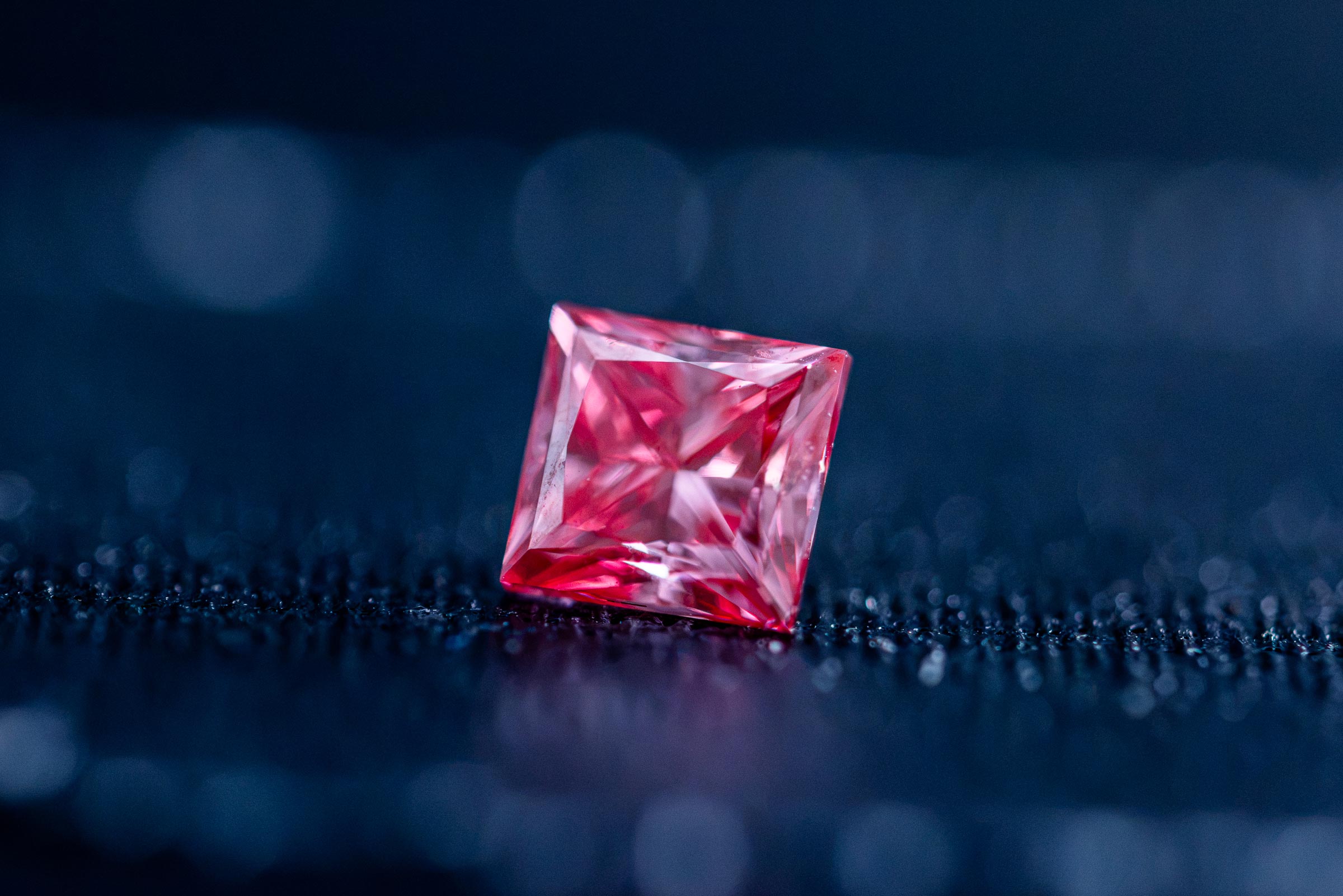
By modeling diamond defects as molecules, scientists can predict their behavior faster and identify promising building blocks for quantum computers and sensors.
Most materials being considered for quantum technology can hold a stable quantum state only when chilled to extreme temperatures. Diamond-based materials can work at room temperature, but their usefulness depends on defects in the crystal that have been difficult and computationally demanding to simulate.
At the U.S. Department of Energy’s (DOE) Princeton Plasma Physics Laboratory (PPPL), staff research scientist Mark Martirez has developed a far faster way to calculate how those defects respond to light and microwave pulses. The approach has identified promising boron- and oxygen-based defects that could serve as qubits, the basic information-processing units of quantum computers and sensors. The research was recently published in ACS Central Science and has already attracted attention from other experts in the field.
Diamond’s flaws can store quantum information
Pure diamond consists entirely of carbon atoms, but storing and processing quantum information requires a disruption in that structure. A carbon atom might be missing from its usual position, an atom of another element might take its place, or both changes might occur together. The cluster of atoms closest to the defect forms the qubit.
Scientists use laser light and microwave pulses to read information stored in these qubits. Most quantum diamond research has focused on the nitrogen-vacancy defect, in which a nitrogen atom replaces a carbon atom and a nearby position normally occupied by another carbon atom is empty. When illuminated by a laser, this qubit emits red light if it is in a particular quantum state. Calculating how other defects respond to light and microwaves helps researchers assess whether they, too, could be useful.
Molecular models identify new qubit candidates
Martirez simplifies those calculations by computationally “carving out” a cluster of just 16 to 30 atoms around a defect and considering it in isolation. This makes highly accurate tools that chemists have used for decades to study simple compounds available for studying defects inside a solid.
“Because we’re treating the qubits as molecules, the cost of calculating these defects is equivalent to the cost of just modeling a simple molecule,” Martirez said. “This method really opened the floodgates” in terms of how qubits can be assessed.
The calculations identified oxygen-based defects that shine blue and boron-based defects that emit ultraviolet light. These defects, known as color centers, could potentially serve different roles within a single quantum device.
“One could imagine, then, combining different qubits of different responses, so you can basically probe one qubit but not the other,” Martirez said.
Chemistry’s path to custom qubits
Understanding the chemistry could also change how researchers conceive of a qubit’s structure. Diamond-based qubits are often treated as a physics problem, but Martirez’s work shows that chemistry offers another way to understand them. A fuller chemical understanding could let scientists design and build qubits for specific purposes, much as chemists design custom molecules, such as a new medication.
Martirez encouraged other chemists to bring their expertise into solid-state physics. “At this moment in time, there’s a great emphasis on building the first state-of-the-art qubit computer,” he said. “But it’s not just physicists who should be participating in this research. Chemists have decades of developed intuition about chemical systems that could be easily translated into understanding defects in solids as well.”
Practical quantum devices could eventually support sensors with greater sensitivity and accuracy than those currently available, along with computers capable of tackling highly complex problems far faster than today’s conventional supercomputers. Developing these future technologies is among the strategic national priorities PPPL works to advance.
For quantum chemistry, that progress could create a useful cycle. The field could help develop tools that allow it to “enrich itself” in the decades ahead, Martirez said. He expects a practical system containing multiple qubits to greatly improve the accuracy of quantum chemistry calculations.
“We could describe larger molecules, biomolecules, proteins, and everything like that in a more accurate way, and that could improve all the chemical-adjacent industries, such as pharmaceutical science and materials science. Even our fundamental understanding of molecular systems could be enriched.”
Reference: “A Chemist’s Guide to Solid-State Qubits: Diamond Color Centers as Embedded Vacancy-Centered Molecules” by John Mark P. Martirez, July 27, 2026, ACS Central Science.
DOI: 10.1021/acscentsci.6c00548
Funding for this research comes from PPPL’s Laboratory Directed Research and Development under prime contract number DE-AC02-09CH11466, as well as additional support from DOE Office of Science, Office of Fusion Energy Sciences.
Never miss a breakthrough: Join the SciTechDaily newsletter.
Follow us on Google and Google News.