
Ancient black holes may hold vital clues to the nature of dark matter.
An ancient black hole no larger than an atom could consume a star from within and eventually trigger a spectacular explosion. New simulations by physicists at MIT and collaborating institutions suggest that these events could produce detectable bursts of radiation, offering a possible way to discover black holes formed shortly after the Big Bang.
The findings, published in The Astrophysical Journal, could also help scientists investigate dark matter, the invisible substance that makes up most of the universe’s matter.
Ancient Black Holes Hidden in the Universe
Primordial black holes may have formed when exceptionally dense regions collapsed under gravity during the first fraction of a second after the Big Bang. The smallest would have evaporated through Hawking radiation, but heavier examples could survive today. Some might be as small as an atom yet contain the mass of an asteroid (or about a millionth of the mass of the Earth).
The researchers investigated what would happen if one of these black holes encountered a Sun-like star. Although a star’s gravity alone would not capture a passing black hole, interactions involving a companion star or planet could trap it. Repeated passages through the star would gradually reduce its orbital energy, allowing it to settle into the stellar core over thousands to millions of years.
“Then, this is where the action begins,” says lead author Ore Gottlieb, an assistant professor of physics at MIT.
How a Tiny Black Hole Could Destroy a Star
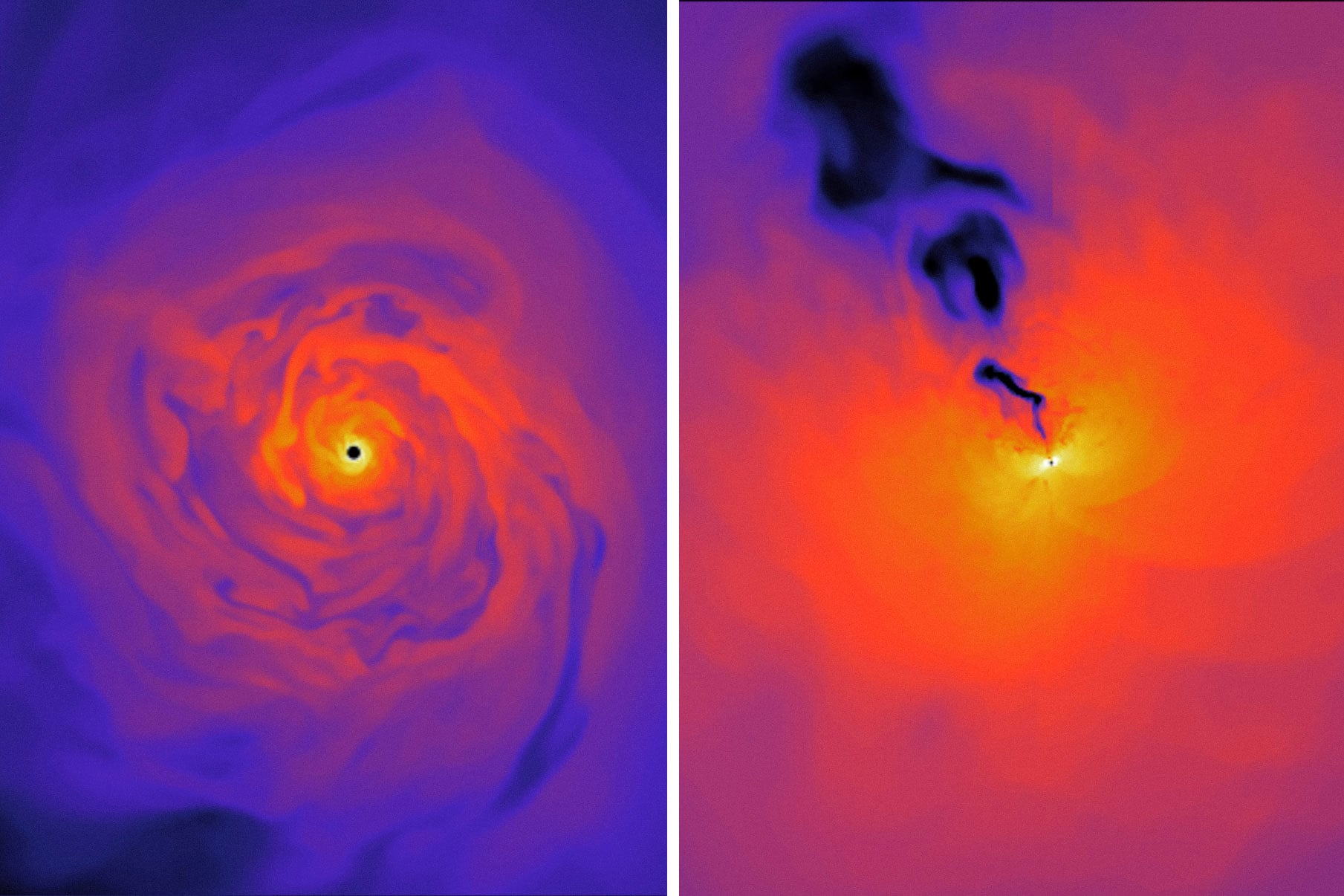
The team’s three-dimensional simulations suggest that a captured black hole could grow by consuming stellar material. Within several million years, it might absorb approximately 1 percent of the star’s mass. If the star rotates fast enough, the remaining gas would form a spinning disk around the black hole.
“Inside the star, you have a black hole with a disk,” Gottlieb says. “The black hole is also spinning, and it’s twisting space and time.”
As material spirals inward, the black hole would twist magnetic fields in the surrounding disk, generating powerful jets capable of tearing through the star.
“Once the disk forms, this is essentially a death sentence for the star,” Gottlieb says.
“This twisted magnetic field will power very strong electromagnetic jets from the poles of the black hole,” Gottlieb explains. “And these jets will just explode the star, within a few dozen seconds. It’s very fast. Once you have a disk, you are done.”
A New Way to Search for Dark Matter
The resulting explosion could produce a brilliant flash of blue and ultraviolet light, along with X-rays and gamma rays. As the event evolves, its emissions would shift across the electromagnetic spectrum.
“We would initially detect some X-rays and gamma rays, then over time optical and infrared emissions, and later on radio emissions,” Gottlieb says. “This is something we could potentially detect, if it’s not happening too far from us. It could be many galaxies away, not just in our backyard.”
Other cosmic explosions can produce similar signals, so astronomers would need additional evidence to identify a primordial black hole. One possible clue would be an explosion involving a star that would not normally be expected to explode.
“For instance, if the star is a certain mass that is not supposed to explode, it must be something that is happening inside that is a sort of parasite that is consuming the star from the inside,” Gottlieb says.
No primordial black hole has yet been confirmed through this mechanism, but the predicted signals could guide future observations.
“There is hope for us to probe primordial black holes through interactions with stars,” Gottlieb says. “We expect this to be visible, and it’s something we should look into.”
“The broader impact is that we can now place constraints on primordial black holes, and their contributions to dark matter, using observations.”
Reference: “The Life and Death of Stars that Capture Primordial Black Holes” by Ore Gottlieb, Matteo Cantiello, Cameron Norton, Ken Van Tilburg and Matthew Kleban, 19 November 2026, The Astrophysical Journal.
DOI: 10.3847/1538-4357/aeb7e1
This work was supported, in part, by the U.S. Department of Energy Office of Science Advanced Scientific Computing Research Program, and by the National Science Foundation.
Never miss a breakthrough: Join the SciTechDaily newsletter.
Follow us on Google and Google News.