
Before electrical power became available, water fountains worked by relying on gravity to channel water from a higher elevation to a lower one. This water could then be redirected to shoot out of the fountain and create a centerpiece for people to admire.
In space, awesome gaseous fountains have been discovered in the centers of galaxy clusters. One such fountain is in the cluster Abell 2597. There, vast amounts of gas fall toward a supermassive black hole, where a combination of gravitational and electromagnetic forces sprays most of the gas away from the black hole in an ongoing cycle lasting tens of millions of years.
Scientists used data from the Atacama Large Millimeter/submillimeter Array (ALMA), the Multi-Unit Spectroscopic Explorer (MUSE) on ESO’s Very Large Telescope (VLT) and NASA’s Chandra X-ray Observatory to find the first clear evidence for the simultaneous inward and outward flow of gas being driven by a supermassive black hole.
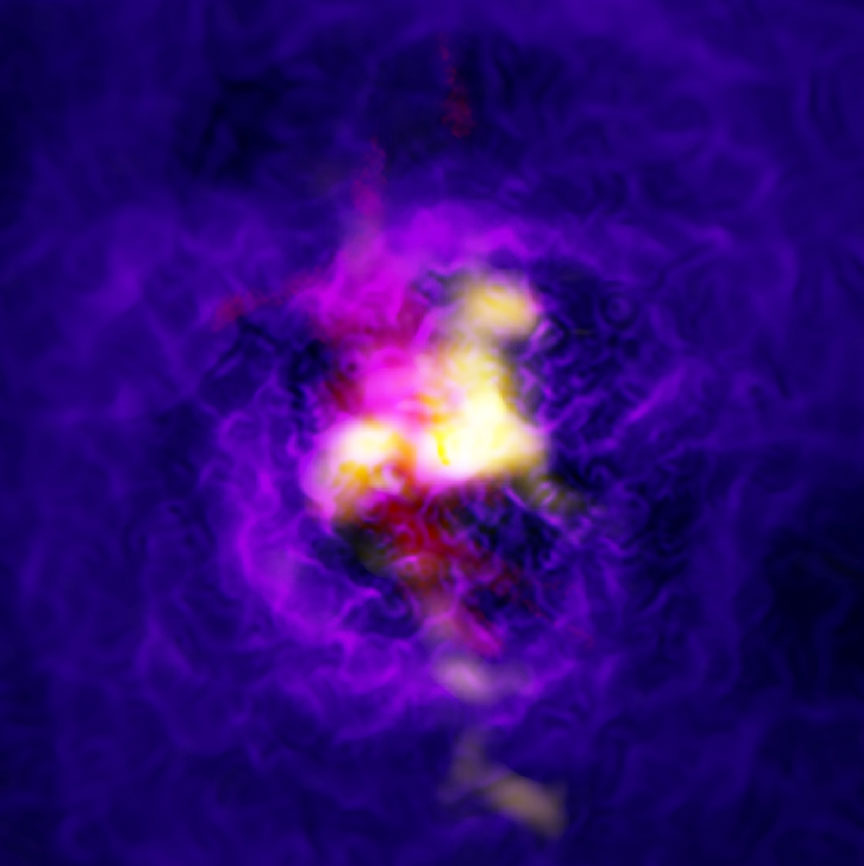
Cold gas falls toward the central black hole, like water entering the pump of a fountain. Some of this infalling gas (seen in the image as ALMA data in yellow) eventually reaches the vicinity of the black hole, where the black hole’s gravity causes the gas to swirl around with ever-increasing speeds, and the gas is heated to temperatures of millions of degrees. This swirling motion also creates strong electromagnetic forces that launch high-velocity jets of particles that shoot out of the galaxy.
These jets push away huge amounts of hot gas detected by Chandra (purple) surrounding the black hole, creating enormous cavities that expand away from the center of the cluster. The expanding cavities also lift up clumps of warm and cold gas and carry them away from the black hole, as observed in the MUSE/VLT data (red).
Eventually, this gas slows down and the gravitational pull of material in the center of the galaxy causes the gas to rain back in on the black hole, repeating the entire process.
A substantial fraction of the three billion solar masses of gas are pumped out by this fountain and form a filamentary nebula — or cosmic “spray” — that spans the innermost 100,000 light-years of the galaxy.
These observations agree with predictions of models describing how matter falling towards black holes can generate powerful jets. Galaxy clusters like Abell 2597, containing thousands of galaxies, hot gas, and dark matter, are some of the largest structures in the entire Universe. Abell 2597 is located about 1.1 billion light-years from Earth.
A paper by Grant Tremblay (Harvard-Smithsonian Center for Astrophysics) et al. describing these results appeared in the September 18, 2018 issue of The Astrophysical Journal. NASA’s Marshall Space Flight Center in Huntsville, Alabama, manages the Chandra program for NASA’s Science Mission Directorate in Washington. The Smithsonian Astrophysical Observatory in Cambridge, Massachusetts, controls Chandra’s science and flight operations.
Paper: “A Galaxy-Scale Fountain of Cold Molecular Gas Pumped by a Black Hole” by G. R. Tremblay, F. Combes, J. B. R. Oonk, H. R. Russell, M. A. McDonald, M. Gaspari, B. Husemann, P. E. J. Nulsen, B. R. McNamara, S. L. Hamer, C. P. O’Dea, S. A. Baum, T. A. Davis, M. Donahue, G. M. Voit, A. C. Edge, E. L. Blanton, M. N. Bremer, E. Bulbul1, T. E. Clarke, L. P. David, L. O. V. Edwards, D. Eggerman, A. C. Fabian, W. Forman, C. Jones, N. Kerman, R. P. Kraft, Y. Li, M. Powell, S. W. Randall, P. Salomé, A. Simionescu, Y. Su1, M. Sun, C. M. Urry, A. N. Vantyghem, B. J. Wilkes and J. A. ZuHone, 17 September 2018, The Astrophysical Journal.
DOI: 10.3847/1538-4357/aad6dd
Never miss a breakthrough: Join the SciTechDaily newsletter.
Follow us on Google and Google News.
1 Comment
I wonder if we are not seeing the supposed ‘companion’ of a black hole claimed to be orbiting the hole and extracting gas?