

Residents of northern California won’t have to worry about prisoners escaping from the Alameda County’s Santa Rita Jail in the event of a major earthquake. This “mega-jail” has its own microgrid that is being optimized by scientists from the Berkeley Lab using software they developed called DER-CAM.
When the next “big one” hits northern California, chances are good that the power will be knocked out across large swaths of the Bay Area. But one place that is likely to stand unaffected is Alameda County’s Santa Rita Jail in Dublin, California, the third largest jail in the state and fifth largest in the country. If all goes according to plan, this “mega-jail,” housing about 4,000 inmates, will seamlessly disconnect itself from the electric grid and switch over to its own microgrid, powering itself for the duration.
Scientists at the Department of Energy’s Lawrence Berkeley National Laboratory (Berkeley Lab) are using software they developed called DER-CAM (Distributed Energy Resources-Customer Adoption Model), which looks at electricity and heat requirements, to help analyze and develop an optimal plan for the Jail to meet its needs at minimum cost.
“Microgrids have several promising advantages,” said Berkeley Lab scientist Chris Marnay. “Number one is that they can be tailored to local requirements, so in the case of the jail, the microgrid can help them achieve the extreme reliability their mission demands.”
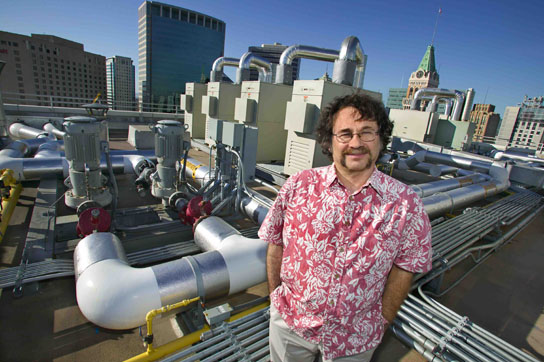
This demonstration project—led by Chevron Energy Solutions and funded in part by a $6.9 million grant from the Department of Energy with additional funding from the California Energy Commission, the California Public Utilities Commission, and others—is aimed at modernizing the nation’s electricity grid. Berkeley Lab is collaborating with a number of additional entities on the project, including Alameda County, Pacific Gas & Electric, the University of Wisconsin, and the National Renewable Energy Laboratory. The microgrid at the jail became operational at the end of the last year and is to be unveiled on March 22.
As Hurricane Irene and other natural disasters have shown, blackouts can cause severe disruptions and major financial losses. “Without power you don’t have phones, transportation, water treatment, and so on. And without communications other things don’t work,” said Marnay, who leads the jail project for Berkeley Lab. “The motivation for doing localized generation is in part to survive outages and improve local power quality.”
The Santa Rita Jail has intensive electricity needs, with peak demand reaching about 3.0 megawatts (MW), so energy efficiency has long been part of the Jail’s strategy. Various energy efficiency measures over the past 20 years have effectively lowered the jail’s electrical needs by 40 percent. To lower its reliance on the grid, the jail boasts a 1.2-MW rooftop solar system (which was the largest in the U.S. when installed in 2002), a 1-MW molten carbonate fuel cell, and five small wind generators.
The microgrid’s newly installed 2-MW lithium ferrous phosphate battery can carry the load during a power outage without turning on backup generators. During long outages, when the battery’s storage is depleted, the microgrid will turn on the generators at full speed, and effectively power the jail and simultaneously charge the batteries.
The DER-CAM software was used to come up with an optimal schedule for charging and discharging the battery so as to minimize costs. Based on this analysis and other research, DER-CAM is already being used to directly control the large solar thermal system in the Mechanical Engineering Building on the University of New Mexico campus. The same approach has also been selected by the U.S. Department of Defense to optimize charging of a fleet of plug-in electric vehicles to be deployed at the Los Angeles Air Force Base.
“We are excited to be hosting one of the first-of-its-kind, large-scale microgrids,” said Matt Muniz, Alameda County’s Energy Program Manager. “We believe that this demonstration project will successfully exhibit the numerous advantages of microgrids and will be a model for both public agencies and private companies to emulate.”
The batteries are also used to provide energy storage, allowing the jail to buy electricity during less expensive off-peak times and minimize the jail’s energy consumption during the peak periods in the summer. When the fuel cell, solar panels, and wind turbines are operating, they will be integrated by the microgrid to maximize their utilization in powering the jail.
The technology that allows the microgrid to seamlessly disconnect itself from the grid and function as an island and then reconnect is the CERTS Microgrid, which was developed by the Consortium for Electric Reliability Technology Solutions at the University of Wisconsin under a decade-long research program managed by Berkeley Lab.
In future work funded by the California Energy Commission, Berkeley Lab’s Demand Response Research Center will explore options for the jail to control its loads to further lower costs and potentially provide support to the grid.
Of course, the microgrid can also function when it’s connected to the grid, allowing the Jail to reduce its electricity bill as well as lowering the load on the local electricity distribution network. “Part of this grant is to demonstrate the ability to lower the electrical load on the neighboring PG&E feeder, which is part of the electricity distribution system from the substation to the meter,” Marnay said. “So the Jail can coordinate with nearby loads such that the overall peak load on that feeder is reduced, which is another way of saying that it provides a big financial benefit to the utility because it postpones them having to upgrade their equipment to increase capacity.”
Besides reliability, microgrids offer several other advantages. One is that they can be tailored to take advantage of local resources, such as the sun or wind. Integrating small and uncontrollable renewables into our legacy grid is tricky because of the requirement that supply and demand must constantly be in balance while these resources vary continuously.
“This thinking leads to the most controversial advantage, by far, which is that we may be able to live with a less reliable grid because highly sensitive loads, such as the Jail, are served in a more localized fashion,” Marnay said. “To me, that’s where the huge advantage lies, in unshackling the traditional grid. With our current system, the grid has no feasible way to differentiate and prioritize between a recharging iPhone and hospital life-saving equipment.”
Along with hospitals and university campuses, another sector very interested in microgrids is the military, for which energy security and reliability are paramount. Earlier last year, DOE announced new steps to enhance cooperation with the Department of Defense (DOD) on clean energy and energy security, including cost-effective energy storage. Marnay’s next big project at the Los Angeles Air Force Base is only one of several current and planned DOD microgrid demonstrations.
Never miss a breakthrough: Join the SciTechDaily newsletter.
Follow us on Google and Google News.