
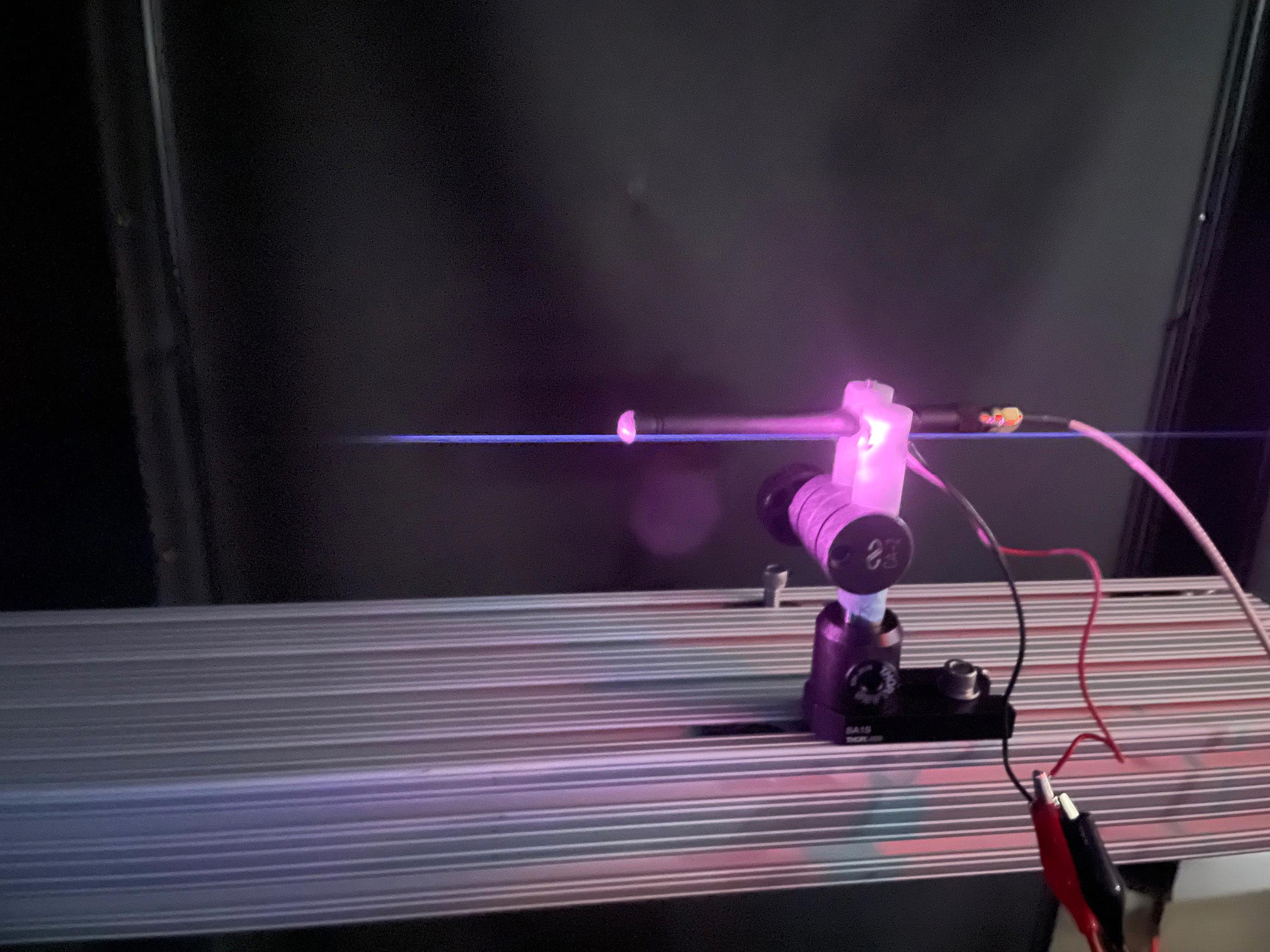
A plasma antenna resembling a lightsaber has transmitted radio waves and could let future spacecraft retune and redirect their antennas by adjusting a laser.
Changing a radio antenna’s length can be difficult in space exploration equipment, even though that dimension helps determine which frequencies it can transmit and receive. Researchers have now demonstrated a possible alternative by transmitting radio waves with an antenna made from a laser-generated column of plasma.
“One of the questions we wanted to explore with this work was whether it would be possible to create plasma antennas using lasers, which would allow us to generate antennas at whatever length was needed,” says Prya Darshni, corresponding author of the journal article describing the work and a Ph.D. student at North Carolina State University. “And we have now shown that it is possible.”
An antenna shaped by light
With a specific power and beam diameter, a laser ionizes a thin column of air, turning it into plasma, a gas containing electrically charged particles. The resulting shaft is called a plasma filament.
“By controlling the parameters of the laser, you can control the characteristics of the plasma filament – including its length,” says Darshni. “This is valuable for applications where you need an antenna that can sweep all frequencies. But there’s another benefit as well.
“There are also applications where it is important to be able to control the angle of the antenna, in order to target the direction of radar sweeps or to improve the strength of a signal you want to pick up,” says Darshni. “The technique we’ve demonstrated here would allow users to control the angle of the plasma filament antenna via beam steering – simply shifting the direction of the laser.”
Feeding a plasma antenna without contact
To supply the filament with a radio signal, the team built and demonstrated a contactless antenna feed using a metal ring. The laser passes through the ring’s opening, leaving the ring surrounding the plasma filament. Acting as a capacitor, the ring receives a signal from a radio frequency generator and produces an electromagnetic field. That field interacts with the plasma, causing it to transmit radio waves at the appropriate frequency without physical contact between the ring and the filament.
“The plasma beam antenna looks like a lightsaber and is tunable, meaning we should be able to transmit across a broad range of frequencies,” says Darshni. “And while we have not demonstrated its ability to serve as an antenna that can receive radio signals, there’s no reason to believe it wouldn’t also work as a receiver.”
Space use depends on available air
Satellites and other space exploration technologies are among the potential long-term applications, since both payload and the ability to scan across many frequencies matter for those systems.
“This is an exciting new concept that enables one to be able to have a customized antenna without complex mechanical deployment mechanisms,” says Paul Franzon, co-author of the paper and the Cirrus Logic Distinguished Professor of Electrical and Computer Engineering at NC State.
Space use would also require enough air for the laser to create the filament. “In low earth orbit, there is sufficient air to form a plasma,” says Franzon.
“This is the first step, but it is a big step – it is the first time anyone has ever demonstrated that plasma-filament antennas can work,” says Darshni. “Now that we’ve shown it is possible, we can begin improving its performance.”
Reference: “Laser-Induced-Plasma-Filament Antenna Transmitting 30 MHz VHF” by Prya Darshni, Arthur Dogariu and Paul D. Franzon, 01 September 2026, IEEE Journal of Microwaves.
DOI: 10.1109/JMW.2026.3722433
Never miss a breakthrough: Join the SciTechDaily newsletter.
Follow us on Google and Google News.