
Close Menu
    Facebook X (Twitter) Instagram
    SciTechDaily
    • Biology
    • Chemistry
    • Earth
    • Health
    • Physics
    • Science
    • Space
    • Technology
    Facebook X (Twitter) Pinterest YouTube RSS
    SciTechDaily
    Home»Technology»Ultra-Strong Artificial Muscles Made From Carbon Nanotubes
    Technology

    Ultra-Strong Artificial Muscles Made From Carbon Nanotubes

    By SciTechDailyNovember 16, 2012No Comments2 Mins Read
    Facebook Twitter Pinterest Telegram LinkedIn WhatsApp Email Reddit
    Share
    Facebook Twitter LinkedIn Pinterest Telegram Email Reddit
    ultra-strong-carbon-nanotube-muscle
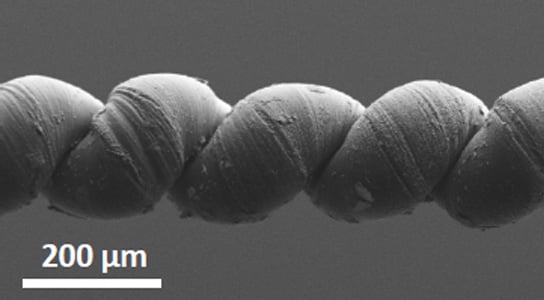
    UT Dallas researchers have made artificial muscles from carbon nanotube yarns that have been infiltrated with paraffin wax and twisted until coils form along their length. The diameter of this coiled yarn is about twice the width of a human hair. Credit: UT Dallas

    In order to showcase ultra-strong artificial muscles, Ray Baughman from the University of Texas at Dallas and his colleagues built a catapult.

    The scientists published their findings in the journal Science. The device contains yarns similar in diameter to human hair, spun from carbon nanotubes and soaked in paraffin wax. When a current is passed through the yarn, the wax heats up and expands. As the yarn swells, its particular helical weave causes it to shorten, and the muscle contracts. As it cools, the yarn relaxes and returns to its original length. When coiled lightly or heated to high enough temperatures, wax-free yarns behave in the same fashion.

    The torque produced by the twisting and untwisting of the yarns is sufficient to power a miniature catapult. The yarn can haul 200 times the weight that a natural muscle of the same size can, and generates more torque than a large electric motor if compared by weight. Currently, the available manufacturing techniques have limited the weight of the yarn. They can make yarn that lifts up 50 grams. That doesn’t sound like much, but researchers have shown the nanotube yarns lifting loads as much as 50,000 times greater than their own weight.

    The yarn could be used as actuators in microfluidic systems or as components in optical cameras, within 2 years. They could also be used as intelligent sensors.


    Video courtesy of The Alan G. MacDiarmid NanoTech Institute, The University of Texas at Dallas.

    Reference: “Electrically, Chemically, and Photonically Powered Torsional and Tensile Actuation of Hybrid Carbon Nanotube Yarn Muscles” by Márcio D. Lima, Na Li, Mônica Jung de Andrade, Shaoli Fang, Jiyoung Oh, Geoffrey M. Spinks, Mikhail E. Kozlov, Carter S. Haines, Dongseok Suh, Javad Foroughi, Seon Jeong Kim, Yongsheng Chen, Taylor Ware, Min Kyoon Shin, Leonardo D. Machado, Alexandre F. Fonseca, John D. W. Madden, Walter E. Voit, Douglas S. Galvão and Ray H. Baughman,
    16 November 2012, Science.
    DOI: 10.1126/science.1226762

    Never miss a breakthrough: Join the SciTechDaily newsletter.
    Follow us on Google and Google News.

    Engineering Nanotechnology Nanotubes Robotics
    Share. Facebook Twitter Pinterest LinkedIn Email Reddit

    Related Articles

    Less Than 1 Centimeter: Engineers Create World’s Smallest Wireless Flying Robot

    “Particle Robots” Form Large Groups to Complete Tasks

    MIT Researchers Create Perfect Nanoscrolls from Graphene Oxide

    Stanford Engineers Improve Flexible Carbon Nanotube Circuits

    Engineers Build a Carbon Nanotube Computer

    Nanosponges May Help With Environmental Cleanup

    Analyzing the Environmental Costs and Impacts of Technology

    Carbon Nanotubes Increase the Speed of Biological Sensors

    Researchers Find Maximum Nanotube Brightness is Proportional to Length

    Leave A Reply Cancel Reply

    • Facebook
    • Twitter
    • Pinterest
    • YouTube

    Don't Miss a Discovery

    Subscribe for the Latest in Science & Tech!

    Trending News

    New Pill Lowers Stubborn Blood Pressure and Protects the Kidneys

    Humans May Have Hidden Regenerative Powers, New Study Suggests

    Scientists Just Solved the Mystery of Why Crabs Walk Sideways

    Doctors Are Surprised by What This Vaccine Is Doing to the Heart

    This Popular Supplement May Boost Your Brain, Not Just Your Muscles

    Scientists Say This Simple Supplement May Actually Reverse Heart Disease

    Warming Oceans Could Trigger a Dangerous Methane Surge

    This Simple Movement Could Be Secretly Cleaning Your Brain

    Follow SciTechDaily
    • Facebook
    • Twitter
    • YouTube
    • Pinterest
    • Newsletter
    • RSS
    SciTech News
    • Biology News
    • Chemistry News
    • Earth News
    • Health News
    • Physics News
    • Science News
    • Space News
    • Technology News
    Recent Posts
    • Scientists Discover Cheap Material That Kills Deadly Superbugs
    • This Magnetic Field Trick Creates Entirely New Forms of Matter
    • Astronomers Stunned by Ancient Galaxy With No Spin
    • Physicists May Be on the Verge of Discovering “New Physics” at CERN
    • AI Learns To Work Backward and Reveal Hidden Forces in Nature
    Copyright © 1998 - 2026 SciTechDaily. All Rights Reserved.
    • Science News
    • About
    • Contact
    • Editorial Board
    • Privacy Policy
    • Terms of Use

    Type above and press Enter to search. Press Esc to cancel.