
Close Menu
    Facebook X (Twitter) Instagram
    SciTechDaily
    • Biology
    • Chemistry
    • Earth
    • Health
    • Physics
    • Science
    • Space
    • Technology
    Facebook X (Twitter) Pinterest YouTube RSS
    SciTechDaily
    Home»Earth»Massive Methane Leak Visible From Space
    Earth

    Massive Methane Leak Visible From Space

    By European Space Agency (ESA)December 20, 2019No Comments3 Mins Read
    Facebook Twitter Pinterest Telegram LinkedIn WhatsApp Email Reddit
    Share
    Facebook Twitter LinkedIn Pinterest Telegram Email Reddit
    Methane Leak Visible From Space
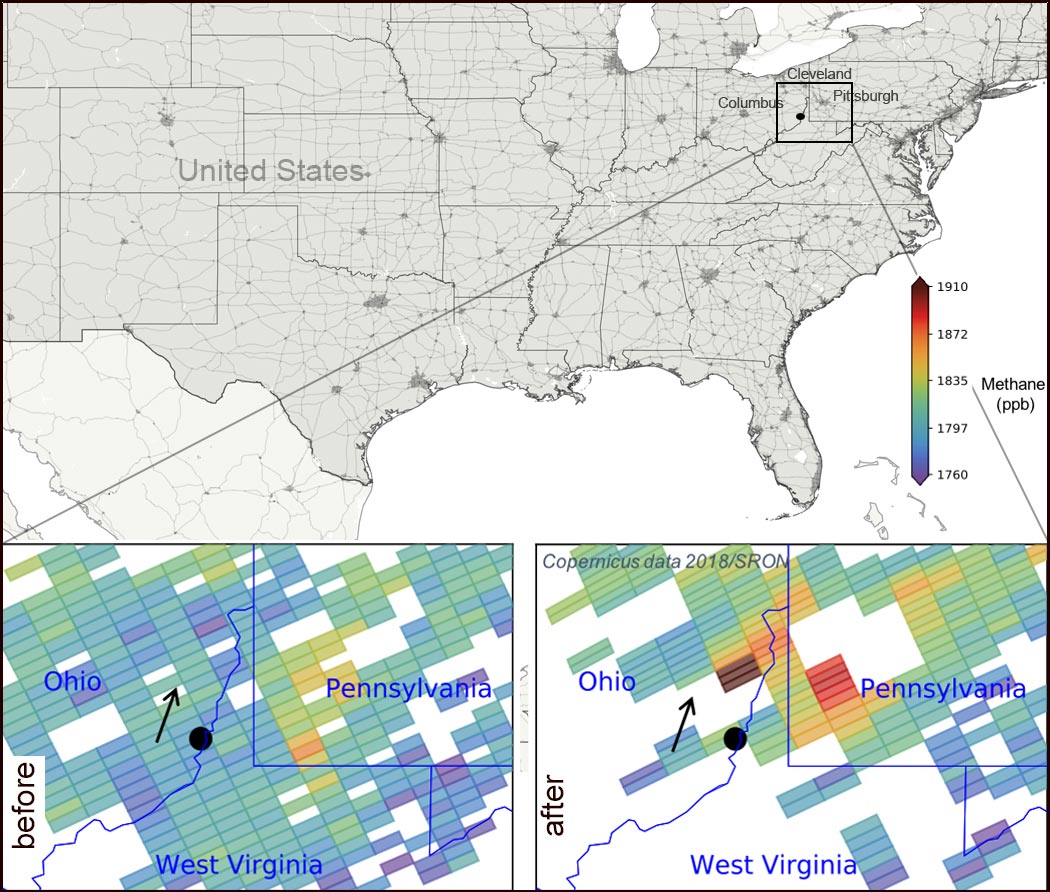
    Data from the Copernicus Sentinel-5P satellite revealed that an explosion in a natural gas well in Ohio in February 2018 released more than 50,000 tons of methane into the atmosphere. The location of the explosion is marked by a black dot in the image, and shows the methane emissions before and after the blowout. The black arrow indicates the wind direction and the direction of the methane plume. Credit: ESA, contains modified Copernicus Sentinel data (2018), processed by SRON

    Data from the Copernicus Sentinel-5P satellite revealed that an explosion in a natural gas well in Ohio in February 2018 released more than 50,000 tons of methane into the atmosphere. The blowout leaked more of this potent greenhouse gas in 20 days than the majority of many European nations do in a year from their oil and gas industries.

    The findings were published in a study in the Proceedings of the National Academy of Sciences on December 16, 2019, and the study reveals the importance of using satellite data to detect and quantify pollutants such as methane. Data from the Copernicus Sentinel-5P’s Tropomi instrument revealed that 120 tons of methane were emitted per hour due to the blowout.

    While carbon dioxide is more abundant in the atmosphere and therefore more commonly associated with global warming, methane is about 30 times more potent as a heat-trapping gas.

    The location of the explosion is marked by a black dot in the image, and shows the methane emissions before and after the blowout. The black arrow indicates the wind direction and the direction of the methane plume.

    Claus Zehner, ESA’s Copernicus Sentinel-5P mission manager, comments, “These Sentinel-5P measurements show that satellites can measure the concentrations of greenhouse gases emitted by a point source. The satellite’s capabilities will be further exploited with the upcoming Copernicus Carbon Dioxide Monitoring mission.”

    While carbon dioxide is more abundant in the atmosphere and therefore more commonly associated with global warming, methane is about 30 times more potent as a heat-trapping gas. It usually enters the atmosphere mainly from the fossil fuel industry, landfill sites, livestock farming, rice agriculture, and wetlands – but can also be released during oil and gas extraction.

    Sentinel-5P, with its state-of-the-art instrument Tropomi, can also map other pollutants such as nitrogen dioxide, carbon monoxide, sulfur dioxide, and aerosols – all of which affect the air we breathe and our climate.

    Reference: “Satellite observations reveal extreme methane leakage from a natural gas well blowout” by Sudhanshu Pandey, Ritesh Gautam, Sander Houweling, Hugo Denier van der Gon, Pankaj Sadavarte, Tobias Borsdorff, Otto Hasekamp, Jochen Landgraf, Paul Tol, Tim van Kempen, Ruud Hoogeveen, Richard van Hees, Steven P. Hamburg, Joannes D. Maasakkers and Ilse Aben, 16 December 2019, Proceedings of the National Academy of Sciences.
    DOI: 10.1073/pnas.1908712116

    Never miss a breakthrough: Join the SciTechDaily newsletter.
    Follow us on Google and Google News.

    Climate Change European Space Agency Greenhouse Gas Methane
    Share. Facebook Twitter Pinterest LinkedIn Email Reddit

    Related Articles

    Methane Plumes Detected Over Poland’s Coal Mines

    Reducing Methane Emissions at Landfills – New Technology To Capture More of the Potent Greenhouse Gas

    Methane Observatory Launched To Boost Action on Powerful Climate-Warming Greenhouse Gas

    Methane Emitted by Humans Vastly Underestimated – Powerful Greenhouse Gas Is Large Contributor to Global Warming

    Fears of Massive Greenhouse Gas Release From Old Carbon Reservoirs Are Overblown

    Millions of Arctic Methane Hotspots Detected by NASA – Global Climate Change Impact

    Princeton Experts: Controlling Methane Is a Fast and Critical Way to Slow Global Warming

    Methane Levels Higher Than Previous Estimates in California

    Increased Methane Gas Levels Found Over Cracks in Arctic Sea Ice

    Leave A Reply Cancel Reply

    • Facebook
    • Twitter
    • Pinterest
    • YouTube

    Don't Miss a Discovery

    Subscribe for the Latest in Science & Tech!

    Trending News

    Once-in-a-Century Impact: NASA Just Found a Massive New Crater on the Moon

    Anak Krakatau Just Blasted Ash 50,000 Feet Into the Sky

    NASA’s Chandra Reveals Galaxies Being Torn Apart, Blasted by Black Holes, and Reborn in Stars

    Ozempic’s Active Ingredient Shows Surprising Anti-Aging Effects

    Scientists Discover Canada’s First Dinosaur Tracks From a Rarely Documented Cretaceous Age

    Astronomers Just Caught a Giant Planet in the Act of Forming

    Two Dead Stars Are Racing Around Each Other Every 6.2 Minutes

    Natural Compound May Help Protect the Brain and Heart From Excess Salt

    Follow SciTechDaily
    • Facebook
    • Twitter
    • YouTube
    • Pinterest
    • Newsletter
    • RSS
    SciTech News
    • Biology News
    • Chemistry News
    • Earth News
    • Health News
    • Physics News
    • Science News
    • Space News
    • Technology News
    Recent Posts
    • Scientists Discover a Molecular “Memory” That Could Make Lost Weight Come Back
    • They Flew Around the Moon. Now NASA Has a New Mission for Them
    • NASA’s Roman Telescope Opens Its 300-Megapixel Eye on the Universe
    • This Strange Planet Is Going Backwards – and Scientists Don’t Know Why
    • Losing the Same Weight Didn’t Produce the Same Health Benefits
    Copyright © 1998 - 2026 SciTechDaily. All Rights Reserved.
    • Science News
    • About
    • Contact
    • Editorial Board
    • Privacy Policy
    • Terms of Use

    Type above and press Enter to search. Press Esc to cancel.