
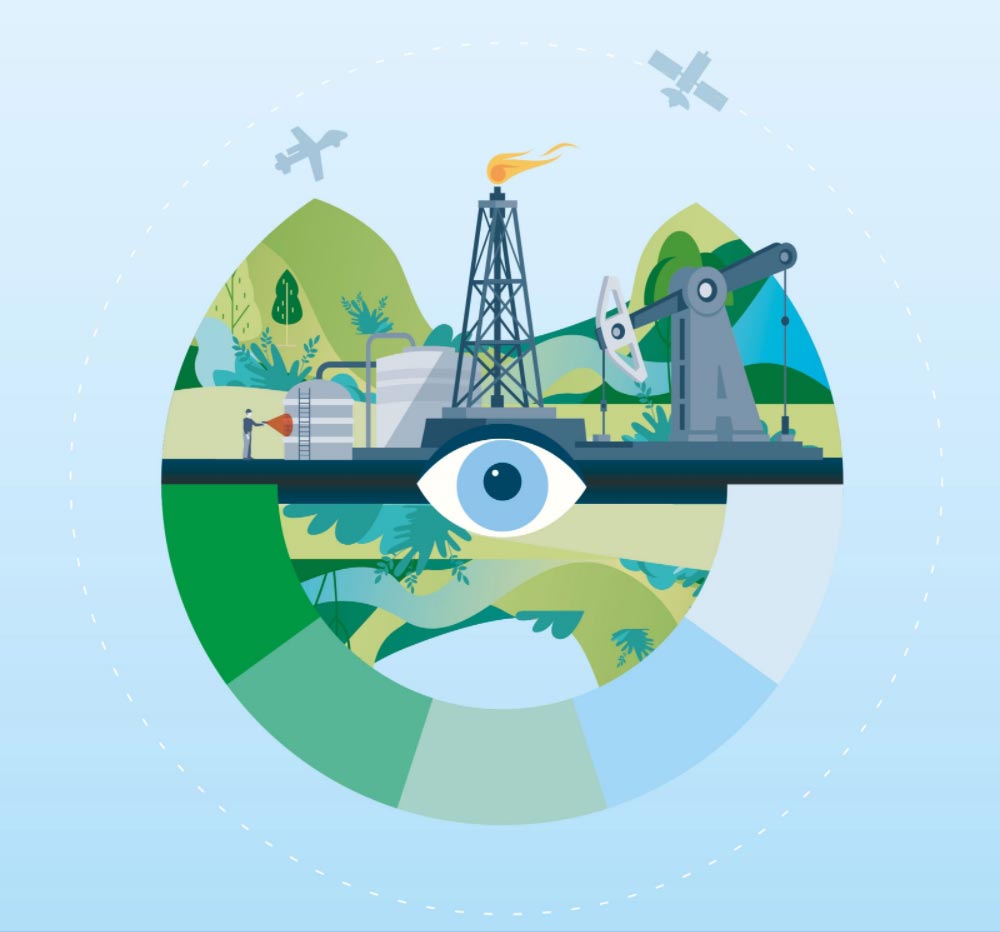
The UN launched the International Methane Emissions Observatory to track and cut methane emissions.
The UN Environment Program (UNEP), with support from the European Union, today launched a new Observatory to drive action on reducing methane emissions – a powerful greenhouse gas responsible for at least a quarter of the current climate warming.
The International Methane Emissions Observatory (IMEO) was launched at the G20 Summit, on the eve of the latest round of climate talks, known as COP26 in Glasgow.
IMEO will improve the reporting accuracy and public transparency of human-caused methane emissions. IMEO will initially focus on methane emissions from the fossil fuel sector, and then expand to other major emitting sectors like agriculture and waste.
The recently published UNEP-CCAC Global Methane Assessment states that zero or low net-cost reductions could almost halve anthropogenic methane emissions and proven measures could shave 0.28 degrees Celsius from the forecasted rise in the planet’s average temperature by 2050.
IMEO will provide the means to prioritize actions and monitor commitments made by state actors in the Global Methane Pledge – a US- and EU-led effort by over two dozen countries to slash methane emissions by 30 percent by 2030.
Methane: Over 80 Times More Potent Than CO2
To stay on track to reach the Paris Agreement goal of limiting climate change to 1.5°C (2.7°F), the world needs to almost halve greenhouse gas emissions by 2030. The Intergovernmental Panel on Climate Change notes that if the world is to achieve the 1.5°C temperature target, deep methane emissions reductions must be achieved over this time.
“As highlighted by IPCC, if the world is serious about avoiding the worst effects of climate change, we need to cut methane emissions from the fossil fuel industry. But this is not a get-out-of-jail-free card: methane reductions must go hand in hand with actions to decarbonize the energy system to limit warming to 1.5°C, as called for in the Paris Agreement,” said Inger Andersen, Executive Director of UNEP.
Methane released directly into the atmosphere is more than 80 times more potent than CO2 over a 20-year time horizon. However, as methane’s atmospheric lifespan is relatively short – 10 to 12 years – actions to cut methane emissions can yield the most immediate reduction in the rate of warming, while also delivering air quality benefits.
EU Commissioner for Energy Kadri Simson said, “Methane has accounted for roughly 30 percent of global warming since pre-industrial times, and today its emissions are increasing faster than at any other time since record keeping began in the 1980s. Existing systems do not allow us to determine precisely enough where emissions happen across the globe and in what volumes. Once better data is available, countries can take swift and well-targeted action. In the EU, we will already propose pioneering legislation to cut methane emissions this year. This includes mandatory leak detection and repair and limiting venting and flaring.”
The fossil fuel industry is responsible for one-third of anthropogenic emissions and is the sector with the highest potential for reductions. The wasted methane, the main component in natural gas, is a valuable source of energy that could be used to fuel power plants or homes.
IMEO: An Independent and Trusted Entity
The Observatory will produce a global public dataset of empirically verified methane emissions – starting with the fossil fuel sector – at an increasing level of granularity and accuracy by integrating data principally from four streams: reporting from the Oil and Gas Methane Partnership 2.0 (OGMP 2.0), direct measurement data from scientific studies, remote sensing data, and national inventories. This will allow IMEO to engage companies and governments around the world to utilize this data to target strategic mitigation actions and support science-based policy options.
Critical to this effort are data collected through OGMP 2.0, launched in November 2020 in the framework of the Climate and Clean Air Coalition. OGMP 2.0 is the only comprehensive, measurement-based reporting framework for the oil and gas sector, and its 74 member companies represent many of the world’s largest operators across the entire value chain, with assets that account for over 30 percent of all oil and gas production.
IMEO: First Annual Report
In a report released to coincide with the launch, IMEO laid out its Theory of Change, at the heart of which is the need for an independent and trusted entity to integrate these multiple sources of heterogeneous data into a coherent and policy-relevant dataset. The report also includes the analysis of the first reports submitted by the company members of the OGMP 2.0. During this first year, most companies put significant effort into reporting and outlined ambitious 2025 reduction targets. Out of the 55 companies that set targets, 30 meet or exceed the recommended targets of 45% reduction or near-zero methane intensity, and 51 have submitted plans that provide confidence the accuracy of their data will improve in the next 3-5 years.
Hosted by UNEP, IMEO is budgeted at EUR 100 million over five years. To maintain its independence and credibility, it will receive no industry funding. Instead, IMEO will be entirely funded by governments and philanthropies, with core resources provided by the European Commission as a founding member.
About the UN Environment Program (UNEP)
UNEP is the leading global voice on the environment. It provides leadership and encourages partnership in caring for the environment by inspiring, informing, and enabling nations and peoples to improve their quality of life without compromising that of future generations.
About the European Commission
The European Commission is the European Union’s politically independent executive arm. It is alone responsible for drawing up proposals for new European legislation, and it implements the decisions of the European Parliament and the Council of the EU.
Never miss a breakthrough: Join the SciTechDaily newsletter.
Follow us on Google and Google News.
1 Comment
As is too often the case with climate hand waving, the article is short on relevant numbers. The current atmospheric concentration of CO2 is a little over 400 PPMv; CH4 is less than 2 PPMv. Allowing for the claimed 85X greater potential for warming from methane, the 2 PPMv is approximately equivalent to about 160 PPMv of CO2. However, methane is apparently only increasing at a rate of about 0.008 PPMv per year; that is equivalent to about 0.7 PPMv of CO2. However, CO2 is increasing a little over 2 PPMv. That is, the modeled relative increase of the annual forcing of CO2 is about 3X that of CH4. Although, there is not agreement on just how much warming is caused by a doubling of CO2.
The article states, “The fossil fuel industry is … the sector with the highest potential for reductions.” The fossil fuel contribution to annual atmospheric methane growth is about 18%. [https://scitechdaily.com/global-methane-emissions-soar-to-record-high-even-as-pandemic-has reduced-carbon-emissions/] To achieve even a 50% reduction in annual fossil fuel CH4 would not be easy! That would amount to an equivalent of less than 0.05 PPMv CO2, which is in the noise level for measuring CO2.
I think that those promoting targeting fossil fuel methane reductions are overly optimistic. The companies producing methane are losing potential profits from flaring and leakage. If preventing the losses was easy, they probably would be doing it.