
Close Menu
    Facebook X (Twitter) Instagram
    SciTechDaily
    • Biology
    • Chemistry
    • Earth
    • Health
    • Physics
    • Science
    • Space
    • Technology
    Facebook X (Twitter) Pinterest YouTube RSS
    SciTechDaily
    Home»Physics»First Universal Quantum Network Prototype Operational
    Physics

    First Universal Quantum Network Prototype Operational

    By SciTechDailyApril 16, 20121 Comment3 Mins Read
    Facebook Twitter Pinterest Telegram LinkedIn WhatsApp Email Reddit
    Share
    Facebook Twitter LinkedIn Pinterest Telegram Email Reddit
    universal-quantum-network-prototype
    Quantum physicists have developed a basic network designed to store and share quantum information.

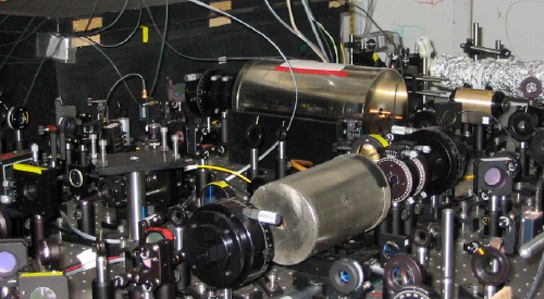
    Quantum physicists have constructed an elementary network for storing and exchanging quantum information. The network was setup with two all-purpose nodes, which can send, receive, and store quantum information. The nodes were linked by fiber-optic cable, which carries the quantum information from node to node with a single photon.

    The prototype network could form the basis of communication channels for relaying quantum information, if it could be refined and scaled up. The findings were published by a group from the Max Planck Institute of Quantum Optics  (MPQ) in Garching, Germany in the April 12th issue of the journal Nature.
    universal-quantum-network-prototype-machinery

    Quantum bits can use quantum superposition to store a third state, which hovers between 0 and 1, unlike classical bits that can store only two values (0 and 1). Physicists have tried to use all sorts of quantum objects to store qubits, from electrons, atomic nuclei, to photons and more. In the new experiment, the qubit at each node is stored in the internal quantum state of a single rubidium atom trapped in a reflective optical cavity.

    The atom transmits its stored information via an optic fiber by emitting a single photon, whose polarization state carries the mark of the atom’s quantum state. The atom can absorb a photon that comes through the fiber, imprinting the quantum state of that photon’s polarization.

    The network could be scaled by adding extra nodes. The nodes would remain universal. It’s only recently that all of the technologies involved in this process have become sufficiently advanced for them to work together. Such networks were proposed 15 years ago, but getting the photons and atoms to communicate was difficult.

    The optical cavity uses mirrors to reflect a photon past the rubidium atom tens of thousands of times, boosting the chances of an interaction happening. The MPQ group put their network through a series of tests finding that they lose a significant number of photons, which limits the efficiency of the network, but they believe optical fibers could connect nodes at greater distances than 21 meters, the distance between the two connected labs.

    Reference: “An elementary quantum network of single atoms in optical cavities” by Stephan Ritter, Christian Nölleke, Carolin Hahn, Andreas Reiserer, Andreas Neuzner, Manuel Uphoff, Martin Mücke, Eden Figueroa, Joerg Bochmann and Gerhard Rempe, 11 April 2022, Nature.
    DOI: 10.1038/nature11023

    Never miss a breakthrough: Join the SciTechDaily newsletter.
    Follow us on Google and Google News.

    Optics Quantum Entanglement Quantum Physics Qubits
    Share. Facebook Twitter Pinterest LinkedIn Email Reddit

    Related Articles

    20 Years in the Making: Physicists Confirm Long-Standing Quantum Prediction

    Researchers Develop A Universal Quantum Gate

    Study Shows Creation of Entanglement Simultaneously Gives Rise to a Wormhole

    Physicists Create and Control a Large Quantum Mechanical System Built on Photons

    Researchers Use Light to Manipulate a Quantum Bit

    Theoretical Physicists Devise Rules for More Effective Teleportation

    Quantum Bits Store Data for Nearly Two Seconds Using Laboratory Grown Diamonds

    Quantum Information is Preserved for Longer Than a Second at Room Temperature

    Physicists in China Break Quantum Teleportation Record

    1 Comment

    1. Paul on November 7, 2013 8:58 am

      I’m curious about the mirrors in the cavity and the reflection process at the quantum level. Doesn’t that involve absorption and re-emission? Does that ever change the polarization of the photon?

      If the photon is not absorbed and re-emitted during reflection, then how is it’s direction changed by the mirror?

      Reply
    Leave A Reply Cancel Reply

    • Facebook
    • Twitter
    • Pinterest
    • YouTube

    Don't Miss a Discovery

    Subscribe for the Latest in Science & Tech!

    Trending News

    Scientists Say Love Follows Mathematical Patterns

    “Zombie Cells” Reveal a Hidden Weakness That Could Help Fight Aging

    Alien Signals May Be Hiding in a Radio Band SETI Has Barely Explored

    Earth’s Hidden Thermostat Has Regulated Climate for 60 Million Years

    This 518-Million-Year-Old Creature Reveals How Spiders Got Their Bite

    Scientists Built a Programmable Chip That Can Slow Light on Command

    The Backyard “Silly Sprinkler” That Cracked One of Physics’ Biggest Puzzles

    This Common Sleep Habit Could Be Making You Gain Weight

    Follow SciTechDaily
    • Facebook
    • Twitter
    • YouTube
    • Pinterest
    • Newsletter
    • RSS
    SciTech News
    • Biology News
    • Chemistry News
    • Earth News
    • Health News
    • Physics News
    • Science News
    • Space News
    • Technology News
    Recent Posts
    • Underwater Drones Find “Dead” Coral Reefs Teeming With Life
    • How Brown Tree Snakes Became an Unstoppable Invasive Species
    • Scientists Discover the Brain Is Not Always Ready To Make Memories
    • Earth’s First Complex Organisms May Hold Clues to Life Beyond Our Planet
    • Dark Matter’s Secret Force Could Reshape Our Understanding of the Universe
    Copyright © 1998 - 2026 SciTechDaily. All Rights Reserved.
    • Science News
    • About
    • Contact
    • Editorial Board
    • Privacy Policy
    • Terms of Use

    Type above and press Enter to search. Press Esc to cancel.