
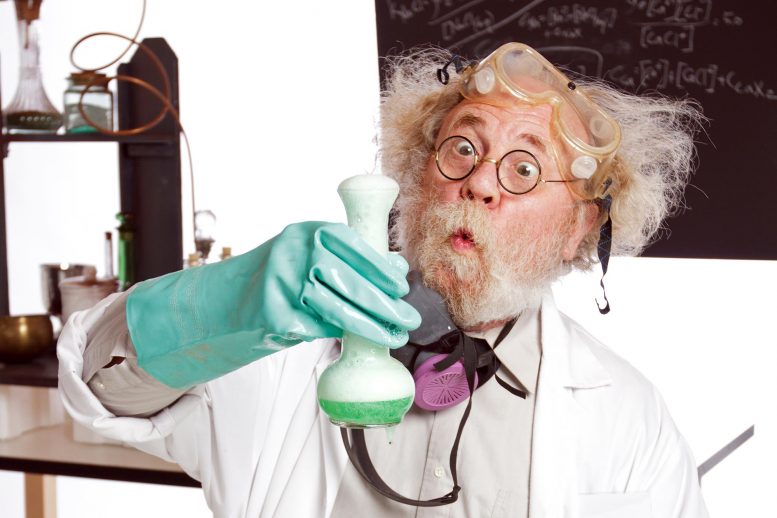
White lab coats and dangerous experiments all epitomize the ‘mad scientist’ from many a Hollywood blockbuster but, even beyond the silver screen, the stereotype lives on, and according to new research, it could mar the next generation of potential scientists.
Conducted by the University of South Australia and the Australian Catholic University, the new research shows how gender stereotypes influence young people’s perceptions of scientists, with findings showing that despite enjoying science, few children are interested in pursuing it as a career.
UniSA researcher, Dr. Garth Stahl, and ACU researcher Dr. Laura Scholes say understanding how stereotypes of science and scientists can influence children’s career aspirations — even at the primary school level — is important if we are to tackle the skills shortage in science, technology, engineering, and maths (STEM).
“Primary school is a time when kids are influenced by all sorts of stereotypes — through books, TV, and movies. In the case of science, media often shows scientists to be eccentric men in white coats,” Dr. Stahl says.
“The problem with stereotypes is that they tend to stick, so what we’re seeing with primary school students is that their perceptions of science and scientists are influencing their ideas of future careers.”
In this study, researchers interviewed 45 (29 male and 16 female) Year four (9-10-year-olds) primary school students, across six economically and geographically diverse schools. Children were asked about the job they’d like when they grew up; whether they’d like to be a scientist; what kind of work a scientist did; and what a scientist might look like.
The majority of students (55 percent) both Scholes and Stahl spoke with had no aspirations to be a scientist; six were ambivalent; and 13 said they would strongly consider a job as a scientist. Nearly 40 percent of students said they ‘did not like’ science, and that it was ‘boring’ or ‘weird’.
A heartening finding was that most students did not see gender as a defining factor for a scientist, with only two students saying a scientist was ‘usually a man.’
“The fact that most kids said science could be a career for a woman or a man, shows just how far we’ve come in terms of gender, and the waning of gender stereotypes may reflect the impact of a range of initiatives across Australia to normalize women in STEM,” Dr. Stahl says.
“But there’s still room to do more, especially as students talked about stereotypical images of scientists wearing white coats and protective goggles and doing lab-based experiments.
“The notion of science being ‘weird’, ‘unusual’, ‘dangerous’ and ‘challenging’, is a barrier that we still need to tackle, with many kids feeling that a career in science could be too difficult or high-pressure for them to achieve.
“It’s two steps forward, one step back — gender stereotypes may be in decline, but we still have a long way to go if we are to get children to understand the role of a modern scientist.”
Reference: “‘I’m good at science but I don’t want to be a scientist’: Australian primary school student stereotypes of science and scientists” by Laura Scholes and Garth Stahl, 15 April 2020, International Journal of Inclusive Education.
DOI: 10.1080/13603116.2020.1751316
Never miss a breakthrough: Join the SciTechDaily newsletter.
Follow us on Google and Google News.
1 Comment
As for me, this school age is the perfect time to start learning programming for children. Children with high levels of digital literacy are capable of self-learning through critical thinking skills and the ability to navigate the digital environment.