
Close Menu
    Facebook X (Twitter) Instagram
    SciTechDaily
    • Biology
    • Chemistry
    • Earth
    • Health
    • Physics
    • Science
    • Space
    • Technology
    Facebook X (Twitter) Pinterest YouTube RSS
    SciTechDaily
    Home»Physics»Pentadiamond: Scientists Devise a Way to Build a Harder Diamond
    Physics

    Pentadiamond: Scientists Devise a Way to Build a Harder Diamond

    By University of TsukubaJuly 5, 20202 Comments3 Mins Read
    Facebook Twitter Pinterest Telegram LinkedIn WhatsApp Email Reddit
    Share
    Facebook Twitter LinkedIn Pinterest Telegram Email Reddit
    Pentadiamond Geometric Structure
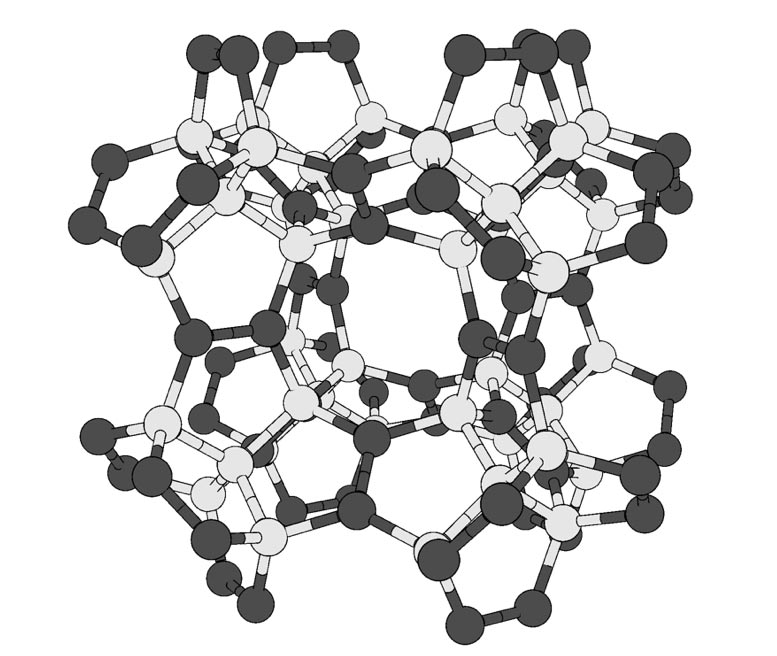
    Geometric structure of pentadiamond. White and black balls indicate C atoms with four and three adjacent C atoms, respectively. Credit: University of Tsukuba

    Scientists at the University of Tsukuba use computer calculations to propose a new way to rearrange the carbon atoms in a diamond to make it even harder, which may be useful in industrial applications that rely on synthetic cutting diamonds.

    Researchers at the University of Tsukuba used computer calculations to design a new carbon-based material even harder than diamond. This structure, dubbed “pentadiamond” by its creators, may be useful for replacing current synthetic diamonds in difficult cutting manufacturing tasks.

    Diamonds, which are made entirely of carbon atoms arranged in a dense lattice, are famous for their unmatched hardness among known materials. However, carbon can form many other stable configurations, called allotropes. These include the familiar graphite in pencil lead, as well as nanomaterials such as carbon nanotubes. The mechanical properties, including hardness, of an allotrope depend mostly on the way its atoms bond with each other. In conventional diamonds, each carbon atom forms a covalent bond with four neighbors. Chemists call carbon atoms like this as having sp3 hybridization. In nanotubes and some other materials, each carbon forms three bonds, called sp2 hybridization.
    Fused Pentagons
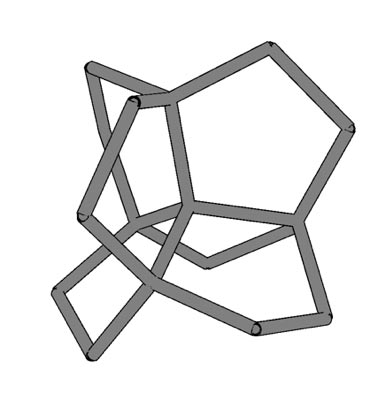
    Fused pentagons as a constituent unit of pentadiamond. Credit: University of Tsukuba

    Now, researchers at the University of Tsukuba have explored what would happen if carbon atoms were arranged in a more complex structure with a mixture of sp3 and sp2 hybridization.

    “Carbon allotropes with both sp2 and sp3 hybridized atoms have greater morphological diversity due to the huge number of combinations and arrangements in networks,” says first author Yasumaru Fujii.

    To calculate the most stable atomic configuration, as well as estimate its hardness, the team relied on a computational method called density functional theory (DFT). DFT has been successfully used throughout chemistry and solid-state physics to predict the structure and properties of materials. Keeping track of the quantum states of all of the electrons in a sample, and especially their interactions, is usually an intractable task. Instead, DFT uses an approximation that focuses on the final density of electrons in space orbiting the atoms.

    This simplifies the calculation to make it suitable for computers, while still providing very precise results. The scientists found that the Young’s modulus, a measure of hardness, of pentadiamond was predicted to be almost 1700 GPa, compared with about 1200 GPa for conventional diamond.

    “Not only is pentadiamond harder than conventional diamond, its density is much lower, equal to that of graphite,” explains co-author Professor Mina Maruyama. “This work shows the power of designing materials ab initio. In addition to industrial cutting and drilling uses, pentadiamonds might be used in place of diamond anvil cells currently used in scientific research to recreate the extreme pressure inside planets” said senior co-author Professor Susumu Okada.

    Reference: “Pentadiamond: A Hard Carbon Allotrope of a Pentagonal Network of sp2 and sp3 C Atoms” by Yasumaru Fujii, Mina Maruyama, Nguyen Thanh Cuong and Susumu Okada, 30 June 2020, Physical Review Letters.
    DOI: 10.1103/PhysRevLett.125.016001

    Never miss a breakthrough: Join the SciTechDaily newsletter.
    Follow us on Google and Google News.

    Materials Science Molecular Physics Particle Physics Popular University of Tsukuba
    Share. Facebook Twitter Pinterest LinkedIn Email Reddit

    Related Articles

    New MIT ‘Refrigerator’ Super-Cools Molecules to Nanokelvin Temperatures

    Devices to Process Ultra-High-Speed Wireless Data and Harvest Energy for Power Simultaneously

    Long-Standing Quantum Physics Prediction Proven: Bethe Strings Experimentally Observed

    A New Kind of Light in the Universe? “Super-Planckian” Material Emits Light That Exceeds Limits of Natural Law

    Tickling an Atom to Investigate Atomic Impurities in Nanomaterials

    Using Light to Put a Twist on Electrons – Inducing Asymmetrical Patterns in Exotic Materials

    Room Temperature Superconductor Breakthrough at Oak Ridge National Laboratory

    50-Year-Old Mechanics Puzzle Solved: Physicists Prove 2D and 3D Liquids Are Fundamentally Different

    Taking an X-Ray of an Atomic Bond – Unlocking Potential of Engineering Materials at Atomic Level

    2 Comments

    1. Tom Nelson on July 6, 2020 4:02 am

      Would Pentadiamond theoritically be a superior material for building a space elevator?

      I wonder what its electrical conductivity properties would be.
      I seem to recall that graphene has excellent electrical conductivity.
      Would Pentadiamond be stronger and have better electrical conductivity?

      Reply
    2. Anton Szautner on July 6, 2020 4:30 am

      Now that they know what its structure should be, how are they going to make them?

      Reply
    Leave A Reply Cancel Reply

    • Facebook
    • Twitter
    • Pinterest
    • YouTube

    Don't Miss a Discovery

    Subscribe for the Latest in Science & Tech!

    Trending News

    The Secret to Healthy Aging May Be More Protein and More Exercise

    These 567-Million-Year-Old Fossils Are Rewriting the Story of Life on Earth

    The Spider-Like Creatures Helping Scientists Decode the Origins of Fatherhood

    Scientists Baffled by a Sudden Reversal Deep Inside Earth’s Core

    This Strange Sea Creature Can Survive Five Years Without Food – Scientists Finally Know Why

    New Quantum Sensor Opens a Window Into the Invisible Universe

    Stanford Scientists Reverse Age-Related Memory Loss by Targeting the Gut

    James Webb Uncovers the Atmosphere of a Hellish Lava World 41 Light-Years Away

    Follow SciTechDaily
    • Facebook
    • Twitter
    • YouTube
    • Pinterest
    • Newsletter
    • RSS
    SciTech News
    • Biology News
    • Chemistry News
    • Earth News
    • Health News
    • Physics News
    • Science News
    • Space News
    • Technology News
    Recent Posts
    • Why Swallowing a Fish Bone Can Become a Life-Threatening Medical Emergency
    • Your Daily Orange Juice Could Have an Unexpected Health Benefit
    • New Research Could Help Break China’s Rare Earth Magnet Monopoly
    • The Milky Way’s Black Hole Isn’t Tearing Everything Apart – New Observations Reveal a Surprise
    • Black Hole Shredded a Massive Star in the Most Powerful Stellar Explosion Ever Seen
    Copyright © 1998 - 2026 SciTechDaily. All Rights Reserved.
    • Science News
    • About
    • Contact
    • Editorial Board
    • Privacy Policy
    • Terms of Use

    Type above and press Enter to search. Press Esc to cancel.