

Close Menu
    Facebook X (Twitter) Instagram
    SciTechDaily
    • Biology
    • Chemistry
    • Earth
    • Health
    • Physics
    • Science
    • Space
    • Technology
    Facebook X (Twitter) Pinterest YouTube RSS
    SciTechDaily
    Home»Physics»50-Year-Old Mechanics Puzzle Solved: Physicists Prove 2D and 3D Liquids Are Fundamentally Different
    Physics

    50-Year-Old Mechanics Puzzle Solved: Physicists Prove 2D and 3D Liquids Are Fundamentally Different

    By Nanyang Technological UniversityJanuary 14, 2020No Comments3 Mins Read
    Facebook Twitter Pinterest Telegram LinkedIn WhatsApp Email Reddit
    Share
    Facebook Twitter LinkedIn Pinterest Telegram Email Reddit
    3D Liquid Artists Rendering
    Researchers have demonstrated that 2D liquids exhibit distinct dynamic properties compared to 3D liquids.

    A 50-year-old puzzle in statistical mechanics has been solved by an international team of researchers who have proved that two-dimensional (2D) liquids have fundamentally different dynamical properties to three-dimensional (3D) liquids.

    Researchers routinely use 2D experiments and simulations to represent 3D liquids, simply because studies in 2D are easier to do.

    With these studies, physicists aim at rationalizing familiar macroscopic fluid properties, such as the viscosity, in terms of the microscopic motion of the particles, which in 2D can be directly visualized.

    The team led by Associate Professor Massimo Pica Ciamarra at Nanyang Technological University, Singapore (NTU Singapore) set out to understand the ‘thermal motion’ of atoms in 2D and 3D liquids.
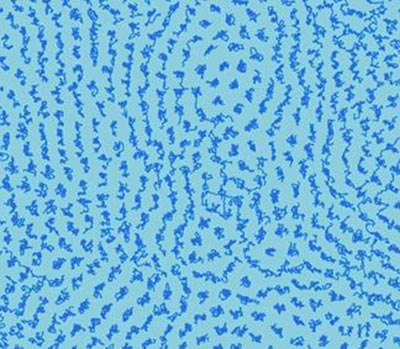
    Atomic Trajectories
    An image of atomic trajectories in a two-dimensional liquid, generated by computer simulations. Most trajectories are elongated, and the elongation of close trajectories is similar. This is the visual signature of the collective motions found by Li et al., which demonstrates a fundamental difference between two-dimensional and three-dimensional liquids. Credit: NTU Singapore

    Using a mix of pen-and-paper calculations and numerical simulations, they predicted that atoms in 2D liquids can travel for long distances before effectively ‘forgetting’ their initial positions. This behavior gives rise to a subtle collective motion of the atoms, of a sort that had previously only been thought to occur in solids.

    To confirm their theoretical findings, the researchers performed experiments that tracked the motions of colloidal particles under a microscope. In ordinary three-dimensional liquids, such particles execute a type of random motion known as Brownian motion.

    But in two-dimensional liquids, the team was able to demonstrate that the Brownian motion is overlaid on large-scale collective motions. This collective motion was previously believed to only occur in 2D solids, as predicted in the 1960s by Mermin and Wagner.

    The proof of the fundamental difference between 2D and 3D liquids was obtained by researchers at NTU Singapore, the Jawaharlal Nehru Centre for Advanced Scientific Research in India, the University of Science and Technology of China, and the University of California (Los Angeles) in the United States. Their work was published in November in the Proceedings of the National Academy of Sciences (PNAS).

    “Our discovery shows that two-dimensional liquids and three-dimensional liquids are not just variants of each other, but fundamentally different types of matter,” said Associate Professor Pica Ciamarra.

    Pica Ciamarra, NTU
    NTU Associate Professor Pica Ciamarra from the School of Physical and Mathematical Sciences, who discovered that 2D and 3D are fundamentally different in their properties. Credit: NTU Singapore

    “Our findings help to explain many puzzling differences between the dynamical properties of two- and three-dimensional liquids, which had been reported in the scientific literature,” said Assoc Prof Pica Ciamarra. “It is only in 2D, not in 3D or higher dimensions, that the relaxation time is not inversely proportional to the diffusivity of the particles.”

    “To extract relevant information on the dynamics of 3D liquids from the 2D investigations” added Dr. Y.-W. Li, co-author of this study, “researchers need to develop a way to selectively filter out the effect of the observed collective particle oscillations.”

    Reference: “Long-wavelength fluctuations and anomalous dynamics in 2-dimensional liquids” by Yan-Wei Li, Chandan K. Mishra, Zhao-Yan Sun, Kun Zhao, Thomas G. Mason, Rajesh Ganapathy and Massimo Pica Ciamarra, 28 October 2019, Proceedings of the National Academy of Sciences.
    DOI: 10.1073/pnas.1909319116

    Never miss a breakthrough: Join the SciTechDaily newsletter.
    Follow us on Google and Google News.

    Molecular Physics Nanyang Technological University Particle Physics Popular
    Share. Facebook Twitter Pinterest LinkedIn Email Reddit

    Related Articles

    Quark-Gluon Plasma – Which Filled the Universe Shortly After the Big Bang – Flows Like Water

    Zeptoseconds: New World Record in Short Time Measurement As Physicists Track the Propagation of Light in a Molecule

    Ultracold Mystery Solved: Researchers Crack a Molecular Disappearing Act

    Pentadiamond: Scientists Devise a Way to Build a Harder Diamond

    New MIT ‘Refrigerator’ Super-Cools Molecules to Nanokelvin Temperatures

    Room Temperature Superconductor Breakthrough at Oak Ridge National Laboratory

    Possible Mistakes Found in Faster Than Light Neutrino Measurement

    Quantum Entanglement of 8 Photons Successfully Accomplished by Physicists

    Higgs Boson Signals Gain Strength at Large Hadron Collider

    Leave A Reply Cancel Reply

    • Facebook
    • Twitter
    • Pinterest
    • YouTube

    Don't Miss a Discovery

    Subscribe for the Latest in Science & Tech!

    Trending News

    Scientists Discover Game-Changing New Way To Treat High Cholesterol

    This Small Change to Your Exercise Routine Could Be the Secret to Living Longer

    Scientists Discover 430,000-Year-Old Wooden Tools, Rewriting Human History

    AI Could Detect Early Signs of Alzheimer’s in Under a Minute – Far Before Traditional Tests

    What if Dark Matter Has Two Forms? Bold New Hypothesis Could Explain a Cosmic Mystery

    This Metal Melts in Your Hand – and Scientists Just Discovered Something Strange

    Beef vs. Chicken: Surprising Results From New Prediabetes Study

    Alzheimer’s Breakthrough: Scientists Discover Key Protein May Prevent Toxic Protein Clumps in the Brain

    Follow SciTechDaily
    • Facebook
    • Twitter
    • YouTube
    • Pinterest
    • Newsletter
    • RSS
    SciTech News
    • Biology News
    • Chemistry News
    • Earth News
    • Health News
    • Physics News
    • Science News
    • Space News
    • Technology News
    Recent Posts
    • Revolutionary Imaging Technique Unlocks Secrets of Matter at Extreme Speeds
    • Where Does Mass Come From? Scientists Find Evidence of a New Exotic Nuclear State
    • Quantum Breakthrough: Unhackable Keys Sent Over 120 km Using Quantum Dots
    • Researchers Discover Unknown Beetle Species Just Steps From Their Lab
    • Jellyfish Caught Feasting on Exploding Sea Worms for the First Time
    Copyright © 1998 - 2026 SciTechDaily. All Rights Reserved.
    • Science News
    • About
    • Contact
    • Editorial Board
    • Privacy Policy
    • Terms of Use

    Type above and press Enter to search. Press Esc to cancel.