
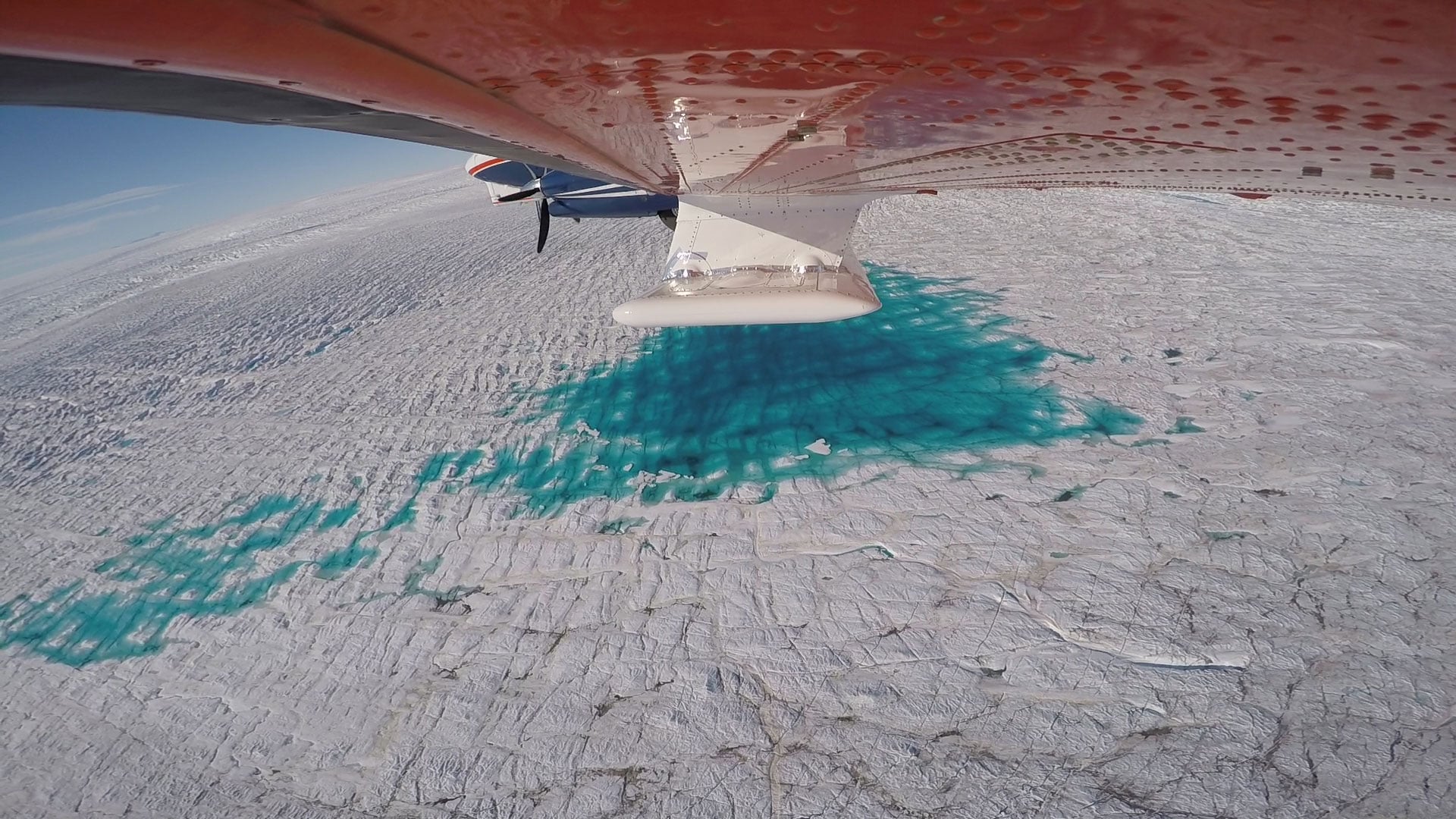
Repeated, rapid drainages from a meltwater lake on Greenland’s 79°N Glacier are exposing how warming-driven fractures and hidden channels may be pushing the glacier into an unfamiliar and potentially unstable state.
Since the mid-1990s, the Greenland ice sheet has steadily lost mass, and only three floating glacier tongues remain today. One of them, Nioghalvfjerdsbræ, also known as the 79°N Glacier, is already beginning to show signs of instability. While warmer ocean water is increasingly eroding the ice from below, meltwater flowing across the glacier’s surface is becoming an equally important factor.
In a recent study, scientists from the Alfred Wegener Institute examined the formation and evolution of a large meltwater lake on the surface of the 79°N Glacier. Covering an area of 21 km2, the lake developed as a result of global warming. Over time, the researchers found that it triggered enormous fractures in the ice and that the draining water was strong enough to lift parts of the glacier. The results of the study were published in the journal The Cryosphere.
The lake was first detected in observational data from 1995.
“There were no lakes in this area of the 79°N Glacier before the rise in atmospheric temperatures in the mid-1990s,” as Prof. Angelika Humbert, glaciologist at the Alfred Wegener Institute Helmholtz Centre for Polar and Marine Research (AWI) stated. “From the time of its formation in 1995 until 2023, the lake’s water repeatedly and abruptly drained through channels and cracks in the ice, causing massive amounts of fresh water to reach the edge of the glacier tongue towards the ocean.”
Altogether, the researchers documented seven major drainage events. Four of these occurred within the past five years.
“During these drainages, extensive triangular fracture fields with cracks in the ice formed from 2019 onwards, which are shaped differently from all lake drainages I have seen so far,” Angelika Humbert marvels. Some of these cracks form channels with openings several dozen meters wide (moulins).
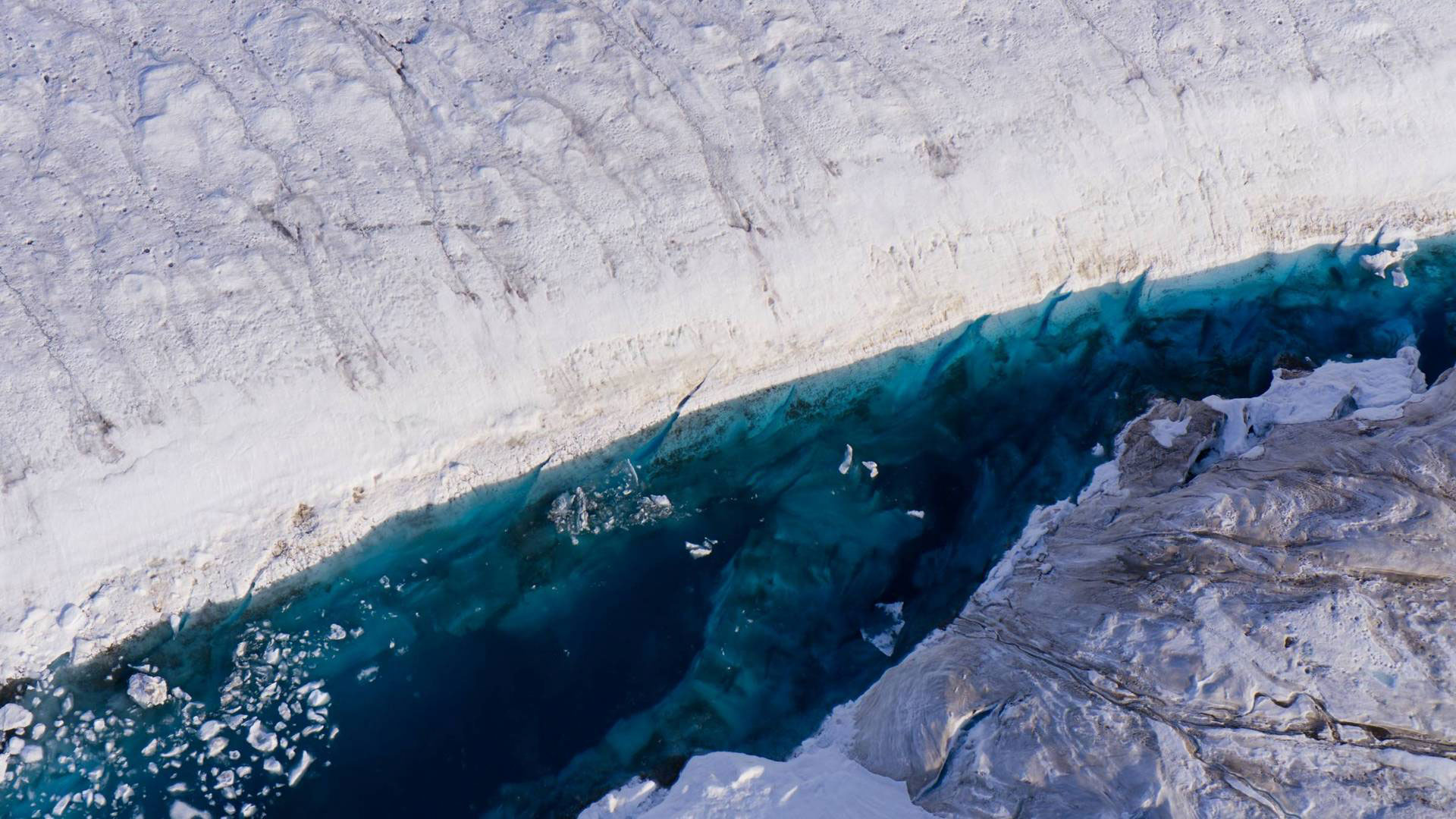
Water flows through these moulins also after the main drainage of the lake, meaning that within hours, a huge amount of water reaches the base of the ice sheet. “For the first time, we have now measured the channels that form in the ice during drainage and how they change over the years.”
Ice as Both Fluid and Elastic Solid
After the lake had formed in 1995, its size decreased over time, with the first cracks appearing. In recent years, the drainage has occurred at increasingly shorter intervals.
“We suspect that this is due to the triangular moulins that have been reactivated repeatedly over the years since 2019,” says Angelika Humbert.
The material behavior of the glacier plays a role here: on the one hand, the ice behaves like an extremely thick (viscous) fluid that flows slowly over the substrate. At the same time, however, it is also elastic, allowing it to deform and return to its original shape, similar to a rubber band.
The elastic nature of the ice is what allows cracks and channels to form in the first place. On the other hand, the creeping nature of the ice helps channels inside the glacier to close again over time after the drainage has taken place.
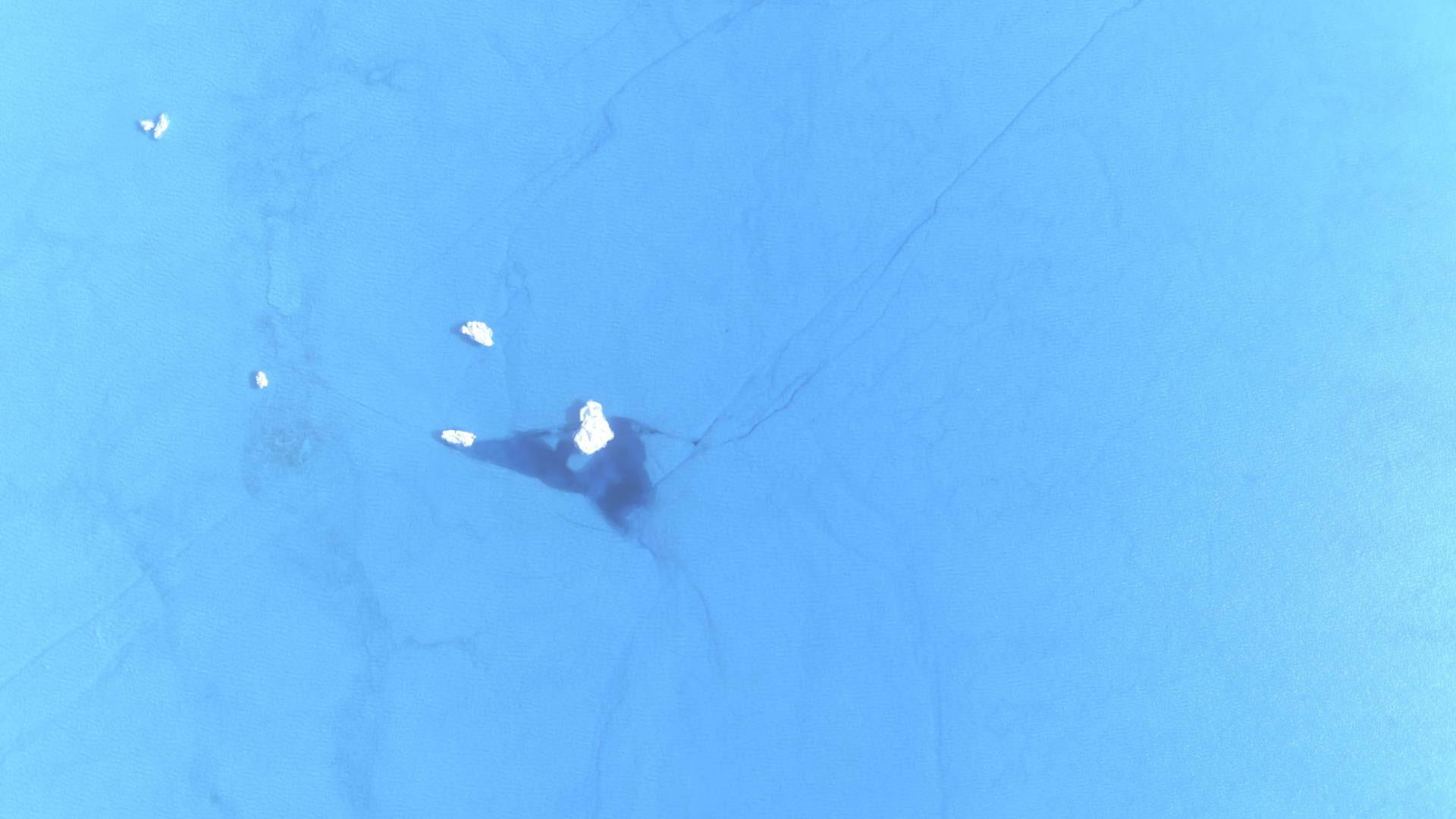
“The size of the triangular moulin fractures on the surface remains unchanged for several years. Radar images show that although they change over time inside the glacier, they are still detectable years after their formation.” This data also reveals that there is a network of cracks and channels, meaning that there is more than one way for the water to escape.
Meltwater is lifting the glaciers
The researchers were able to see shadows along the cracks in some aerial photographs. “In some cases, the ice at the fracture surfaces has also shifted in height, as if it were raised more on one side of the moulin than on the other,” as Angelika Humbert related.
The largest shift is encountered directly in the lake, which is due to the enormous masses of water that have entered the cracks beneath the glacier and formed a subglacial lake there. Radar images from inside show that a blister has apparently formed on this lake beneath the ice, pushing the glacier upwards at this point. Even more than 15 years after the first drainage, the cracks are still visible on the surface.
Observations, Models, and Open Questions
In conducting their study, the researchers analyzed data from various measurements. Using satellite remote sensing data and data from airborne surveys, they were able to investigate how the lake fills and drains and the paths of the water within the glacier. Viscoelastic modelling enabled them to determine whether and how drainage paths close over time.
The results raise a crucial question: Have the frequent drainages forced the glacier system into a new state, or can the system (still) return to a normal winter state in spite of these extreme amounts of water?
“In just ten years, recurring patterns and regularity have developed in the drainage, with massive and abrupt changes in meltwater inflow on a timescale of hours to days,” says Angelika Humbert. “These are extreme disturbances within the system, and it has not yet been investigated whether the glacial system can absorb this amount of water and is able to influence the drainage itself.”
The study provides important data for integrating cracks into ice sheet models and researching how they form and influence the glacier. AWI researchers are working closely with scientists from TU Darmstadt and the University of Stuttgart on the modelling.
Understanding and taking the behavior and effects of cracks in the glacier into account is particularly important when regarding the development of the lake on the 79°N Glacier: due to the advancing warming of the atmosphere, the fracture surfaces have been occurring further and further up the slope, impacting an increasingly larger area of the glacier.
Reference: “Insights into supraglacial lake drainage dynamics: triangular fracture formation, reactivation and long-lasting englacial features” by Angelika Humbert, Veit Helm, Ole Zeising, Niklas Neckel, Matthias H. Braun, Shfaqat Abbas Khan, Martin Rückamp, Holger Steeb, Julia Sohn, Matthias Bohnen and Ralf Müller, 14 August 2025, The Cryosphere.
DOI: 10.5194/tc-19-3009-2025
Never miss a breakthrough: Join the SciTechDaily newsletter.
Follow us on Google and Google News.
14 Comments
Everything changes 50 years from now it could be back to so call normal things change all the time give it a chance
Mostly what I read in this press release, and the actual published paper, is that there are correlations between 2m atmospheric temperatures and the physical changes that are occurring in the glacier, notably the production of a large volume of meltwater that found its way to the base of the glacier, as in:
“In the mid-1990s, the weather station Danmarkshavn (76.8° N, 18.7° W) recorded an increase in 2 m temperature of more than 1 °C (Zhang et al., 2022).”
The authors don’t address the cause of the warming, apparently defaulting to the consensus position that increasing anthropogenic CO2 is responsible for all global warming. Indeed, the press release explicitly says, “… the lake developed as a result of global warming.” Mentioning whether the increase in temperature was the diurnal arithmetic mean, diurnal mid-range, Tmax, Tmin, or some other statistical metric, would go a long way towards understanding cause and effect for the observed melting. There is at least one other obvious interpretation that should have been considered, but apparently wasn’t. That is, that there has been a change in cloudiness over Greenland, particularly after a short time-lag following the Summer Solstice in June. The meltwater lakes appear to be most common in July and August, which corresponds to the most practical field season. Generally speaking, warming from CO2 has been shown to be more effective at increasing the Tmin, particularly at night and in the Winter, whereas reduced cloudiness would probably be more effective at increasing the Summer Tmax, hence melting. Remember, there is no direct sunlight at all for much of the Winter at the latitude of the field research.
In reviewing the reference provided (Zhang et al., 2022), I only see ‘anomaly’ air temperatures, not actual air temperatures (T2m). Thus, there is no direct confirmation that the air temperatures were consistently, or even more frequently, above freezing post-1995. Therefore, we cannot even rule out the possibility of ‘skin’ temperatures of the ice being influenced by direct solar insolation.
As observational research, the authors have compiled significant data. However, some of their assertions are a stretch, as the supporting evidence is lean, at best. Any assertion that global warming is being driven by anthropogenic CO2 emissions is not supported by their data.
The glacier is stting on a volcanic rift that may be producing c02 but the melting is most likely caused by heat from shallow magma beneath the surface.
I’m sorry but I don’t need 8 years of College and 20 years in Weather related work to say Whats happening to this planet and the rapid warming of the Northern half is caused by The whole human population and the excessive Gluttony of Resources without stopping and watching our effects. I listen to all you genius babble about how its normal for it to be warming up. Its been warming up for 10k years!!! SMH.
Our atmosphere hasn’t had this much CO2 released into it ever. And there is no data that has been gathered and analyzed by anyone because this has never happened and the amounts being released everyday cannot be measured effectively because there are other gases know being released that cant be measured because the amounts vary from mile to mile from every inch of the planet. Methane is rushing out so fast in Alaska,Canada,Russia, Greenland everywhere and Scientists are baffled by the huge holes popping up in. Russia. Its from a build up of methane then it exlpodes.Instead of Government s around the world. Stopping the build up. They all worry about their economy’s. If we dont stop Pushing this the planet wont be able to recover without getting rid of whats killing it. Then in several hundred years it will heal. Humans have run out of time.
There was more than 4,000 PPM CO2 during the Cambrian period. Were Earth’s inhabitants gluttonous then as well? There are many reasons for rising and falling CO2 levels and humans are part of most of them.
“Our atmosphere hasn’t had this much CO2 released into it ever.”
When someone makes an easily disproved claim such as the above, it discounts their claim to be well-educated and to have years of practical experience. If you want to influence people’s thinking, I suggest that you pay attention to the facts and maybe even use some measurements to back them up.
As to your characterization of “methane is rushing out so fast,” I suggest that you read the following: https://wattsupwiththat.com/2023/03/06/the-misguided-crusade-to-reduce-anthropogenic-methane-emissions/
Agree
The press release states, “The elastic nature of the ice is what allows cracks and channels to form in the first place.” Actually, cracks in a material are usually referred to as inelastic behavior, or brittle failure. They typically form because the tensile strength is much less than the compressive strength. Thus, ice tends to develop ‘pressure ridges’ when under compression, and cracks or crevasses when under tension, such as happens when ice flexes over a bedrock ridge or dome. Depending on the dimensions of the claimed “basin,” I would expect crevasses to be more abundant at the upstream and downstream edges of said “basin.” The nomenclature the authors use is more than a little unconventional.
If something is elastic it stretches and bends. Not crack, that is the opposite of elastic. This author is no scientist he doesnot even have common sense
It all depends on the rates at which the deformation of ice occurs, as well as the P-T conditions of the ice; as in just about any solid.
Which is why the crevasses tend to close up after the meltwater drains away.
You think leaving a portable nuclear reactor and wast under Greenland has anything thing to do with this LoL. Remember operation iceworm, or camp century. Yep it’s still there. Also in Himalayas cia lost nuclear devices third plutonium 1965 they still can’t find . And you wonder about climate change . Over 1,000 nuclear test in the atmosphere wouldn’t hurt . Google everything I just said . It’s true. And we are paying for it.
Who said anything about Camp Century besides you? It is my understanding that the PORTABLE reactor and its fuel were removed before abandoning the installation. Only low-level radioactive material was left behind.
George Carlin said it the best this world of ours shrugs its shoulders every 10,000 to 100,000 years and starts over and everything on it goes so you know believe what you want