
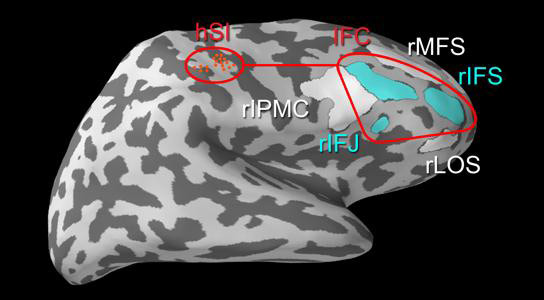
By scanning the brains of people engaged in selective attention to sensations, researchers from Brown University have learned how the brain appears to coordinate the response needed to ignore distractions.
Providence, Rhode Island (Brown University) — When we concentrate on something, we also engage in the unsung, parallel act of purposefully ignoring other things. A new study describes how the brain may achieve such “optimal inattention.” With this knowledge, scientists at Brown University hope they can harness our power to ignore — for instance, to reduce pain.
“This is about the mechanisms the brain is using to block out distracting things in the environment,” said Stephanie Jones, assistant professor (research) of neuroscience at Brown and corresponding author of the study.
Ignore the hand, attend the foot
The new findings, to be published in the Journal of Neuroscience, arise from brain scans of 12 volunteers, who during experiments were told they would feel a brief tap on the left middle finger or the left big toe. In some cases they were then told to report only stimuli felt on the foot and to disregard what they might feel on their hand. In other cases they were told to attend to or report sensations only in the hand and to ignore those in the foot.
With magnetoencephalography (MEG) scans, meanwhile, the researchers measured the power and timing of different brain wave frequencies in various brain regions. They were particularly interested in brainwave synchronization between the part of the somatosensory cortex that processes touch in the hand and the right inferior frontal cortex (rIFC), a part of the brain known to govern suppression of attention and action.
They looked at other nearby areas of the frontal cortex as well to be careful not to miss anything. Those regions functioned as experimental controls.
The researchers found significant patterns of synchrony between regions. In particular, looking at the synchrony between the somatosensory cortex’s hand region and the rIFC, they saw significant increases when people were told to attend to only sensations in the foot compared to when they were told to attend to sensations only in the hand.
One pattern emerged during the fraction of a second after people were told to focus their attention on the coming sensation but before the stimulation actually occurred. In that period, alpha wave synchrony (7-14Hz) was much higher between the part of the somatosensory cortex responsible for the hand and the rIFC in people focusing on the foot than in people focusing on the hand. This pattern is consistent with the brain preparing to suppress or ignore sensations felt in the hand.
Another pattern emerged in a distinctly later fraction of a second when people prepared to feel a sensation and were readying to report it (by clicking a button with the right hand). In people focusing on the foot, beta wave synchrony (15-29Hz) increased between the part of the somatosensory cortex responsible for the hand and the rIFC. This pattern is consistent with the brain actively suppressing or ignoring a possible sensation felt in the hand and consistent with suppressing the further urge to act on that feeling (for instance, to report it). These patterns were specific to rIFC and not found in the surrounding frontal cortex control regions.
The researchers also saw a significant difference in alpha rhythm synchrony between the IFC on the left side of the brain (specifically the left inferior frontal sulcus, IFS) and the somatosensory cortex pertaining to the hand, which they speculate could be related to formulating the rules about whether suppress or attend to sensations.
“That was an unexpected finding,” Jones noted.
Therapeutic inattention?
Led by study co-senior author Catherine Kerr, assistant professor (research) of family medicine in the Alpert Medical School, the team has already seen that people can learn — through mindfulness meditation, for instance — to manipulate their alpha rhythms in the somatosensory cortex as they switch their attentional focus.
The new results extend that work by laying out how alpha and beta rhythms appear to connect the somatosensory cortex to the frontal cortex to coordinate the multistep process of taking attention away from, and then ignoring, a sensory stimulus.
Jones and Kerr are now working with Dr. Ben Greenberg, professor of psychiatry and human behavior, to test whether they can use noninvasive, transcranial alternating current electrical stimulation (tACS) to take advantage of this process. They will test whether they can use the technology to manipulate alpha and beta waves between parts of the brain such as the somatosensory cortex and the rIFC to suppress attention to, or even the detection of, pain.
In a similar vein, research results show that mindfulness meditation, also possibly via the mechanism of throttling attention via control of alpha rhythms, can help people ignore depressive thoughts. Jones and Kerr are also interested to study whether explicit manipulation of alpha and beta waves between a different part of the cortex and the rIFC could provide much the same relief.
The Brown Institute for Brain Science recently outfitted a new lab on campus with the needed hardware for tACS and other brain stimulation research. BIBS and the Norman Prince Neurosciences Institute are funding the collaboration with Greenberg.
“This is part of a really cool effort at Brown to see if you can take pretty high-level cognitive questions, find the relevant areas in the brain, and then figure out how to put that in a context with the underlying neurophysiology, at the level of computational models and animal models,” Kerr said. “We’re linking different ways of looking at the brain that don’t usually come into dialogue with one another.”
And, Jones added, “making active efforts to bring it to the clinic.”
The study’s lead authors are former Brown research assistants Matthew Sacchet, now at Stanford, and Roan LaPlante, now at Harvard. Other authors are Qian Wan of Harvard, Dominique Pritchett of MIT, Adrian Lee of the University of Washington, Matti Hamalainen of Massachusetts General Hospital, and Christopher Moore of Brown.
The National Institutes of Health and the National Science Foundation funded the work.
Reference: “Attention Drives Synchronization of Alpha and Beta Rhythms between Right Inferior Frontal and Primary Sensory Neocortex” by Matthew D. Sacchet, Roan A. LaPlante, Qian Wan, Dominique L. Pritchett, Adrian K.C. Lee, Matti Hämäläinen, Christopher I. Moore, Catherine E. Kerr and Stephanie R. Jones, 4 February 2015, Journal of Neuroscience.
DOI: 10.1523/JNEUROSCI.1292-14.2015
Never miss a breakthrough: Join the SciTechDaily newsletter.
Follow us on Google and Google News.