
Close Menu
    Facebook X (Twitter) Instagram
    SciTechDaily
    • Biology
    • Chemistry
    • Earth
    • Health
    • Physics
    • Science
    • Space
    • Technology
    Facebook X (Twitter) Pinterest YouTube RSS
    SciTechDaily
    Home»Space»CfA Astronomers Propose a Cell Phone Search for Galactic Fast Radio Bursts
    Space

    CfA Astronomers Propose a Cell Phone Search for Galactic Fast Radio Bursts

    By Harvard-Smithsonian Center for AstrophysicsFebruary 15, 2017No Comments3 Mins Read
    Facebook Twitter Pinterest Telegram LinkedIn WhatsApp Email Reddit
    Share
    Facebook Twitter LinkedIn Pinterest Telegram Email Reddit
    Astronomers Propose a Cell Phone Search for Galactic Fast Radio Bursts
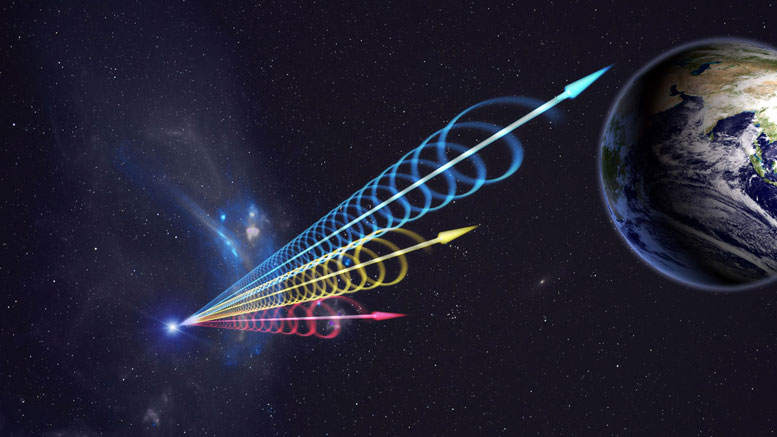
    Artist’s impression of a Fast Radio Burst (FRB) reaching Earth. The colors represent the burst arriving at different radio wavelengths, with long wavelengths (red) arriving several seconds after short wavelengths (blue). This delay is called dispersion and occurs when radio waves travel through cosmic plasma.

    A newly published study from the Harvard-Smithsonian Center for Astrophysics details how radio frequencies used by cell phones, Wi-Fi, and similar devices could be used to detect fast radio bursts.

    Fast radio bursts (FRBs) are brief spurts of radio emission, lasting just one-thousandth of a second, whose origins are mysterious. Fewer than two dozen have been identified in the past decade using giant radio telescopes such as the 1,000-foot (300-meter) dish in Arecibo, Puerto Rico. Of those, only one has been pinpointed to originate from a galaxy about 3 billion light-years away.

    The other known FRBs seem to also come from distant galaxies, but there is no obvious reason that, every once in a while, an FRB wouldn’t occur in our own Milky Way galaxy too. If it did, astronomers suggest that it would be “loud” enough that a global network of cell phones or small radio receivers could “hear” it.

    “The search for nearby fast radio bursts offers an opportunity for citizen scientists to help astronomers find and study one of the newest species in the galactic zoo,” says theorist Avi Loeb of the Harvard-Smithsonian Center for Astrophysics (CfA).

    Previous FRBs were detected at radio frequencies that match those used by cell phones, Wi-Fi, and similar devices. Consumers could potentially download a free smartphone app that would run in the background, monitoring appropriate frequencies and sending the data to a central processing facility.

    “An FRB in the Milky Way, essentially in our own backyard, would wash over the entire planet at once. If thousands of cell phones picked up a radio blip at nearly the same time, that would be a good sign that we’ve found a real event,” explains lead author Dan Maoz of Tel Aviv University.

    Finding a Milky Way FRB might require some patience. Based on the few, more distant ones, that have been spotted so far, Maoz and Loeb estimate that a new one might pop off in the Milky Way once every 30 to 1,500 years. However, given that some FRBs are known to burst repeatedly, perhaps for decades or even centuries, there might be one alive in the Milky Way today. If so, success could become a yearly or even weekly event.

    A dedicated network of specialized detectors could be even more helpful in the search for a nearby FRB. For as little as $10 each, off-the-shelf devices that plug into the USB port of a laptop or desktop computer can be purchased. If thousands of such detectors were deployed around the world, especially in areas relatively free from Earthly radio interference, then finding a close FRB might just be a matter of time.

    This work has been accepted for publication in the Monthly Notices of the Royal Astronomical Society.

    Reference: “Searching for giga-Jansky fast radio bursts from the Milky Way with a global array of low-cost radio receivers” by Dan Maoz and Abraham Loeb, 17 February 2017, MNRAS.
    DOI: 10.1093/mnras/stx400
    arXiv: 1701.01475

    Never miss a breakthrough: Join the SciTechDaily newsletter.
    Follow us on Google and Google News.

    Astrophysics Cell Phone Fast Radio Bursts Harvard-Smithsonian Center for Astrophysics Tel-Aviv University
    Share. Facebook Twitter Pinterest LinkedIn Email Reddit

    Related Articles

    Mysterious Radio Signals Reveal What’s Hiding Between Galaxies

    Fast Radio Bursts Should Occur Over the Entire Observable Universe

    Astronomers Examine the Possibility That Fast Radio Bursts Originate from Extragalactic Civilizations

    Astrophysicists Show Water Could Have Been Abundant in the Early Universe

    New Research Shows Fast Radio Bursts Might Come From Nearby Stars

    Rogue Planets Captured by Stars

    Runaway Planets at 30 Million MPH

    Origins of Type Ia Supernovae

    Hubble Reveals GJ1214b is a Waterworld Enshrouded by a Steamy Atmosphere

    Leave A Reply Cancel Reply

    • Facebook
    • Twitter
    • Pinterest
    • YouTube

    Don't Miss a Discovery

    Subscribe for the Latest in Science & Tech!

    Trending News

    Could Low Vitamin D Be Making Your Pain Worse?

    Scientists Discover Once-Weekly Workout That Melts Belly Fat Surprisingly Effectively

    Scientists Just Tested a Thruster Powerful Enough for Human Missions to Mars

    Doctors Say Your Ice Pack Might Be Making Injuries Worse

    Scientists Discover 43-Foot Sea Reptile Twice the Size of a Great White Shark

    Bees and Birds Are Drinking Alcohol From Flowers

    Scientists Discover How Obesity May Trigger Alzheimer’s Disease

    Scientists Confirm Alcohol Causes Widespread Health Damage

    Follow SciTechDaily
    • Facebook
    • Twitter
    • YouTube
    • Pinterest
    • Newsletter
    • RSS
    SciTech News
    • Biology News
    • Chemistry News
    • Earth News
    • Health News
    • Physics News
    • Science News
    • Space News
    • Technology News
    Recent Posts
    • Scientists Stop Pancreatic Cancer Before It Starts in Landmark Preclinical Study
    • Scientists Discover Surprising Anti-Aging Power Hidden in Aged Garlic
    • Just Minutes of Intense Exercise Could Slash Disease Risk by 50%
    • People Who Stop Ozempic Often Don’t Gain the Weight Back
    • Why More People in Their 30s Are Suddenly Getting Colon Cancer
    Copyright © 1998 - 2026 SciTechDaily. All Rights Reserved.
    • Science News
    • About
    • Contact
    • Editorial Board
    • Privacy Policy
    • Terms of Use

    Type above and press Enter to search. Press Esc to cancel.