
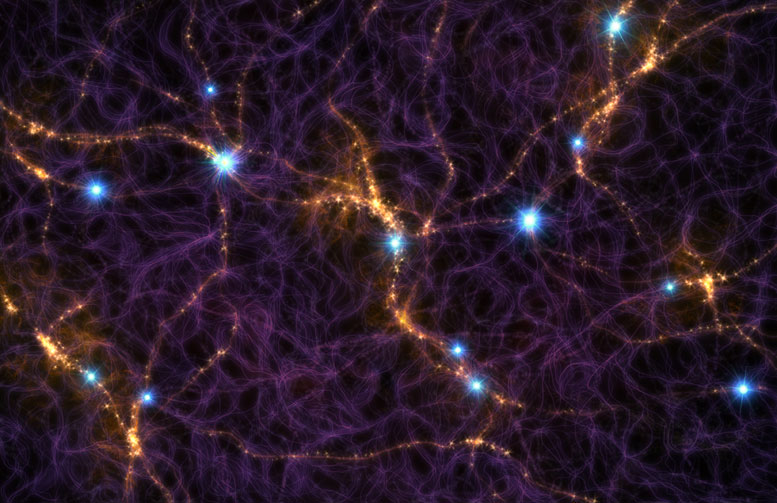
New research from the Harvard-Smithsonian Center for Astrophysics reveals that fast radio bursts should occur over the entire observable universe, with at least one FRB going off somewhere every second.
When fast radio bursts, or FRBs, were first detected in 2001, astronomers had never seen anything like them before. Since then, astronomers have found a couple of dozen FRBs, but they still don’t know what causes these rapid and powerful bursts of radio emission.
“If we are right about such a high rate of FRBs happening at any given time, you can imagine the sky is filled with flashes like paparazzi taking photos of a celebrity,” said Anastasia Fialkov of the CfA, who led the study. “Instead of the light we can see with our eyes, these flashes come in radio waves.”
To make their estimate, Fialkov and co-author Avi Loeb assumed that FRB 121102, a fast radio burst located in a galaxy about 3 billion light years away, is representative of all FRBs. Because this FRB has produced repeated bursts since its discovery in 2002, astronomers have been able to study it in much more detail than other FRBs. Using that information, they projected how many FRBs would exist across the entire sky.
“In the time it takes you to drink a cup of coffee, hundreds of FRBs may have gone off somewhere in the Universe,” said Avi Loeb. “If we can study even a fraction of those well enough, we should be able to unravel their origin.”
While their exact nature is still unknown, most scientists think FRBs originate in galaxies billions of light years away. One leading idea is that FRBs are the byproducts of young, rapidly spinning neutron stars with extraordinarily strong magnetic fields.
Fialkov and Loeb point out that FRBs can be used to study the structure and evolution of the Universe whether or not their origin is fully understood. A large population of faraway FRBs could act as probes of material across gigantic distances. This intervening material blurs the signal from the cosmic microwave background (CMB), the leftover radiation from the Big Bang. A careful study of this intervening material should give an improved understanding of basic cosmic constituents, such as the relative amounts of ordinary matter, dark matter, and dark energy, which affect how rapidly the universe is expanding.
FRBs can also be used to trace what broke down the “fog” of hydrogen atoms that pervaded the early universe into free electrons and protons, when temperatures cooled down after the Big Bang. It is generally thought that ultraviolet (UV) light from the first stars traveled outwards to ionize the hydrogen gas, clearing the fog and allowing this UV light to escape. Studying very distant FRBs will allow scientists to study where, when, and how this process of “reionization” occurred.
“FRBs are like incredibly powerful flashlights that we think can penetrate this fog and be seen over vast distances,” said Fialkov. “This could allow us to study the ‘dawn’ of the universe in a new way.”
The authors also examined how successful new radio telescopes – both those already in operation and those planned for the future – may be at discovering large numbers of FRBs. For example, the Square Kilometer Array (SKA) currently being developed will be a powerful instrument for detecting FRBs. The new study suggests that over the whole sky the SKA may be able to detect more than one FRB per minute that originates from the time when reionization occurred.
The Canadian Hydrogen Intensity Mapping Experiment (CHIME), that recently began operating, will also be a powerful machine for detecting FRBs, although its ability to detect the bursts will depend on their spectrum, i.e. how the intensity of the radio waves depends on wavelength. If the spectrum of FRB 121102 is typical then CHIME may struggle to detect FRBs. However, for different types of spectra CHIME will succeed.
The paper by Fialkov and Loeb describing these results was published in the September 10, 2017 issue of The Astrophysical Journal Letters.
PDF Copy of the Paper:
Reference: “A Fast Radio Burst Occurs Every Second throughout the Observable Universe” by Anastasia Fialkov and Abraham Loeb, 8 September 2017, The Astrophysical Journal Letters.
DOI: 10.3847/2041-8213/aa8905
Never miss a breakthrough: Join the SciTechDaily newsletter.
Follow us on Google and Google News.
1 Comment
Instructions for reading this:
With no specific method to discern what knowledge has been acquired and comprehended by any individual mind, we must start at a win one, two, three momenta. Each of the following three parallels examples the same incredible process at three different sizes. We are no more at the center of the Universe than we are at the center of size. Smaller is to imagine one direction opposite of the direction that is Larger.
1 Here, at step one, we start with a verified par size example.
2 Here at step two, we step with a verified size smaller example.
3 Here at step three, we momenta an unverified size larger example.
1 When an object of X density outpaces the speed of sound, Sonic Boom.
2 When a charged particle of X density outpaces the speed of light, Cherenkov radiation.
3 When an object of X density outpaces the speed of radio waves, Fast Radio Burst.
1 A supersonic jet passes the speed of sound waves in a medium (air), Sonic Boom.
2 When an electron passes the speed of light waves in a medium (water), Cherenkov Radiation.
3 When a magnetar passes the speed of radio waves in a medium (?), Fast Radio Burst.
1 A sonic boom is audibly produced when a bullet travels faster than the speed of sound through (air).
2 An underwater nuclear reactor’s characteristic blue glow is visually produced when a charged particle travels faster than the speed of light through (water).
3 An intense burst of radio waves occurs when a cosmic object passes radio waves’ speed through (medium).
1 Refracted Sound Wave Aperture
Given that Mach 1 means the speed of sound, then Mach 2 is twice that speed. When a bullet, cracking bullwhip, or supersonic jet accelerates beyond Mach 1, an audible burst of sound, commonly known as a Sonic Boom, occurs.
2 Refracted Light Wave Aperture
Give that c means the speed that light travels in vacuum, a medium of empty space with no cosmological constant. Light travels through a vacuum faster than it travels through a body of water.
By example medium, sorted from faster to slower media speeds, light travels most rapidly in expansion > vacuum > air > water > glass. The rate that light shines through water is more rapid than it shines through glass. Electromagnetic radiation emits when a charged particle passes through an inhomogeneous media, such as the sample surface and an electron microscope’s vacuum.
In water, an electron that accelerates beyond the speed of light traveling in that water will procure Cherenkov Radiation (luminescence). This happens because the electron’s velocity breached light’s speed, aperture a less resistant path for the compacted light waves held in its wake to burst out as a radioactive blue glow. This same wave-related process causes sonic booms and fast radio bursts.
3 Refracted Radio Wave Aperture
Radio waves propagate like light waves. Astronomical bodies procure a fast radio burst when their speed surpasses radio’s phase velocity in a medium.
When we watch a simulation video of Fast Radio Bursts in actual time, we see bursts of light.
When we speed up a simulation video of Fast Radio Bursts enough, the simulation screen glows uniform color.
When we slow down a simulation video of Cherenkov Radiation enough, we see bursts of light.
When we watch a video with Cherenkov Radiation in actual time, we see the water glow a uniform color.