
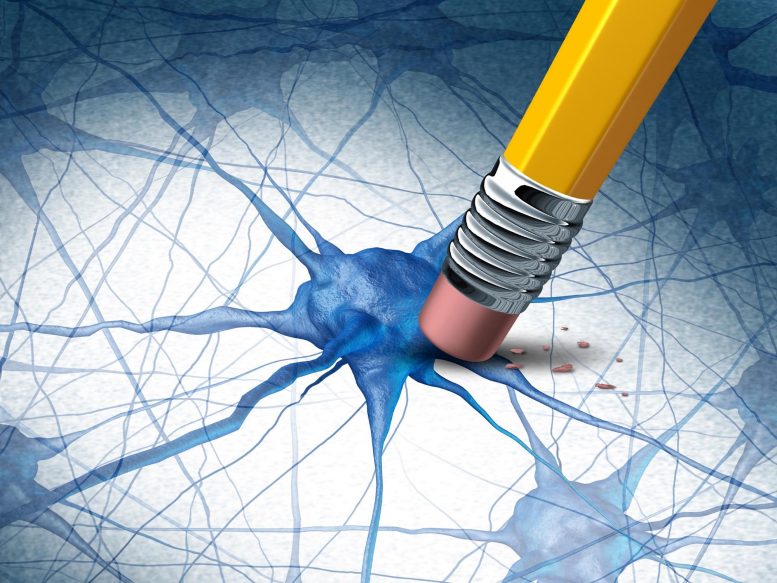
Dementia patients struggle with changes due to damage in brain networks vital for recognizing new situations.
People with dementia struggle to adapt to changes in their environment because of damage to areas of the brain known as ‘multiple demand networks’, highly-evolved areas of the brain that support general intelligence, say scientists at the University of Cambridge.
Multiple Demand Networks
There are many different types of dementia, such as Alzheimer’s disease and frontotemporal dementia (FTD), which are characterized by the build-up of different toxic proteins in different parts of the brain. This means that the symptoms of dementia vary, and can include problems with memory, speech, behavior, or vision. But one symptom seen across every type of dementia is a difficulty in responding to unexpected situations.
Dr. Thomas Cope from the MRC Cognition and Brain Science Unit and Department of Clinical Neurosciences at the University of Cambridge said: “At the heart of all dementias is one core symptom, which is that when things change or go unexpectedly, people find it very difficult. If people are in their own environment and everything is going to plan, then they are OK. But as soon as the kettle’s broken or they go somewhere new, they can find it very hard to deal with.”
To understand why this happens, Dr. Cope and colleagues analyzed data from 75 patients, all of whom are affected by one of four types of dementia that affect different areas of the brain. The patients, together with 48 healthy controls, listened to changing sounds while their brain activity was recorded by a magnetoencephalography machine, which measures the tiny magnetic fields produced by electrical currents in the brain. Unlike traditional MRI scanners, these machines allow very precise timing of what is happening in the brain and when. The results of their experiment are published today (March 8, 2022) in the Journal of Neuroscience.
During the scan, the volunteers watched a silent film – David Attenborough’s Planet Earth, but without its soundtrack – while listening to a series of beeps. The beeps occurred at a steady pattern, but occasionally a beep would be different, for example, a higher pitch or different volume.
Damage to Multiple Demand Networks in Dementia
The team found that the unusual beep triggered two responses in the brain: an immediate response followed by a second response around 200 milliseconds – a fifth of a second – a later.
The initial response came from the basic auditory system, recognizing that it had heard a beep. This response was the same in the patients and healthy volunteers.
The second response, however, recognized that the beep was unusual. This response was much smaller among the people with dementia than among the healthy volunteers. In other words, in the healthy controls, the brain was better at recognizing that something had changed.
The researchers looked at which brain areas activated during the task and how they were connected up, and combined their data with that from MRI scans, which show the structure of the brain. They showed that damage to areas of the brain known as ‘multiple demand networks’ was associated with a reduction in the later response.
Importance of Multiple Demand Networks in Perception
Multiple demand networks, which are found both at the front and rear of the brain, are areas of the brain that do not have a specific task, but instead are involved in general intelligence – for example, problem-solving. They are highly evolved, found only in humans, primates, and more intelligent animals. It is these networks that allow us to be flexible in our environment.
In the healthy volunteers, the sound is picked up by the auditory system, which relays information to the multiple demand network to be processed and interpreted. The network then ‘reports back’ to the auditory system, instructing it whether to carry on or to attend to the sound.
“There’s a lot of controversy about what exactly multiple demand networks do and how involved they are in our basic perception of the world,” said Dr. Cope. “There’s been an assumption that these intelligence networks work ‘above’ everything else, doing their own thing and just taking in information. But what we’ve shown is no, they’re fundamental to how we perceive the world.
“That’s why we can look at a picture and immediately pick out the faces and immediately pick out the relevant information, whereas somebody with dementia will look at that scene a bit more randomly and won’t immediately pick out what’s important.”
Implications for Dementia Care and Broader Conditions
While the research does not point to any treatments that may alleviate the symptom, it reinforces advice given to dementia patients and their families, said Dr. Cope.
“The advice I give in my clinics is that you can help people who are affected by dementia by taking a lot more time to signpost changes, flagging to them that you’re going to start talking about something different or you’re going to do something different. And then repeat yourself more when there’s a change, and understand why it’s important to be patient as the brain recognizes the new situation.”
Although their study only looked at patients with dementia, the findings may explain similar phenomena experienced by people living with conditions such as schizophrenia, where brain networks can become disrupted.
Reference: “Causal Evidence for the Multiple Demand Network in Change Detection: Auditory Mismatch Magnetoencephalography across Focal Neurodegenerative Diseases” by Thomas E. Cope, Laura E. Hughes, Holly N. Phillips, Natalie E. Adams, Amirhossein Jafarian, David Nesbitt, Moataz Assem, Alexandra Woolgar, John Duncan and James B. Rowe, 8 March 2022, Journal of Neuroscience.
DOI: 10.1523/JNEUROSCI.1622-21.2022
The research was funded by the Medical Research Council and National Institute for Health Research, with additional support from Wellcome, the Biotechnology and Biological Sciences Research Council, and the James S McDonnell Foundation.
Dr. Cope is a fellow at Murray Edwards College, Cambridge.
Never miss a breakthrough: Join the SciTechDaily newsletter.
Follow us on Google and Google News.