
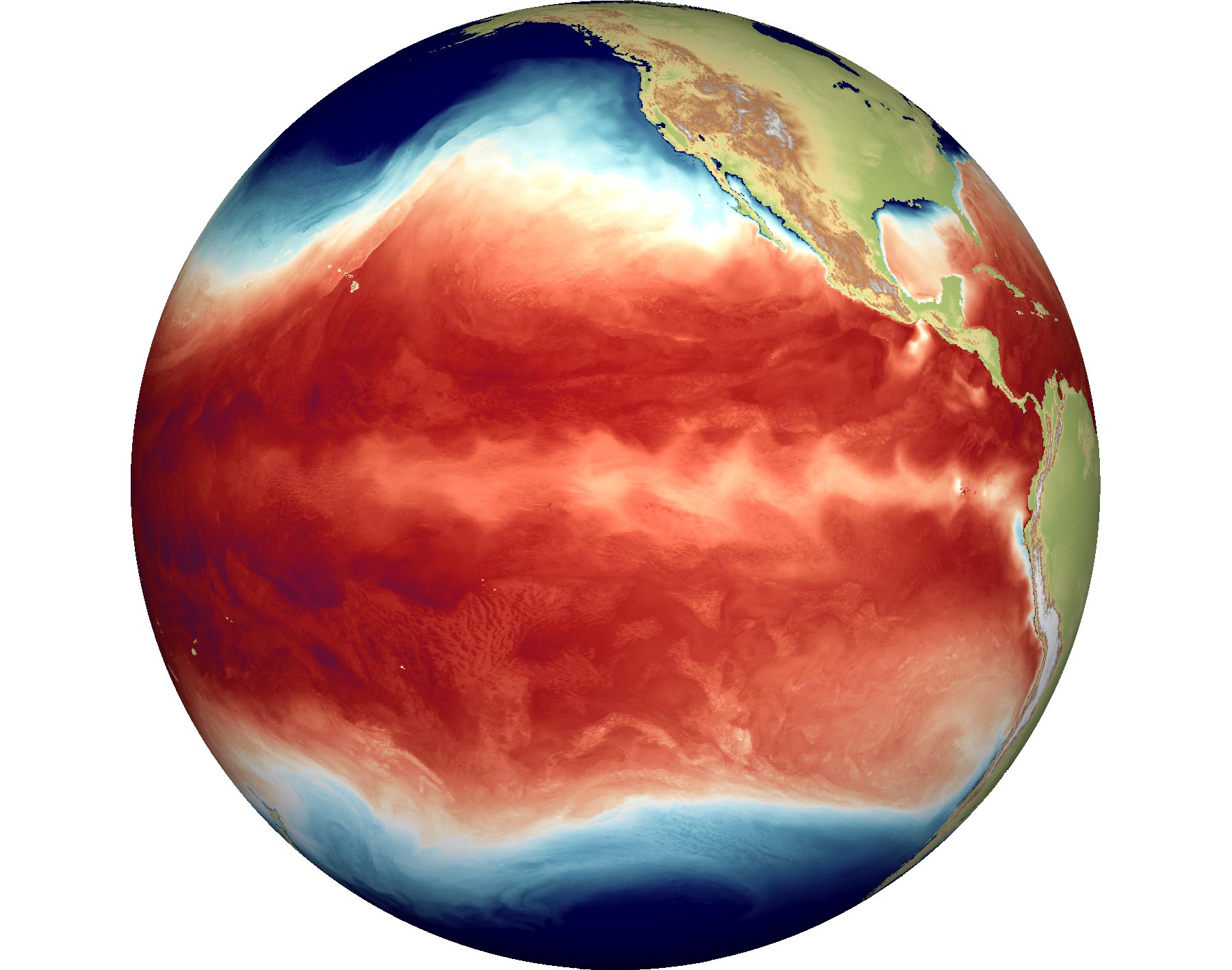
Scientists predict that global warming could make El Niño far more powerful and consistent than before.
High-resolution models show that within decades, the Pacific may hit a tipping point, locking Earth into intense, rhythmic climate cycles. This synchronization of global systems could increase extreme weather and rainfall variability around the world.
El Niño’s Future Shock: A Climate System on the Brink
A new study published in Nature Communications reports that the El Niño–Southern Oscillation (ENSO), one of the most influential forces shaping Earth’s climate, may undergo a major transformation as greenhouse gas levels rise. Using high-resolution climate simulations (Figure 1), researchers from South Korea, the USA, Germany, and Ireland found that ENSO could rapidly strengthen in the coming decades and begin to move in sync with other global climate systems. These changes are expected to reshape worldwide temperature and rainfall patterns by the end of the century.
From Chaos to Rhythm: A Dramatic Shift in ENSO Cycles
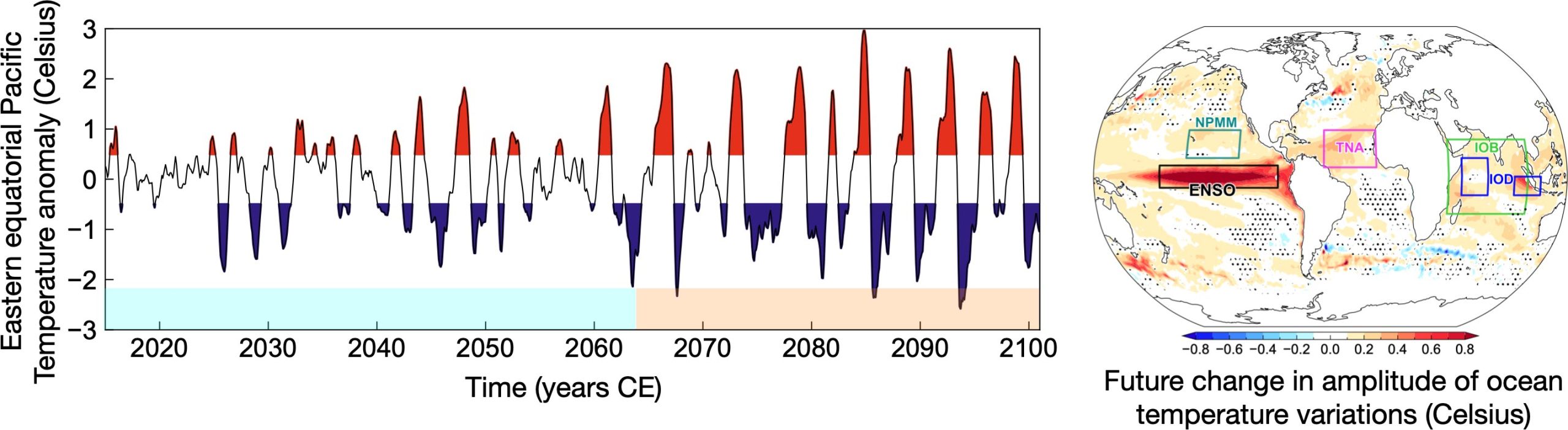
The study predicts that within the next 30 to 40 years, the irregular swings of El Niño and La Niña could evolve into consistent, powerful cycles defined by stronger sea surface temperature (SST) variations (Figure 2).
“In a warmer world, the tropical Pacific can undergo a type of climate tipping point, switching from stable to unstable oscillatory behavior. This is the first time this type of transition has been identified unequivocally in a complex climate model,” says Prof. Malte F. Stuecker, lead author of the study and Director of the International Pacific Research Center at the University of Hawaiʻi at Mānoa, USA. “Enhanced air-sea coupling in a warming climate, combined with more variable weather in the tropics, leads to a transition in amplitude and regularity,” he adds.
Climate Phenomena in Sync: A Planetary Chain Reaction
The team’s high-resolution model simulations show that a stronger and more regular ENSO may begin to synchronize with other major climate systems, including the North Atlantic Oscillation (NAO), the Indian Ocean Dipole (IOD), and the Tropical North Atlantic (TNA) mode. This synchronization is similar to how loosely connected pendulums eventually start swinging together at the same rhythm.
“This synchronization will lead to stronger rainfall fluctuations in regions such as Southern California and the Iberian Peninsula, increasing the risk of hydroclimate ‘whiplash’ effects,” says Prof. Axel Timmermann, corresponding author of the study and Director of the IBS Center for Climate Physics at Pusan National University, South Korea. “The increased regularity of ENSO could improve seasonal climate forecasts; however, the amplified impacts will necessitate enhanced planning and adaptation strategies,” he adds.
Supercomputers and Climate Tipping Points
To examine these changes, researchers used the Alfred Wegener Institute Climate Model (AWI-CM3), which simulates atmospheric conditions at a resolution of 31 km and ocean processes at 4–25 km, under a high-emission greenhouse gas scenario. They also compared their results with observational data and other climate models to confirm the findings.
“Our simulation results, which some other climate models support, show that ENSO’s future behavior could become more predictable, but its amplified impacts will pose significant challenges for societies worldwide,” says Dr. Sen Zhao, co-lead author of the study and researcher at the University of Hawaiʻi at Mānoa.
Global Consequences and the Need for Preparedness
The study emphasizes that human-driven climate change could fundamentally reshape ENSO and its influence on other climate processes, even in regions far from the tropical Pacific, including Europe.
“Our findings underscore the need for global preparedness to address intensified climate variability and its cascading effects on ecosystems, agriculture, and water resources,” says Prof. Axel Timmermann.
Next Steps: Probing the Planet’s Rhythms in Even Higher Detail
The research team plans to continue exploring how global climate systems become synchronized by conducting additional high-resolution simulations, including experiments with 9 km and 4 km resolution models. These studies are being performed on the Aleph supercomputer at the IBS Center for Climate Physics in South Korea.
Reference: “Global climate mode resonance due to rapidly intensifying El Niño-Southern Oscillation” by Malte F. Stuecker, Sen Zhao, Axel Timmermann, Rohit Ghosh, Tido Semmler, Sun-Seon Lee, Ja-Yeon Moon, Fei-Fei Jin and Thomas Jung, 16 October 2025, Nature Communications.
DOI: 10.1038/s41467-025-64619-0
Never miss a breakthrough: Join the SciTechDaily newsletter.
Follow us on Google and Google News.
22 Comments
The atmosphere is complicated. In various scenarios the average temperature could rise to over 150 F in populated areas, and fall to well below freezing in the Summer in a mater of years. This is why the name was changed from Global Warming to Climate Change. Because in some cases the temperature could go very high in some areas, but also go very low in other areas all at the same time. It’s the climate going wacky, because of out use of gasoline for our cars. Big oil is the cause. Please give us EVs.
Your assertions, sans any citations or even logical support, are not proof of your belief system. What is wacky is your suggestion that “Big oil is the cause” of “Climate Change.” Anthropogenic influences are more varied than just gasoline and diesel fuel. To think that internal combustion engines for transportation are alone responsible demonstrates how myopic your views are. Keep in mind that the last continental glaciation started to wane about 20,000 year ago, and the current Holocene Epoch that we live in is considered to be a warm interglacial episode. Even if humans are contributing to the warming, it is impossible that humans started the warming. The warming that has been occurring is episodic and has sometimes included cooling, such as during the Little Ice Age. A case can be made that while humans do contribute to CO2 in the atmosphere, it is warming that drives the release of natural CO2, which is more than an order of magnitude larger than anthropogenic releases. It is actually contentious what role CO2 plays in the feedback loop of temperature and CO2; there is no agreement on the climate sensitivity to a doubling of the CO2 concentration.
You are free to go buy an EV for whatever reason(s) you choose. However, remember the old warning, “Be careful what you wish for. You may get it.”
“……that the last continental glaciation started to wane about 20,000 year ago, and the current Holocene Epoch that we live in is considered to be a warm interglacial episode…….” .Yes. Question; given that H sap’ activities of diverse sorts have increased atmospheric CO2 by 150ppm since the apparently desirable 270ppm achieved by Mother Nature before the industrial revolution that began when the UK started mining coal in the mid-1600s, has that 150ppm caused a spike in global warming that could trigger the assorted nasties of assorted climatic changes (e.g. the ski-fields of the world just aren’t what they used to be) that have happened since the beginning of the industrial revolution?
If no, that’s fine.
If maybe, the precautionary principle applies.
If yes, electric cars (and air-conditioners) won’t solve the problem as those require energy.
“… given that H sap’ activities of diverse sorts have increased atmospheric CO2 by 150ppm since the apparently desirable 270ppm …”
You are assuming, without incontrovertible proof, that H. sapiens are responsible for the increase in CO2, which in turn is responsible for the warming. For starters, a case can be made that the CO2 increased BECAUSE of the warming: out-gassing from the oceans because CO2 is less soluble in warm water and decreased uptake for the same reason, and increased respiration from soil and tree roots, particularly during the warming Winters. There is increased CO2 also because Earth is ‘greening,’ as documented by NASA (~18%); as the mass of vegetation increases, there is more seasonal detritus for bacteria and fungi to convert to CO2 by decomposition but there is a time lag of a year. Increased evaporation in the oceans will lead to more rain (somewhere), which will increase global methane emissions.
You are uncritically accepting the idea that 270 PPMv concentration of CO2 is preferable over a higher value. During the Little Ice Age, glaciers advanced in the Alps, covering pastures and agricultural fields, and threatening villages. Even lowlands in the rest of Europe experienced early frosts and bitter Winters, destroying field crops before they could be harvested, resulting in frequent and severe famines with loss of lives. It wasn’t just fun and games at ice festivals on the Thames! Even today, more people die from cold than from heat. If CO2 is significantly responsible for modulating Earth temperatures, low levels are NOT desirable.
There is no agreement on how much the temperature increases for a doubling of CO2. No less than some Nobel Laureates and respected emeritus professors, who are atmospheric physicists, have provided rigorous evidence that the warming from CO2 is insignificant. In science, it isn’t the percentage of scientists that believe a paradigm that is significant. It is, instead, the quality of proof. As Einstein pointed out to the numerous critics of his General Theory of Relativity, “Why 100 when it only takes one to prove me wrong?” You seem to prefer to believe the left-leaning ‘news’ media and those of the ilk of Michael Mann, whose academic background, not too different from my own, is in geophysics and mathematics, not climatology. His primary ‘contribution’ to climatology is an algorithm that supposedly demonstrates a ‘hockey stick’ shape for the growth of temperature. It has subsequently been shown to produce a ‘hockey stick’ shape even when fed red noise! Thus, it has been demonstrated to be wrong.
Even if the Industrial Revolution ‘started’ in the mid-1600s, the contribution from coal was insignificant in the beginning. Even the first oil well in 1859, which helped save the whales by providing kerosene to replace whale oil for lamps, made little impact. It wasn’t really until the end of WWII that a correlation between CO2 and fossil fuels was established. What you and many others don’t seem to appreciate is that correlation does NOT establish causation. It is difficult to demonstrate the causation. While humans make a contribution to the rising CO2, actual cause and effect are difficult to prove because the annual contribution of humans is only about 4% of the seasonal flux. If that 4% were to disappear one could not expect the ‘problem’ to be solved because the natural sinks can’t distinguish between natural CO2 and anthropogenic CO2. They sequester CO2 in proportion to the partial pressure of the variously sourced CO2 emissions.
I think that you (and many others) don’t really understand the Precautionary Principle. A rational person does not spend all their savings to protect themselves against a low-probability event that cannot be proven will happen in the future. It instead suggests that if there is little or no cost for a behavioral change that might prevent a low but indeterminate probability event with negative consequences, a prudent person would adopt the change. It is similar to a person who claims not to be superstitious yet still avoids stepping on the cracks in the sidewalk. The Precautionary Principle is analogous to Pascal’s Wager. It does NOT justify significant costs or changes in lifestyle.
Over the 800,000 years prior to the 20th century, atmospheric CO2 was Never Over 300ppm, and only 300ppm once, roughly 330,000 years ago. Close a few other times.
The range was 170-300ppm.
Oh, and other than from the cold, ice sheets etc. during ice ages,
Despite the nonsense from the so called CO2 Coalition, Plants did okay. They do NOT need more CO2, and especially such an insanely fast increase.
—————————————————–
“No less than some Nobel Laureates and respected emeritus professors, who are atmospheric physicists, have provided rigorous evidence that the warming from CO2 is insignificant. In science”
FALSE
ONE Nobel winning scientist with ZERO experience or expertise in climate science; Ivar Giaever.
His science has nothing to do with climate science. He spent about 6 hours Googling Climate Science and made up his mind, according to his own words. He has reportedly been a shill for the tobacco industry.
I’m not even a scientist, but I bet I know more about it than he did, after 18 years and at least 18,000 hours learning about the science. I have about 22,000 pages of notes on climate science.
There is NO “growing number of experts on climate science who are skeptics.”
Here’s where that LIE, repeated by Energy Secretary Chris Wright, comes from. – his own industry’s propaganda -disinformation PR machine.
“there is no climate emergency” Chris Wright
——————–
CLINTEL a fossil fuels funded group that keeps claiming large numbers of skeptic “experts”.
TWO climate scientists out of 900 “experts”
—————————-
CLINTEL claim of 900 skeptic scientists
“over 900 highly-experienced climate scientists and engineers in 37 countries.”
On that list the word “mining” appears 31 times. The word “petroleum appears 23 times.” The word “retired” appears 280 times. “Medical” appears 19 times. “Energy” 118 times. “Metallurgist” 12 times.
“Climatologist” appears 2 times. “Meteorologist” appears 15 times but over half are “retired” or “former.”
—————————
FOUR climate scientists out of 1,100 “experts”
Experts Debunk Viral Post Claiming 1,100 Scientists Say ‘There’s No Climate Emergency’
” the experts told me, the vast majority of the declaration’s signatories have no experience in climate science at all, and the group behind the message—the Climate Intelligence Foundation, or CLINTEL—has well-documented ties to oil money and fossil fuel interest groups.”
“There are millions of scientists worldwide, so I’m not sure getting 1,000 people to sign a petition is particularly meaningful,” Hausfather said, “particularly when balanced against the massive scientific agreement around climate change, including the national academies of science in pretty much every major country.”
In fact, the term “massive” in this context could be considered an understatement. A 2013 study found that some 97 percent of peer-reviewed research on climate change was in agreement: rapid climate change is happening beyond what would be considered resulting from natural causes, and humans are largely responsible. And in 2021, another study, this one published in the journal Environmental Research Letters, analyzed 88,125 peer-reviewed studies on climate change and found that a jaw-dropping 99.9 percent of them came to the same conclusion as the 2013 study.”
Inside Climate News
EVERYTHING in your comment was shown to be FALSE and/or Totally Misleading LONG AGO.
‘release of natural CO2, which is more than an order of magnitude larger than anthropogenic releases’
WHOOPS, you forgot the Other Half of the Carbon Cycle, the flux Out of the atmosphere. The natural sources of CO2 flux into the atmosphere are taking more OUT than they put IN. One of many many denier Slogans repeated endlessly, based on a kernel of truth and Twisted into an egregious LIE.
“while humans do contribute to CO2 in the atmosphere” – another slogan, NOT based on science.
Oh we sure as hell do “contribute”. This is NOT NATURAL
Nature caused CO2 increases over the last 450,000 years, from ice core data
80ppm increase — took 50,000 years
110ppm increase — 25,000 years
120ppm increase — 20,000 years
60ppm increase — 20,000 years
90ppm increase — 15,000 years
100ppm increase — 24,800 years
the fastest natural CO2 increase was 90ppm taking 15,000 years.
WE have done that in about the last 65 years.
————————–
Humans increased CO2 by 25ppm in the last 10 years
Humans increased CO2 by 45ppm in the last 20 years.
Humans increased CO2 by over 80ppm in the last 60 years
Humans increased CO2 by 100ppm in the last 70 years
Humans increased CO2 by 146ppm in the last 144 years
———
“The maximum rate of change in CO2 concentrations from the ice core records is around 100 ppm in 10,000 years, or around 1 ppm per century.
The current rate of change in CO2 concentrations is 1 ppm every 21 weeks.”
NASA Climate Change
That comes to 247 times faster CO2 increase now.
“ONE Nobel winning scientist with ZERO experience or expertise in climate science; Ivar Giaever.”
I’ll see your one Laureate and raise you two more: John Clauser and Kary Mullis. Additionally, there are physicists with impeachable backgrounds such as Freeman Dyson, Richard Lindzen, Will Happer, and William van Wijnggaarden.
Richard Feynman is problematic. While he never explicitly discussed his position (if any) on modern climatology, reading what he DID write confirms he didn’t approve of the way the ‘science’ is conducted with the emphasis on models rather than empirical data.
I have a question for you: Why did you write untruthful things? Did you not do your due diligence, which is unlikely considering that you claim to have 22,000 pages of notes. Or did you do exactly what you accuse others of — you lied.
“They do NOT need more CO2, and especially such an insanely fast increase.”
I’m supposed to believe a self- acknowledged non-scientist when scientists have claimed that plants have an optimum range, and when CO2 concentrations get low, the plants adapt by developing larger stomata. And, commercial growers with hot houses elevate the CO2 for certain crops. Obviously, they know what they are doing.
There are no facts in evidence that the rate of increase of global CO2 is germane to the discussion — even an “insanely fast increase.”
You and NASA are confusing the low-temporal resolution of ice core CO2, which is an average over many years, with the monthly measurements at monthly (actually, daily) resolution. That is, the 1 PPMv concentration every 21 weeks is for the smoothed measurements at MLO. At a temporal resolution fine enough to discern the seasonal changes, typically monthly, the rate of change is much greater than 1 PPMv. Which demonstrates that your cut and paste quotes are really non sequiturs. You have also demonstrated that you don’t understand that correlation alone does not establish causation. So, your tabulation above that attributes the historical rise of CO2 to humans is not logically defensible. It leads me to believe that you really don’t understand what you are reading.
“WHOOPS, you forgot the Other Half of the Carbon Cycle, the flux Out of the atmosphere.”
I have been trying to understand what point you are trying to make. It simply doesn’t make sense. I have more than a passing acquaintance with the subject: https://wattsupwiththat.com/2021/06/07/carbon-cycle/
“‘while humans do contribute to CO2 in the atmosphere’ – another slogan, NOT based on science.”
On the contrary. It is the result of my personal analysis, not the copying and pasting that you engage in.
https://wattsupwiththat.com/2021/06/11/contribution-of-anthropogenic-co2-emissions-to-changes-in-atmospheric-concentrations/
https://wattsupwiththat.com/2021/12/16/co2-party-having-fun-with-probabilities/
https://wattsupwiththat.com/2022/03/22/anthropogenic-co2-and-the-expected-results-from-eliminating-it/
“the Climate Intelligence Foundation, or CLINTEL—has well-documented ties to oil money and fossil fuel interest groups.”
I have asked Copilot (LLM AI) if it can substantiate the claims such as yours. It seems to be little more than an Urban Legend. Copilot was unable provide information on the supposed sources of the money, the amounts, the times, or manner in which the money was provided. Even if the claims are true, there is no substantiated evidence to support it. Thus, to continue to make the claims in the absence of evidence, it is little better than rumor mongering. That isn’t the way that science works.
“A 2013 study found that some 97 percent of peer-reviewed research on climate change was in agreement: …”
There have been at least a couple people who have published a careful analysis of that ‘study.’ It was an extremely poor piece of work. You should be embarrassed to reference it! Perhaps you should do your due diligence on this.
The one thing that you have demonstrated consistently is that, as you state, you are NOT a scientist. At least you got one thing right.
Electric vehicles will pollute the water system .
NOBODY changed the name from Global Warming to Climate Change. Scientists used both terms as far back as the 1970s. It was even in the title of a few peer reviewed published papers.
The Intergovernmental Panel on CLIMATE CHANGE was founded and NAMED in 1988, Thirty Seven years ago.
—————
The was an auto industry executive who suggested changing the term to climate change, to make global warming less scary to the public.
Global warming CAUSES Climate Change.
Heat and drying in already dry parts of the world, changed weather patterns, changed time when seasons begin or end, which disrupts migration patterns of many creatures, including birds, pollinator insects, fish and whales
Sea level rise.
More intense hurricanes, increased intensity of forest fires over much of the world,
Alpine Glaciers (90% of world’s alpine glaciers are melting;
and Polar glaciers, ice sheets and sea ice decreasing;
Ocean acidification harming corals and any sea creature with a shell;
and warmer sea water causing coral reef bleaching and death.
Pine bark beetle populations exploding, devastating conifer trees, due to warmer and shorter winters, all across the U.S. West for example. That adds to the fuel load for forest fires.
Melting of permafrost releasing greenhouse gases methane and CO2
Global warming is the disease. Climate change is the symptoms.
The atmosphere is complicated. In various scenarios the average temperature could rise to over 150 F in populated areas, and fall to well below freezing in the Summer in a mater of years. This is why the name was changed from Global Warming to Climate Change. Because in some cases the temperature could go very high in some areas, but also go very low in other areas all at the same time. It’s the climate going wacky, because of our use of gasoline for our cars. Big oil is the cause. Please give us EVs.
“… [simulated] temperature pattern for a typical La Niña event with equatorial COLD temperatures …”
Where is the color palette for the lede picture that will allow the reader to associate the sea surface temperature with the various shades of red? Rather than just show us a ‘pretty picture,’ with lots of alarming red hues, how about communicating some actual numeric information? I, for one, am interested in knowing the degree of temperatures that are being discussed and what the range is. It isn’t surprising that equatorial waters would be warm, but the caption on the lede picture suggests something different from what the picture suggests.
The article also states, “the Pacific MAY hit a tipping point, locking Earth into intense, rhythmic climate cycles. One simple question: Is there any geological evidence from past warming episodes to confirm that Earth has EVER experienced “intense, rhythmic climate cycles?” If not, then the model is probably wrong. If there is, then the empirical evidence suggests that the hypothesized “tipping point” did not occur because we are NOT still locked into the “intense, rhythmic climate cycles.”
Nobel Laureate Richard Feynman famously said, “It doesn’t matter how beautiful your theory is, it doesn’t matter how smart you are. If it doesn’t agree with experiment, it’s wrong.” Computer models are a form of theory (or more accurately, complex hypothesis). Geological evidence is the result of the equivalent of a natural experiment. Thus, the final arbiter in a disagreement between a computer model and empirical evidence is the evidence. If the model/hypothesis is wrong, then the Scientific Method requires the model to be changed.
The only problem in regard to “climate change” is if the “model” is correct, we won’t know how correct it has been until the experiment is over. The problem is that so far we haven’t yet predicted when this particular climate change experiment will be finished. Evidence may be creeping in, but it ain’t done yet.
There is a HIMALYAN MOUNTAIN RANGE of Evidence for AGW, an overwhelming preponderance of Evidence. And how fast it’s happening is truly frightening for climate scientists.
The science is NOT JUST MODELS, FAR FROM IT.
You are just repeating what people who do not know the science say.
And what those who LIE about it say.
A study of the published peer reviewed research papers found that 99.9% of them agree with AGW.
EVERY major scientific organization of national or international standing on the planet that’s relevant to earth sciences, agrees with the science, as do every relevant govt. science agency, – now with Trump and America as an exception.
I forgot to say that there were 88,1 25 climate research papers analyzed in that study
Science isn’t based on voting. If the papers don’t withstand scrutiny and pointed criticism, then they have zero weight in the ‘weight of evidence.’
https://en.wikipedia.org/wiki/Paradigm_shift
Here is a recent analysis of the two studies you are claiming to support consensus:
https://wattsupwiththat.com/2025/11/09/consensus-likelyhood-and-confidence/
It is well worth reading if you want to actually understand the consensus claims. It also provides insight on the mental processes of those who think that consensus is important in science.