

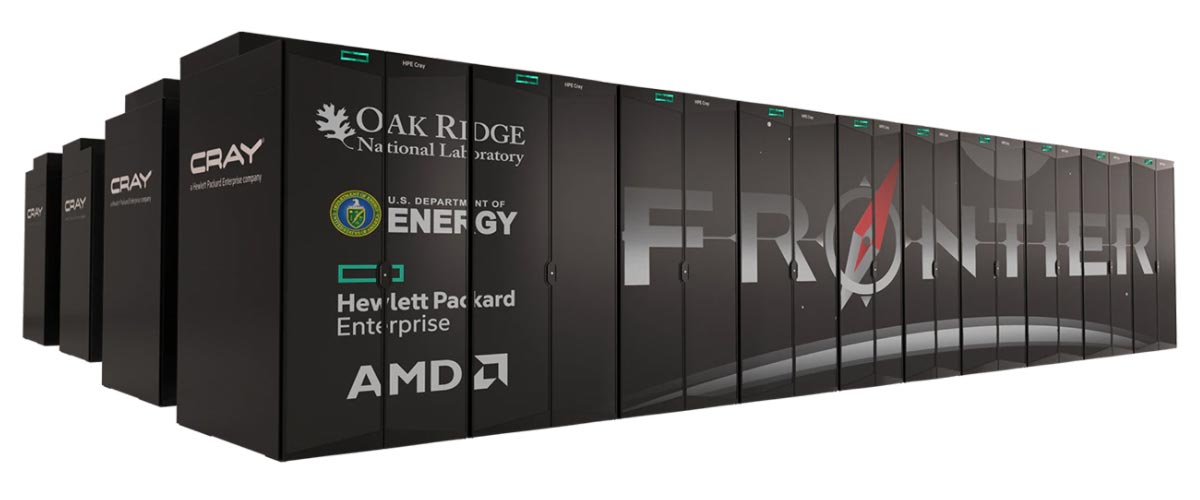
The Frontier supercomputer at Oak Ridge National Laboratory has achieved a new benchmark in computational speed, recording 1.35 exaflops in the High-Performance Linpack score.
Since its debut in 2022, Frontier has added 400 new nodes, contributing to a significant boost in its computing capabilities. The system now excels in mixed-precision computational tasks, which is crucial for applications ranging from modeling biological phenomena to advancing artificial intelligence.
Frontier Supercomputer’s Continued Evolution
Two and a half years after becoming the first supercomputer to break the exascale barrier, the Frontier system at the Department of Energy’s Oak Ridge National Laboratory continues to redefine performance benchmarks for speed and efficiency.
Last week, the HPE Cray EX supercomputer set a new record for problem-solving speed, unveiled during the TOP500 update at the International Conference for High Performance Computing, Networking, Storage, and Analysis (SC24) in Atlanta. Frontier achieved a High-Performance Linpack (HPL) score of 1.35 exaflops—equivalent to 1.35 quintillion calculations per second—using double-precision arithmetic, the 64-bit standard for scientific accuracy in computational research.
Leadership and Performance Achievements
“Frontier’s new numbers reflect the tremendous contributions of OLCF’s computing and computational experts who know how to best optimize bleeding-edge high-performance computing systems to serve the evolving needs of our scientific user community,” said Gina Tourassi, associate laboratory director for computing and computational sciences at ORNL. “They never stop pushing boundaries, throughout the life of the system.”
The score earned Frontier the No. 2 spot on the November 2024 TOP500 list, which ranks the fastest supercomputers in the world. Frontier debuted atop the list in May 2022 at 1.1. exaflops as the first machine to achieve exascale performance at more than a quintillion calculations per second.
“Our in-house team of experts understands just how to get the most from this system in terms of performance,” said Ashley Barker, director of the Oak Ridge Leadership Computing Facility, which houses Frontier. “They’re the world’s most experienced exascale computing team, and they ran this test on Frontier while the machine ran other science problems for users.”

Significant Advancements in Computing Power
Frontier’s improved speed marks a jump of roughly 150 petaflops, or 150 quadrillion calculations per second — roughly equivalent to the performance of its predecessor supercomputer Summit, which was decommissioned last week.
“We could already solve amazingly large problems on Frontier — the biggest science problems on the planet,” said Al Geist, an ORNL Corporate Fellow and Frontier project director. “This year, we’ve basically picked up the power of another supercomputer (like Summit).”
Expanding Capabilities and Future Applications
Frontier relies on a constellation of thousands of nodes, each a self-contained supercomputer of one CPU and four GPUs, connected by more than 90 miles of cable to enable them to communicate and work together on large problems. Frontier debuted in 2022 with more than 9,400 nodes, and crews have since added another 400 nodes for a current total of more than 9,800. The latest HPL benchmark ran across 9,500 nodes.
Geist estimates about half of Frontier’s improved score can be credited to the new nodes, which had been used for application development and testing by the Exascale Computing Project. The ECP oversaw development of software applications for Frontier and other exascale machines, such as the Aurora supercomputer at Argonne National Laboratory and the El Capitan supercomputer at Lawrence Livermore National Laboratory, and completed its work earlier this year.
On top of the new nodes and exascale experience gained by OLCF computing experts, Frontier boasts improvements to its math libraries developed by HPE, which built Frontier, and AMD, maker of the CPUs and GPUs that power Frontier.
Besides the updated HPL number, the Frontier team logged a new High-Performance Linpack-Mixed Precision, or HPL-MxP, score of 11.4 exaflops, or 11.4 quintillion calculations per second, running across all 9,800 nodes. That’s a jump of more than an exaflop from the previous HPL-MxP score of 10.2 exaflops.
The detailed simulations used to model such phenomena as cancer cells, supernovas, the coronavirus or the atomic structure of elements require 64-bit precision, a computationally demanding standard of accuracy. Machine-learning algorithms used for artificial intelligence typically require less precision — sometimes as little as 32-, 24- or 16-bit accuracy.
“This shows how capable Frontier is for AI problems,” Barker said. “The results we get from mixed-precision runs are equally accurate, but they’re reached in a different way, mathematically. For some questions, double precision will remain the standard, but at these potential speeds, we expect more researchers will start to explore what kind of results they can achieve via mixed precision. They’d like to take advantage of this ability to solve problems faster by a factor of 10, and our team knows how to make that happen.”
Frontier is an HPE Cray EX system with more than 9,800 nodes, each equipped with a third-generation AMD EPYC™ CPU and four AMD Instinct™ MI250X GPUs. The OLCF is a DOE Office of Science user facility.
Never miss a breakthrough: Join the SciTechDaily newsletter.
Follow us on Google and Google News.
1 Comment
bMemo 2411300404 Source 1 Analysis_【】
1.
Frontier Supercomputers Solved the Biggest Scientific Problems on Earth Surging With 1.35 Exaplops[1]Frontier Supercomputers at Oak Ridge National Laboratory achieved a new benchmark for computational speed, scoring 1.35 Exaplops on its high-performance Linpack score.
_[1]
The top supercomputer in the first half of this year is Frontier at the Oak Ridge National Laboratory in Tennessee, which has HPL scores. One exa-flops means that it can perform floating-point calculations for 100 times (10^16) in one second. If a small quantum computer is introduced, it will easily reach 135 years (10^20) exa-flops. Huh.
Of course the performance of msbase.nk2 would be 10^gae^^^ at 100googol.adameve_size per second.In the instant, we can figure out the product of the number of particles of all quantities in our universe purely with ms.nk2 without a computer. Huh. They’re laughing. Off!
2.
significant advances in computing power
Frontier’s improved speed is about 150 petaflops, or 150 trillion calculations per second.
Frontier relies on a constellation of thousands of nodes. Each is a standalone supercomputer composed of one CPU and four GPUs, which can be connected by more than 90 miles of cable to communicate and work together on large-scale issues. Frontier debuted with more than 9,400 nodes in 2022, and since then, its crew has added 400 nodes, now totaling more than 9,800. The latest HPL benchmarks have run on 9,500 nodes.
2.
We’ve already been able to solve a surprisingly large problem at Frontier. It’s the biggest scientific problem on Earth.
Detailed simulations used to model phenomena such as cancer cells, supernovae, coronaviruses, or the atomic structure of elements require 64-bit precision. This is a computationally demanding criterion of accuracy. Machine learning algorithms used for artificial intelligence generally require less precision. Sometimes 32, 24, or 16-bit accuracy is required.
“This demonstrates how competent Frontier is at AI problems. Results obtained from mixed precision runs are equally accurate but reach them in a mathematically different way. For some questions, double precision remains the norm, but at this potential rate, we expect more researchers to begin exploring what kind of results can be obtained with mixed precision. They want to take advantage of this feature, which can solve problems 10 times faster, and our team knows how to make it happen.
ㅡㅡㅡㅡㅡㅡㅡㅡㅡㅡㅡㅡㅡㅡ
Source 1.
https://scitechdaily.com/frontier-supercomputer-surges-to-1-35-exaflops-to-tackle-the-biggest-science-problems-on-the-planet/
Frontier Supercomputers Surge to 1.35 Exaflops, Solving “Biggest Scientific Problem on the Planet”