
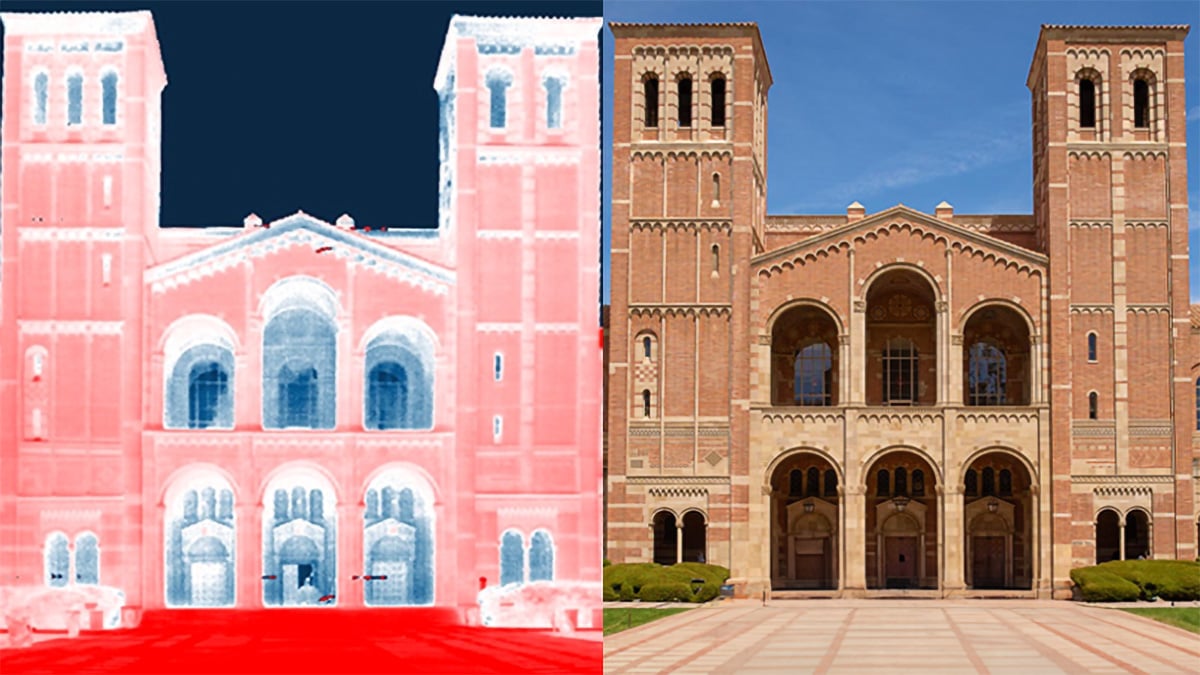
A low-cost method uses common building materials that absorb or radiate heat to regulate temperature.
As global temperatures increase, the demand for sustainable cooling solutions is also on the rise. A team of researchers from UCLA and their collaborators have developed a cost-effective and scalable method to cool buildings during the summer and heat them in the winter.
Led by Aaswath Raman, an associate professor of materials science and engineering at the UCLA Samueli School of Engineering, the research team recently published a study in Cell Reports Physical Science detailing a new method to manipulate the movement of radiant heat through common building materials to optimize thermal management.
Radiant heat, which is felt whenever a hot surface warms our bodies and homes and is carried by electromagnetic waves, travels across the entire broadband spectrum at ground level between buildings and their environments, such as streets and neighboring structures. On the other hand, heat moves between buildings and the sky in a much narrower portion of the infrared spectrum known as the atmospheric transmission window. The difference in how radiant heat travels between buildings and the sky versus the ground has long presented a challenge to cooling buildings with less skyward-facing surfaces. These buildings have been hard to cool in the summer as they retain heat from the ground and neighboring walls when the outside temperature is high. They are equally difficult to warm in wintertime as the outdoor temperature drops and the buildings lose heat.
Historical Context and Modern Innovations
“If we look at historical cities like Santorini in Greece or Jodhpur in India, we find that cooling buildings by making roofs and walls reflect sunlight has been practiced for centuries,” said Raman, who leads the Raman Lab at UCLA Samueli. “In recent years there has been massive interest in cool roof coatings that reflect sunlight. But cooling walls and windows is a much more subtle and complex challenge.”
However, with the proven success of cooling buildings by using super white paint on the roofs to reflect sunlight and radiate heat into the sky, the researchers set out to create a similar passive radiative cooling effect by coating walls and windows with materials that can better manage heat movement between buildings and their surroundings at ground level. The researchers demonstrated that materials capable of preferentially absorbing and emitting radiant heat within the atmospheric window could stay cooler than conventional building materials in the summer and warmer than they could during the winter.
“We were particularly excited when we found that materials like polypropylene, which we sourced from household plastics, can selectively radiate or absorb heat in the atmospheric window very effectively,” Raman said. “These materials border on the mundane, but the same scalability that makes them common also means that we could see them thermoregulating buildings in the near future.”
Energy Savings and Environmental Impact
In addition to leveraging easily accessible cost-saving materials, the team’s approach also has the added benefit of saving energy by reducing the reliance on air conditioners and heaters that are not only costly to run but also contribute to carbon dioxide emissions.
“The mechanism we proposed is completely passive, which makes it a sustainable way to cool and heat buildings with the seasons and yield untapped energy savings,” said Jyotirmoy Mandal, the study’s first author and a former postdoctoral scholar in Raman’s lab. Mandal is now a civil and environmental engineering assistant professor at Princeton University.
According to the researchers, the new methodology can scale easily and will be especially impactful on low-income communities with limited or no access to cooling and heating systems that have seen increasing casualties resulting from extreme weather events across the globe.
Raman and his team are exploring ways to demonstrate this effect at larger building scales and its real-world energy savings, particularly in heat-vulnerable communities in Southern California.
Reference: “Radiative cooling and thermoregulation in the earth’s glow” by Jyotirmoy Mandal, Jyothis Anand, Sagar Mandal, John Brewer, Arvind Ramachandran and Aaswath P. Raman, 27 June 2024, Cell Reports Physical Science.
DOI: 10.1016/j.xcrp.2024.102065
The study was funded in part by a Schmidt Science fellowship, the Rhodes Trust, the Alfred P. Sloan Foundation, and the National Science Foundation. Other authors of the paper are John Brewer — a recent Ph.D. graduate from Raman’s lab, Jyothis Anand of Oak Ridge National Lab, Arvind Ramachandran of Arizona State University, and independent researcher Sagar Mandal.
Never miss a breakthrough: Join the SciTechDaily newsletter.
Follow us on Google and Google News.
1 Comment
Kind of nice, but didn’t really say anything other than something like, “we’ve got something here, but we’re not going to say what”; so what’s that? Nothing.