
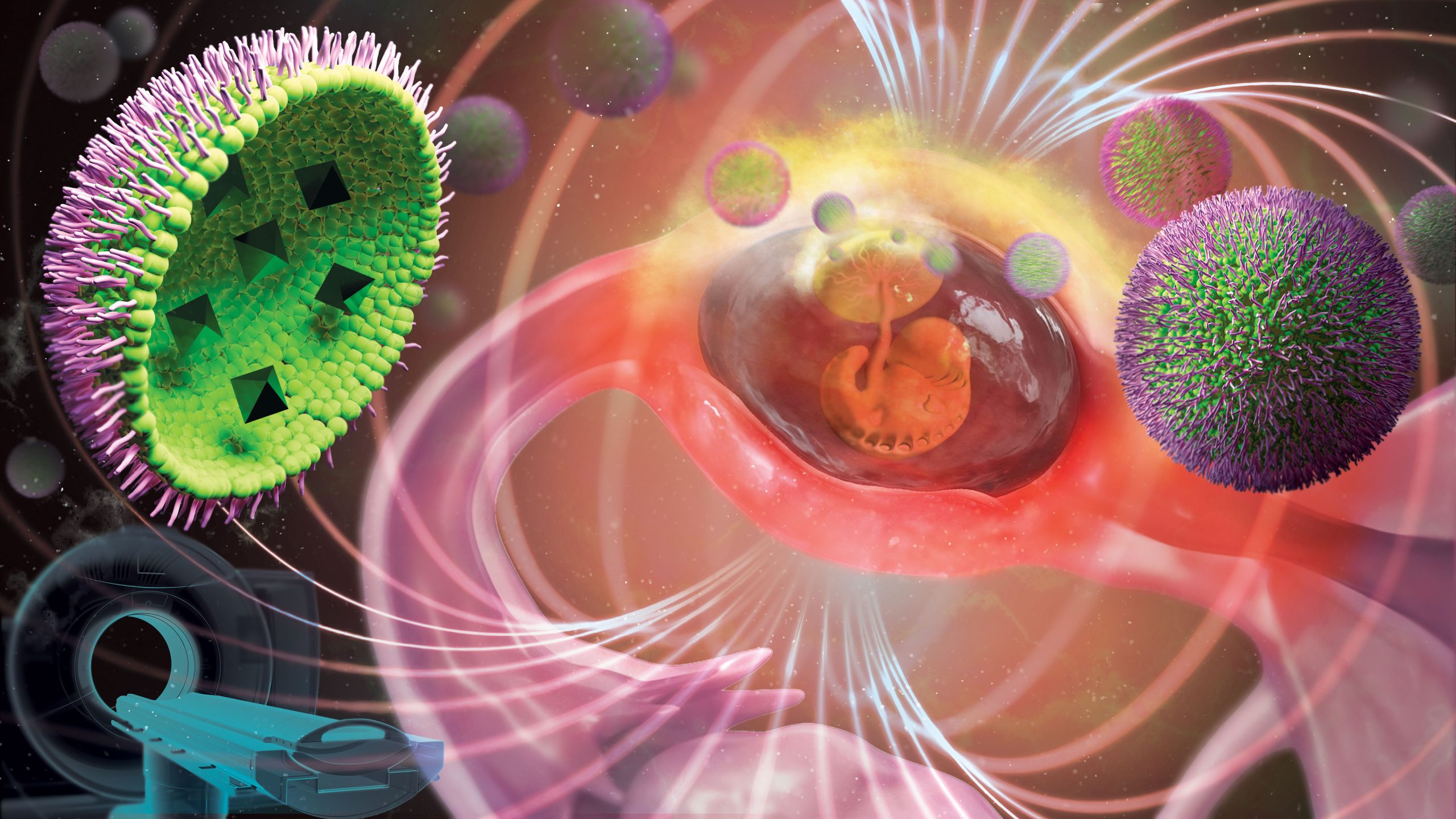
Magnetic nanoparticles could eventually help doctors both locate and treat ectopic pregnancies, after successfully targeting pregnancy-associated tissue in mice.
When a fertilized egg implants inside a fallopian tube instead of the uterus, the growing pregnancy can rupture the tube and trigger life-threatening bleeding. About 98% of these abnormal implantations occur in the fallopian tubes, making early detection and treatment critical.
This condition, known as an ectopic pregnancy, occurs when a fertilized egg implants somewhere other than the lining of the uterus. These pregnancies cannot continue normally and remain a leading cause of maternal mortality during the first trimester.
Ectopic pregnancies account for about 2% of pregnancies in the United States and between 1% and 2% worldwide. In the U.S., that amounts to roughly 100,000 cases each year. Over the past six years, about 30 women have died annually from ectopic pregnancies.
Diagnosis and treatment remain uncertain
Detecting an ectopic pregnancy early can be difficult because transvaginal ultrasound, the standard diagnostic tool, has a misdiagnosis rate of about 10%. Treatment can introduce another layer of uncertainty because methotrexate, the main drug used to end an ectopic pregnancy, has an even higher failure rate.
“Current strategies – attempted diagnosis via ultrasound, treatment with methotrexate, and surgery if necessary – are associated with the risk of tubal rupture and reduced fertility,” said Olena Taratula of the Oregon State University College of Pharmacy. “Also, there’s an increased risk of another ectopic pregnancy – a woman who has had one ectopic pregnancy is 10% more likely to have a second one.”
Methotrexate works by stopping embryonic cells from dividing, but even when the drug successfully ends an ectopic pregnancy, patients can experience nausea, vomiting, diarrhea, elevated liver enzymes, kidney damage, and lung disease, according to Taratula.
Nanoparticles home in on the placenta
Taratula, postdoctoral scholar Karthickraja Duraisamy, and collaborators at Oregon State University and Oregon Health & Science University developed a nanoparticle system intended to tackle both diagnosis and treatment. Tested in pregnant mice, the approach uses specially engineered cobalt-doped soft ferromagnetic iron oxide nanoparticles that can help locate pregnancy-associated tissue and then, when needed, destroy it with controlled heating.
After the nanoparticles were administered intravenously, they accumulated in the placenta, the organ that nourishes and maintains the fetus through the umbilical cord. Nanoparticles can be as small as one-billionth of a meter, allowing the engineered particles to circulate through the body and concentrate in the targeted tissue.
“Effective detection of the growing placenta greatly improves the accuracy and timeliness of ectopic pregnancy identification,” Olena Taratula said.
Once enough nanoparticles had collected in the placenta, researchers could visualize the organ using magnetic resonance imaging. In a human patient, the same principle could reveal whether the placenta is developing in the uterus or somewhere it should not be. If the placenta is correctly positioned, the particles would not affect the embryo because they do not cross the placental barrier.
Magnetic heating spares uterine tissue
If the placenta were instead located in a fallopian tube or another incorrect site, the same particles could potentially become a treatment. Exposure to an alternating magnetic field causes the nanoparticles to heat up, allowing them to irreparably disrupt placental function without an invasive surgical procedure.
“We developed an MRI-guided magnetic nanoplatform for localized hyperthermia, less than or equal to 45 degrees Celsius, of pregnancy-associated tissue,” Duraisamy said. “In pregnant mice, it selectively disrupted gestational sacs while preserving surrounding uterine tissue and fertility, supporting its potential as a minimally invasive treatment for ectopic pregnancy.”
At temperatures of up to 45 degrees Celsius, or about 113 degrees Fahrenheit, the localized heating disrupted the targeted gestational sacs in mice while sparing surrounding uterine tissue, and the researchers reported that fertility was preserved.
The work remains at the animal-testing stage, and the researchers say additional studies will be needed before the technology can move closer to human use.
“Our main goal in this study was to evaluate our nanoparticle’s ability to identify and visualize the developing placenta and demonstrate its magnetic hyperthermia capabilities,” Taratula added. “These results are highly promising; now in the coming years, we need to validate the findings in other animal models to further advance the application of this technology.”
Reference: “Nanoparticle-mediated magnetic hyperthermia for ectopic pregnancy treatment” by Karthickraja Duraisamy, Prem Singh, Akshay Vyawahare, Ana Paula Mesquita Souza, Kongbrailatpam Shitaljit Sharma, Kentaro Yamada, Takeshi Suzuki, Vladislav Grigoriev, Bishal Misra, Leslie Myatt, Maureen K. Baldwin, Khashayar Farsad, Oleh Taratula and Olena R. Taratula, 17 September 2026, Biomaterials.
DOI: 10.1016/j.biomaterials.2026.124639
This study was financially supported by the College of Pharmacy at Oregon State University, the National Cancer Institute of the National Institutes of Health (R01CA237569 and R37CA234006), by the Eunice Kennedy Shriver National Institute of Child Health and Human Development (R01HD112007), and OHSU School of Medicine.
Never miss a breakthrough: Join the SciTechDaily newsletter.
Follow us on Google and Google News.