
Mars’ Largest Recorded Quake Unveils Clues to Planet’s History
- The quake lasted four hours and identified layering in the crust that could indicate a meteoroid impact.
- The 4.7 magnitude temblor happened in May 2022 and released five times more energy than any previously recorded quake on Mars.
- Mapping the seismic activity on Mars will help inform scientists where and how to build structures to ensure the safety of future human explorers.
The largest earthquake ever detected on Mars has revealed layers in its crust that could indicate past collision with a massive object, such as a meteoroid. Previous data has suggested the past occurrence of a large impact, and the findings offer evidence that might support this hypothesis.
The research, led by the University of California, Los Angeles (UCLA) planetary scientists and published in two papers in Geophysical Research Letters, could also indicate that alternating layers of volcanic and sedimentary rocks lie beneath the surface.
Unique Seismic Activity Observed on Mars
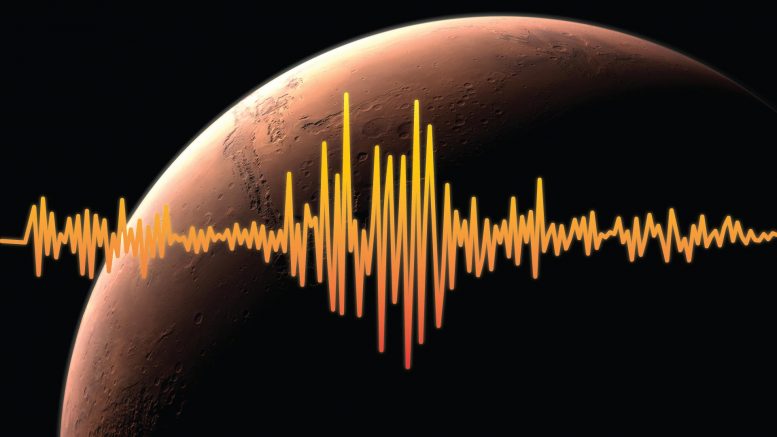
The 4.7 magnitude earthquake, or marsquake, happened in May 2022 and lasted more than four hours, releasing five times more energy than any previously recorded quake. Though moderate by Earth standards, the temblor was nonetheless powerful enough to send seismic surface waves completely around the planet’s circumference, the first time this phenomenon has been observed on Mars.
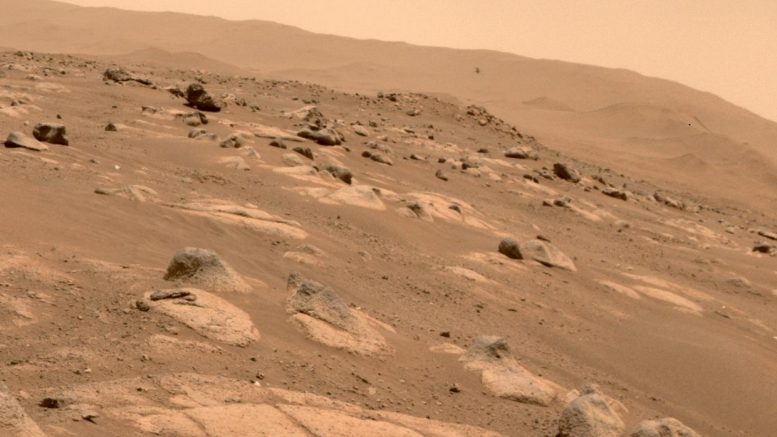
The readings were taken from InSight, which landed on Mars in 2018. InSight is the first outer space seismometer to study in-depth the “inner space” of Mars: its crust, mantle, and core.
“The seismometer aboard the InSight lander has recorded thousands of marsquakes but never one this large, and it took over three years after landing to record it,” said corresponding author Caroline Beghein, a professor of Earth, planetary and space sciences. “This quake generated different kinds of waves, including two types of waves trapped near the surface. Only one of those two has been observed on Mars before, after two impact events, never during a marsquake.”
Mapping the seismic activity, the location and frequency of impacts on Mars and the interior structure is important for future missions to the red planet as it will inform scientists and engineers where and how to build structures to ensure the safety of future human explorers.
As on Earth, studying how seismic waves travel through rocks can give scientists clues about the temperature and composition of the planet below the surface that help inform the search for underground water or magma. It also helps scientists understand the past forces that shaped the planet.
Beghein’s group combined measurements from two types of surface waves, called Love and Rayleigh waves, to infer the speed of underground shear waves, which travel horizontally and move rocks perpendicular to the direction of wave propagation. This is the first time Love waves have been observed in conjunction with Rayleigh waves on Mars.
Insights into Mars’ Crust and Regional Variations
The measurements showed that the shear waves move faster in the crust when rocks between 10 and 25 kilometers underground oscillate in a direction almost parallel to the planet surface than if the rocks vibrate in the vertical direction.
“This wave speed information is related to deformations inside the crust,” Beghein said. “Alternating volcanic rocks and sedimentary layers, which were deposited long ago, or a very large impact, such as a meteoroid, most likely account for the seismic wave measurements we observed.”
These data also enabled Jiaqi Li, a UCLA postdoctoral researcher in Beghein’s group, to learn that shear waves move faster in the Martian southern highland areas than in the northern lowlands. The northern hemisphere of Mars has a lower elevation and is covered with more craters than the southern hemisphere. A large impact in the lowlands has been the prevalent theory to explain the origin of this difference.
The new data point toward the presence of thick accumulations of sedimentary rocks and relatively higher porosity in the lowlands. Larger amounts of gas, such as trapped air in these sedimentary rocks, slow the waves down.
References:
“Crustal Anisotropy in the Martian Lowlands From Surface Waves” by C. Beghein, J. Li, E. Weidner, R. Maguire, J. Wookey, V. Lekić, P. Lognonné and W. Banerdt, 14 December 2022, Geophysical Research Letters.
DOI: 10.1029/2022GL101508
“Different Martian Crustal Seismic Velocities across the Dichotomy Boundary from Multi-Orbiting Surface Waves” by Jiaqi Li, Caroline Beghein, Philippe Lognonné, Scott M. McLennan, Mark Wieczorek, Mark Panning, Brigitte Knapmeyer-Endrun, Paul Davis and William Bruce Banerdt, 14 December 2022, Geophysical Research Letters.
DOI: 10.1029/2022GL101243
Never miss a breakthrough: Join the SciTechDaily newsletter.
Follow us on Google and Google News.
2 Comments
“The northern hemisphere of Mars has a lower elevation and is covered with more craters than the southern hemisphere. ”
The most cursory glance at any large-scale map of Mars shows the complete opposite, so far as crater count is concerned.
Who writes this stuff?
Thanks for the correction. There must be a typo in this interview report.
I agree with William that the southern highlands are highly cratered, and the northern lowlands are resurfaced (i.e., fewer craters from the Mars map).