
Close Menu
    Facebook X (Twitter) Instagram
    SciTechDaily
    • Biology
    • Chemistry
    • Earth
    • Health
    • Physics
    • Science
    • Space
    • Technology
    Facebook X (Twitter) Pinterest YouTube RSS
    SciTechDaily
    Home»Space»NASA’s Cassini Views Uranus for the First Time
    Space

    NASA’s Cassini Views Uranus for the First Time

    By NASAMay 2, 2014No Comments2 Mins Read
    Facebook Twitter Pinterest Telegram LinkedIn WhatsApp Email Reddit
    Share
    Facebook Twitter LinkedIn Pinterest Telegram Email Reddit
    Cassini Views Uranus for the First Time
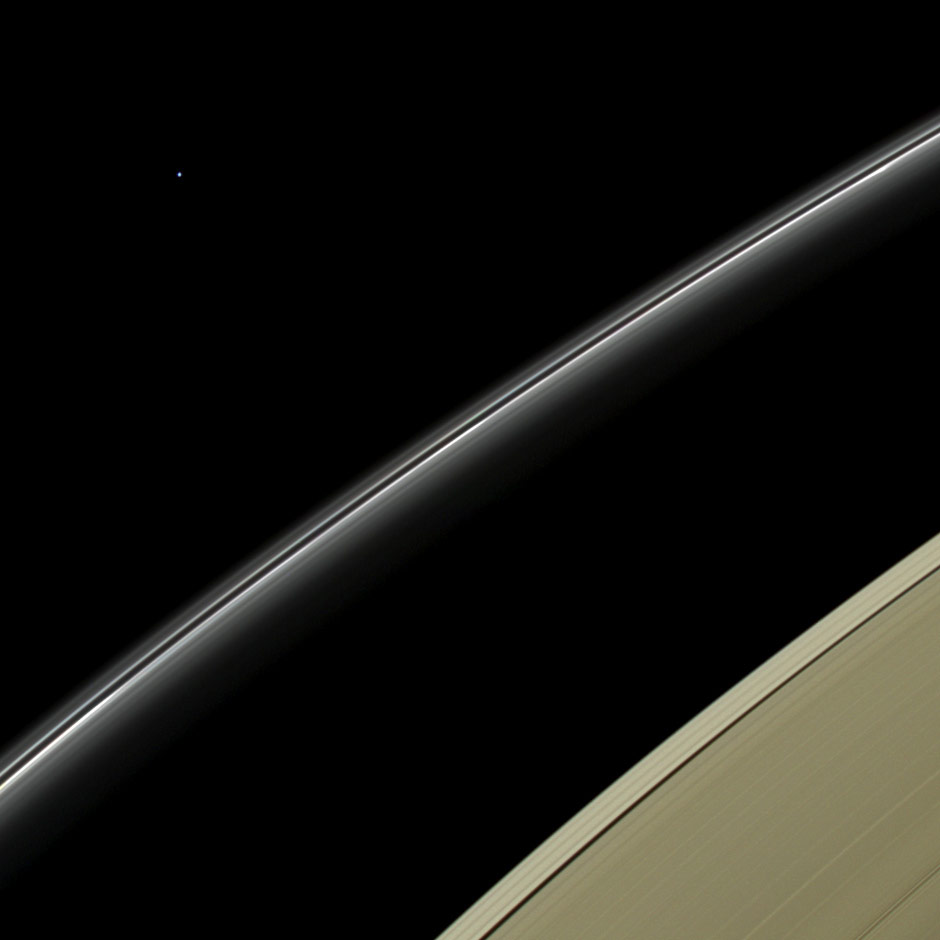
    NASA’s Cassini spacecraft captured this view of the planet Uranus, the mission’s first, on April 11, 2014. Distant Uranus is a small bluish orb here, barely resolved by Cassini’s camera. Credit: NASA/JPL-Caltech/Space Science Institute

    On April 11, 2014, NASA’s Cassini spacecraft took its first-ever image of the planet Uranus, shown in the distance beyond Saturn’s rings.

    The robotic spacecraft briefly turned its gaze away from the ringed beauty of Saturn on April 11, 2014, to observe the distant planet, which is the seventh planet from the sun.

    The planets Uranus and Neptune are sometimes referred to as “ice giants” to distinguish them from their larger siblings, Jupiter and Saturn, the classic “gas giants.” The moniker derives from the fact that a comparatively large part of the planets’ composition consists of water, ammonia, and methane, which are typically frozen as ices in the cold depths of the outer solar system. Jupiter and Saturn are made almost entirely of hydrogen and helium, with smaller percentages of these ices.

    When this view was obtained, Uranus was nearly on the opposite side of the sun as seen from Saturn, at a distance of approximately 28.6 astronomical units from Cassini and Saturn. An astronomical unit is the average distance from Earth to the sun, equal to 93 million miles (150 million kilometers). At their closest – once during each Saturn orbit of nearly 30 years – the two planets approach to within about 10 astronomical units of each other.

    In addition to its aesthetic appeal, Cassini’s view of Uranus also serves a practical purpose. Scientists working on several of Cassini’s science investigations expect that they will be able to use images and spectra from these observations to help calibrate their own instruments.

    The Cassini-Huygens mission is a cooperative project of NASA, the European Space Agency, and the Italian Space Agency. JPL, a division of the California Institute of Technology, Pasadena, manages the mission for NASA’s Science Mission Directorate in Washington.

    Never miss a breakthrough: Join the SciTechDaily newsletter.
    Follow us on Google and Google News.

    Astronomy Cassini-Huygens Mission JPL NASA
    Share. Facebook Twitter Pinterest LinkedIn Email Reddit

    Related Articles

    Cassini Detects Particles Being Accelerated to Ultra-High Energies

    Storm Spawns the Largest Tropospheric Vortex Ever Seen on Saturn

    New Cassini Image of Saturn and Its Rings

    Limited River Erosion on Saturn’s Moon Titan Has Scientists Looking for Possible Explanations

    NASA’s Cassini Spots Lightning in Saturn’s Northern Hemisphere

    Cassini Images Show Signs That the Seasons Are Turning On Saturn’s Moon Titan

    Cassini Data Reveals Likely Subsurface Ocean on Titan

    Heat from Within the Planet Powers Saturn’s Jet Streams

    Cassini Detects Methane Lakes on Titan

    Leave A Reply Cancel Reply

    • Facebook
    • Twitter
    • Pinterest
    • YouTube

    Don't Miss a Discovery

    Subscribe for the Latest in Science & Tech!

    Trending News

    Breakthrough Parkinson’s Drug Targets Disease at Its Genetic Roots

    Just 4 Weeks of Simple Diet Changes Reversed Signs of Aging in Older Adults

    Scientists May Have Finally Solved Why Humans Are Right-Handed

    NASA’s Hubble Accidentally Witnesses a Comet Shattering in Space

    Researchers Discover the Body’s Hidden “Off Switch” for Inflammation

    Scientists Discover Metformin Doesn’t Work the Way We Thought

    Tea or Coffee? Your Daily Choice Could Affect Osteoporosis Risk

    Vitamin C May Fight Cancer in a Surprising Way

    Follow SciTechDaily
    • Facebook
    • Twitter
    • YouTube
    • Pinterest
    • Newsletter
    • RSS
    SciTech News
    • Biology News
    • Chemistry News
    • Earth News
    • Health News
    • Physics News
    • Science News
    • Space News
    • Technology News
    Recent Posts
    • Scientists Stunned by Hybrid California Bees That Beat Deadly Mites
    • Scientists Discover Terrifying Giant Crocodile That Hunted Human Ancestors
    • Scientists Finally Think They Know Why T. rex Had Tiny Arms
    • Scientists Are Turning Ocean Trash Into Roads – and It’s Actually Working
    • This Alien Planet Has Rock Clouds That Vaporize Before Sunset
    Copyright © 1998 - 2026 SciTechDaily. All Rights Reserved.
    • Science News
    • About
    • Contact
    • Editorial Board
    • Privacy Policy
    • Terms of Use

    Type above and press Enter to search. Press Esc to cancel.