
Close Menu
    Facebook X (Twitter) Instagram
    SciTechDaily
    • Biology
    • Chemistry
    • Earth
    • Health
    • Physics
    • Science
    • Space
    • Technology
    Facebook X (Twitter) Pinterest YouTube RSS
    SciTechDaily
    Home»Space»Cassini Detects Particles Being Accelerated to Ultra-High Energies
    Space

    Cassini Detects Particles Being Accelerated to Ultra-High Energies

    By Jia-Rui C. Cook, Jet Propulsion LaboratoryFebruary 20, 2013No Comments3 Mins Read
    Facebook Twitter Pinterest Telegram LinkedIn WhatsApp Email Reddit
    Share
    Facebook Twitter LinkedIn Pinterest Telegram Email Reddit
    Saturn Bowshock Cassini Spacecraft
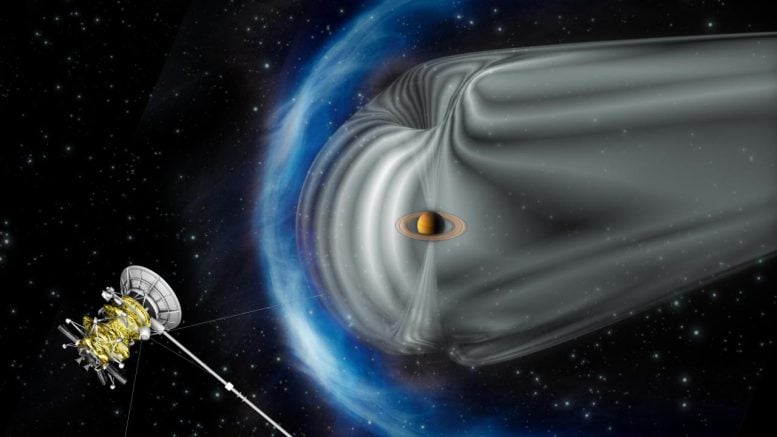
    The international Cassini spacecraft exploring the magnetic environment of Saturn. The image is not to scale. Saturn’s magnetosphere is depicted in grey, while the complex bow shock region – the shock wave in the solar wind that surrounds the magnetosphere – is shown in blue.  Credit: ESA

    Similar to the particle acceleration that takes place around supernovas, observations from NASA’s Cassini spacecraft have detected particles being accelerated to ultra-high energies by an unusually strong solar system shock wave.

    During a chance encounter with what appears to be an unusually strong blast of solar wind at Saturn, NASA’s Cassini spacecraft detected particles being accelerated to ultra-high energies. This is similar to the acceleration that takes place around distant supernovas.

    Since we can’t travel out to the far-off stellar explosions right now, the shockwave that forms from the flow of solar wind around Saturn’s magnetic field provides a rare laboratory for scientists with the Cassini mission — a partnership involving NASA, the European Space Agency and the Italian Space Agency — to observe this phenomenon up-close. The findings, published this week in the journal Nature Physics, confirm that certain kinds of shocks can become considerably more effective electron accelerators than previously thought.
    quasi-parallel-and-quasi-perpendicular-magnetic-field-conditions
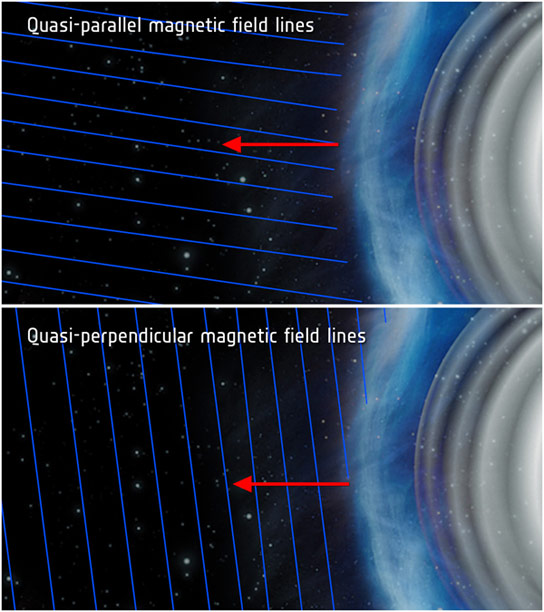
    This illustration shows “quasi-parallel” (top) and “quasi-perpendicular” (bottom) magnetic field conditions at a planetary bow shock. Bow shocks are shockwaves created when the solar wind blows on a planet’s magnetic field. Credit: ESA

    Shock waves are commonplace in the universe, for example in the aftermath of a stellar explosion as debris accelerate outward in a supernova remnant, or when the flow of particles from the sun — the solar wind — impinges on the magnetic field of a planet to form a bow shock. Under certain magnetic field orientations and depending on the strength of the shock, particles can be accelerated to close to the speed of light at these boundaries. These may be the dominant source of cosmic rays, high-energy particles that pervade our galaxy.

    Scientists are particularly interested in “quasi-parallel” shocks, where the magnetic field and the “forward”-facing direction of the shock are almost aligned, as may be found in supernova remnants. The new study, led by Adam Masters of the Institute of Space and Astronautical Science, Sagamihara, Japan, describes the first detection of significant acceleration of electrons in a quasi-parallel shock at Saturn, coinciding with what may be the strongest shock ever encountered at the ringed planet.

    “Cassini has essentially given us the capability of studying the nature of a supernova shock in situ in our own solar system, bridging the gap to distant high-energy astrophysical phenomena that are usually only studied remotely,” said Masters.

    Reference: “Electron acceleration to relativistic energies at a strong quasi-parallel shock wave” by A. Masters, L. Stawarz, M. Fujimoto, S. J. Schwartz, N. Sergis, M. F. Thomsen, A. Retinò, H. Hasegawa, B. Zieger, G. R. Lewis, A. J. Coates, P. Canu and M. K. Dougherty, 17 February 2013, Nature Physics.
    DOI: 10.1038/nphys2541

    The Cassini-Huygens mission is a cooperative project of NASA, ESA and ASI, the Italian space agency. NASA’s Jet Propulsion Laboratory, a division of the California Institute of Technology in Pasadena, manages the mission for NASA’s Science Mission Directorate, Washington.

    Never miss a breakthrough: Join the SciTechDaily newsletter.
    Follow us on Google and Google News.

    Astronomy Cassini-Huygens Mission European Space Agency JPL NASA Popular
    Share. Facebook Twitter Pinterest LinkedIn Email Reddit

    Related Articles

    New NASA Video Shows a 360-Degree View of Saturn’s Auroras

    Astronomers Discover Earliest Starburst Galaxy Ever Observed

    Cassini Data Suggests Saturn’s Moons and Rings Are More Than 4 Billion Years Old

    Detailed Map Reveals New Information about the Age, Contents and Origins of the Universe

    Storm Spawns the Largest Tropospheric Vortex Ever Seen on Saturn

    New Cassini Image of Saturn and Its Rings

    Cassini Images Show Signs That the Seasons Are Turning On Saturn’s Moon Titan

    Heat from Within the Planet Powers Saturn’s Jet Streams

    Cassini Detects Methane Lakes on Titan

    Leave A Reply Cancel Reply

    • Facebook
    • Twitter
    • Pinterest
    • YouTube

    Don't Miss a Discovery

    Subscribe for the Latest in Science & Tech!

    Trending News

    Bone-Strengthening Discovery Could Reverse Osteoporosis

    Scientists Uncover Hidden Trigger Behind Stem Cell Aging

    Scientists Find Way to Reverse Fatty Liver Disease Without Changing Diet

    Could Humans Regrow Limbs? New Study Reveals Promising Genetic Pathway

    Scientists Reveal Eating Fruits and Vegetables May Increase Your Risk of Lung Cancer

    Scientists Reverse Brain Aging With Simple Nasal Spray

    Scientists Uncover Potential Brain Risks of Popular Fish Oil Supplements

    Scientists Discover a Surprising Way To Make Bread Healthier and More Nutritious

    Follow SciTechDaily
    • Facebook
    • Twitter
    • YouTube
    • Pinterest
    • Newsletter
    • RSS
    SciTech News
    • Biology News
    • Chemistry News
    • Earth News
    • Health News
    • Physics News
    • Science News
    • Space News
    • Technology News
    Recent Posts
    • Gaining Weight Young May Be More Dangerous Than You Think
    • Scientists Discover Hidden Pathway Inside Catalysts That Defies Decades of Assumptions
    • Scientists Finally Crack Decades-Old Mystery of “Breathing” Lasers
    • “Like Liquid Metal”: Scientists Create Strange Shape-Shifting Material
    • Early Warning Signals of Esophageal Cancer May Be Hiding in Plain Sight
    Copyright © 1998 - 2026 SciTechDaily. All Rights Reserved.
    • Science News
    • About
    • Contact
    • Editorial Board
    • Privacy Policy
    • Terms of Use

    Type above and press Enter to search. Press Esc to cancel.