
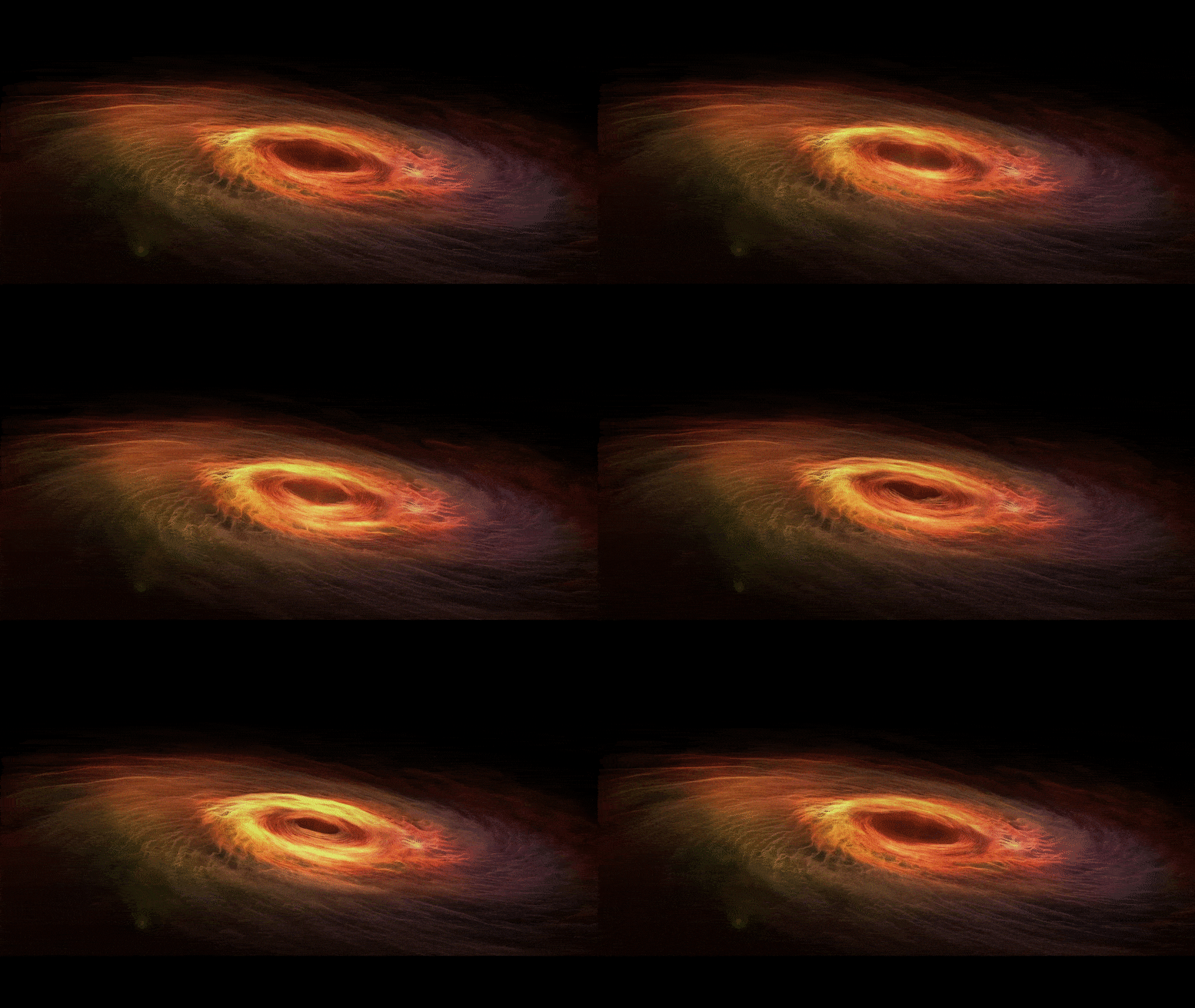
Like most galaxies, the Milky Way hosts a supermassive black hole at its center. Called Sagittarius A*, the object has captured astronomers’ curiosity for decades. And now there is an effort to image it directly.
Catching a good photo of the celestial beast will require a better understanding of what’s going on around it, which has proved challenging due to the vastly different scales involved. “That’s the biggest thing we had to overcome,” said Sean Ressler, a postdoctoral researcher at UC Santa Barbara’s Kavli Institute for Theoretical Physics (KITP), who just published a paper in the Astrophysical Journal Letters, investigating the magnetic properties of the accretion disk surrounding Sagittarius A*.
In the study, Ressler, fellow KITP postdoc Chris White and their colleagues, Eliot Quataert of UC Berkeley and James Stone at the Institute for Advanced Study, sought to determine whether the black hole’s magnetic field, which is generated by in-falling matter, can build up to the point where it briefly chokes off this flow, a condition scientists call magnetically arrested. Answering this would require simulating the system all the way out to the closest orbiting stars.
The system in question spans seven orders of magnitude. The black hole’s event horizon, or envelope of no return, reaches around 4 to 8 million miles (6.5 to 13 million kilometers) from its center. Meanwhile, the stars orbit around 20 trillion miles (32 trillion kilometers) away, or about as far as the sun’s nearest neighboring star.
“So you have to track the matter falling in from this very large scale all the way down to this very small scale,” said Ressler. “And doing that in a single simulation is incredibly challenging, to the point that it’s impossible.” The smallest events proceed on timescales of seconds while the largest phenomena play out over thousands of years.
This paper connects small scale simulations, which are mostly theory-based, with large-scale simulations that can be constrained by actual observations. To achieve this, Ressler divided the task between models at three overlapping scales.
The first simulation relied on data from Sagittarius A*’s surrounding stars. Fortunately, the black hole’s activity is dominated by just 30 or so Wolf-Rayet stars, which blow off tremendous amounts of material. “The mass loss from just one of the stars is larger than the total amount of stuff falling into the black hole during the same time,” Ressler said. The stars spend only around 100,000 years in this dynamic phase before transitioning into a more stable stage of life.
Using observational data, Ressler simulated the orbits of these stars over the course of about a thousand years. He then used the results as the starting point for a simulation of medium-range distances, which evolve over shorter time scales. He repeated this for a simulation down to the very edge of the event horizon, where activity takes place in matters of seconds. Rather than stitching together hard overlaps, this approach allowed Ressler to fade the results of the three simulations into one another.
“These are really the first models of the accretion at the smallest scales in [Sagittarius] A* that take into account the reality of the supply of matter coming from orbiting stars,” said coauthor White.
And the technique worked splendidly. “It went beyond my expectations,” Ressler remarked.
The results indicated that Sagittarius A* can become magnetically arrested. This came as a surprise to the team, since the Milky Way has a relatively quiet galactic center. Usually, magnetically arrested black holes have high-energy jets shooting particles away at relativistic speeds. But so far scientists have seen little evidence for jets around Sagittarius A*.
“The other ingredient that helps create jets is a rapidly spinning black hole,” said White, “so this may be telling us something about the spin of Sagittarius A*.”
Unfortunately, black hole spin is difficult to determine. Ressler modeled Sagittarius A* as a stationary object. “We don’t know anything about the spin,” he said. “There’s a possibility that it’s actually just not spinning.”
Ressler and White next plan to model a spinning back hole, which is much more challenging. It immediately introduces a host of new variables, including spin rate, direction and tilt relative to the accretion disc. They will use data from the European Southern Observatory’s GRAVITY interferometer to guide these decisions.
The team used the simulations to create images that can be compared to actual observations of the black hole. Scientists at the Event Horizon Telescope collaboration — which made headlines in April 2019 with the first direct image of a black hole — have already reached out requesting the simulation data in order to supplement their effort to photograph Sagittarius A*.
The Event Horizon Telescope effectively takes a time average of its observations, which results in a blurry image. This was less of an issue when the observatory had their sights on Messier 87*, because it is around 1,000 times larger than Sagittarius A*, so it changes around 1,000 times more slowly.
“It’s like taking a picture of a sloth versus taking a picture of a hummingbird,” Ressler explained. Their current and future results should help the consortium interpret their data on our own galactic center.
Ressler’s results are a big step forward in our understanding of the activity at the center of the Milky Way. “This is the first time that Sagittarius A* has been modeled over such a large range in radii in 3D simulations, and the first event horizon-scale simulations to employ direct observations of the Wolf-Rayet stars,” Ressler said.
Reference: “Ab Initio Horizon-scale Simulations of Magnetically Arrested Accretion in Sagittarius A* Fed by Stellar Winds” by Sean M. Ressler, Christopher J. White, Eliot Quataert and James M. Stone, 8 June 2020, Astrophysical Journal Letters.
DOI: 10.3847/2041-8213/ab9532
Ressler and White are supported by the Gordon and Betty Moore Foundation and the Simons Foundation.
Never miss a breakthrough: Join the SciTechDaily newsletter.
Follow us on Google and Google News.
5 Comments
above was very interesting
Very informative, thanks
With all those advance instrument, it’s very unfortunate for science that they cannot figure out the universe’s natural phenomena. Most of the theories in the field are pseudoscience if not a conjecture.
Try to learn the true nuclear production of galaxy and or sun and you will uncover the great mysteries that surround the universe.
Read the BOOKS 1. ALL BUT THE WORLD IS LOVING 2. THE THEORY OF EVERYTHING AND THE MAN WHO COULD SAVE THE EARTH (all but the world is loving 2)
Very informative & interesting….
Interesting and thought provoking.